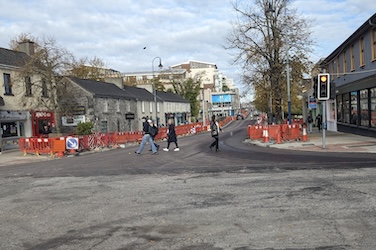
An atypical view of Mill Street during reconstruction works at 9:45am on a single morning at 9:45am but an actual picture as opposed to an AI generated or photoshopped one.
There have been a lot of complaints in recent weeks of congestion in Maynooth, especially at peak times. Most put the blame on Kildare County Council’s redesign of Mill Street and/or its construction. Everyone is entitled to their opinion but many of the comments are ill-informed.
In Maynooth town centre, traffic lanes carry up to nearly 20,000 vehicles per day, the majority of which are private cars. This is more than six times the threshold for a major road as defined under the Environmental Noise regulations. Congestion is caused by too many cars which is why Irish political parties and governments across the world (except in the USA) want to reduce private traffic in favour of more space-efficient and sustainable mobility. During the reconstruction of Mill Street, drivers of cars and other motorised vehicles continue to have use of two lanes as they had before and will have afterwards. Pedestrians, on the other hand, are often unable to use one side of the street, the temporary paths are often barely wide enough for two people to pass and the surface leaves a lot to be desired. As for cyclists, they are directed to dismount and push their vehicle.
Mill Street-Main Street Junction
- Engineers can model how much space vehicles of different sizes and types need to manoeuvre around a corner or bend. If they haven’t modelled it, they should determine what is required before blindly butchering the newly constructed paths.
- Drivers need time to get used to new layouts.
- Tyre marks on kerbs are examples of bad driving and show that the kerb is doing what it is supposed to do – namely protect people on the footpath.
- The width of junctions shouldn’t be decided by bad drivers.
- Last week, watching traffic during the evening peak, for about 30 minutes, 150 vehicles turned left from Mill Street to Main Street. These included three buses, two of which were blocked from accessing the junction by car drivers wanting to turn right and one bus which was able to continue. While the two buses blocked about five cars each, 138 cars were able to get through. Many of the cars were only single occupancy compared to the buses that appeared to be carrying multiple passengers. So who is holding up who?
- The junction can cope with a number of right turning cars but on a number of occasions when there were too many or when they were badly positioned, even cars had difficulty in getting past. In many urban areas, right hand turns are banned or restricted in the interest of traffic flow.
- On some turns of the lights, traffic from Parson Street received a green light to continue to Main Street but ignored the Yellow Box. They stopped in the middle of the junction because the street ahead was already full. When the lights turned to green for left turning traffic from Mill Street, they were unable to proceed. This had nothing to do with the corner or narrowness of the street and everything to do with too many cars.
- If two people want to pass through a doorway at the same time, one will wait while the other person passes through. If two large vehicles, one from Main Street and one from Mill Street can’t take a turn at the same time, a competent driver will do the same – give way to the first with a delay of about 10 seconds.
Width of Mill Street
- I do not know what post construction width KCC has proposed for Mill Street but the full width will not be available during construction due to the need to protect construction staff.
- There are 3m wide traffic lanes in New York which are wide enough for American traffic.
- In Utrecht, a road has recently been reconstructed with two traffic lanes which are each 2.75m wide, admittedly with a 1m strip in between. The road was designed for cars, lorries and buses.
- Waze’s Driver Satisfaction Index – which analyzes the driving experiences of 65 million monthly users in 38 countries and 235 cities across the globe – named the Netherlands as the most satisfying place in the world to drive in 2015 and 2016 so the provision of cycle facilities does not necessarily mean worse conditions for drivers.
- Governments traditionally constructed wider roads. The excessive space can clearly be seen after a snowfall by the amount of road with undisturbed snow. Now, they construct narrower roads in order to reduce the speed of traffic and to decrease the number of pedestrian and cyclist fatalities.
In north Kildare, the M6 Motorway is often congested with traffic stretching back to Maynooth and with a queue of cars from the intersection as far back as Taghadoe. There is congestion in both Celbridge and Leixlip although those towns have no current comparable works to Maynooth. Some of the comments on the Notice Boards refer to taking an hour to drive from one side of Maynooth to the other. We live in a democracy so people are free to continue to do that if they so wish. However, with the future development of housing and the resulting additional traffic as well as the need for parking, a one hour delay is going to become a lot more common unless there is significant take-up in active and sustainable travel. More people will choose walking and cycling as the active travel networks expands due to continuing political support. If not, the big losers will be drivers who have no choice but to drive.
 Maynooth Cycling Campaign