We have made a late addition to our programme – a tour that we haven’t previous taken. Join us if you can.
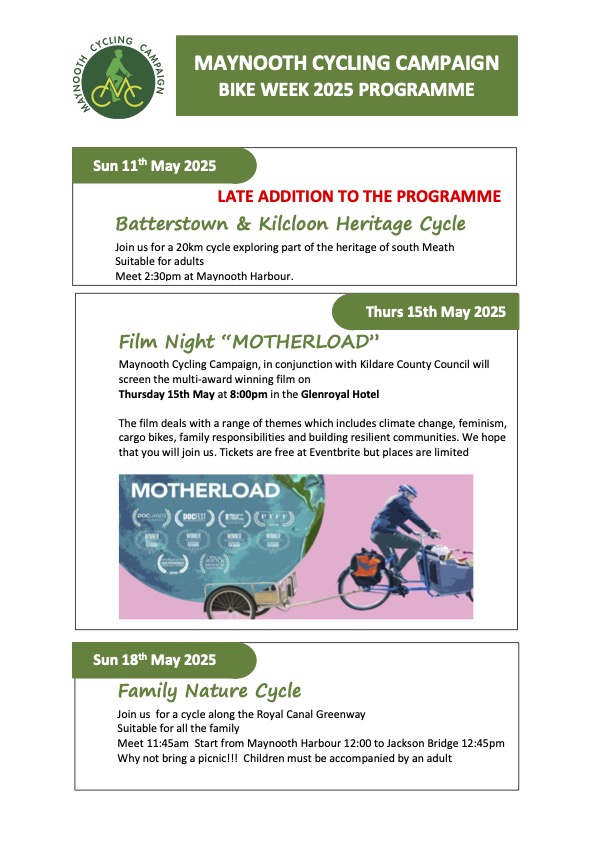
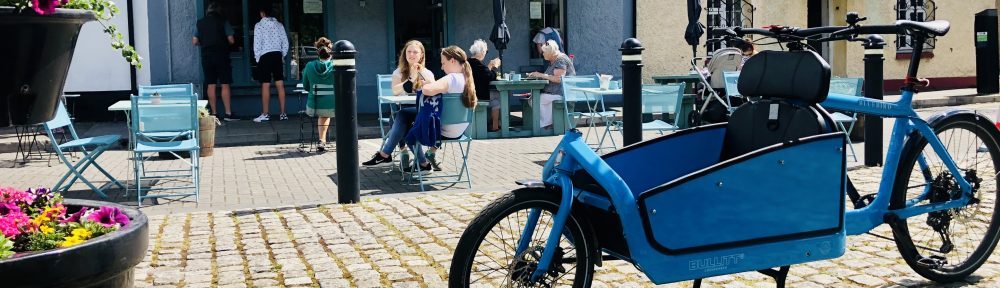
We have made a late addition to our programme – a tour that we haven’t previous taken. Join us if you can.
Maynooth and Environs Local Area Plan 2025-31
Maynooth Cycling Campaign welcomes the decision of the Court of Appeal to overturn the High Court judgement against the planned Strand Road cycle path trial in Dublin. The judgement was against three parties which included a group of residents and a councillor, Mannix Flynn. The scheme proposed a change in Strand Road from two way to one way for private cars in order to upgrade facilities for walking and cycling. The scheme had been through a lengthy consultation process and had been previously approved by a majority of councillors.The impact of applying to the courts was to delay the proposed active travel measures by several years.
We welcome the leadership shown by the majority Dublin councillors who rejected the opinion of residents opposing even the trialing of active travel measures.
Bike Week 2025
Bikeweek 2025 runs from 10th -18th May. Maynooth Cycling Campaign will be organising a number of events – full details will be published on this website. In particular, we wish to stress that we will be screening the award winning film MOTHERLOAD on Thursday 15th May starting at 8:00pm. We hope that you will join us and be inspired about the way some communities have tackled the climate change by looking at alternatives to the private car.
Upgrade Works on Mill Street, Maynooth
Maynooth Cycling Campaign welcomes the continuing upgrade works on Mill Street. However, we are disappointed to see a road sign “CYCLISTS, PLEASE DISMOUNT” on the northbound side of the road. If KCC were prioritising bicycles over private cars as set out in the Design Manual for Roads and Streets (DMRS), the signs should prioritise cyclists with a sign such as “MOTORISTS GIVE WAY TO CYCLISTS”.
Cycling Without Age
We are sorry to announce that the Maynooth trishaw is off the road at present. There is a problem with the braking system which must be repaired. Maynooth Cycling Campaign has been in contact with Kildare County Council regarding the funding for the repairs.
Government Waste?
The media and politicians were very vocal on the cost of €335,000 for a bike shelter in Leinster House. Admittedly, the cost was excessive but, at least there was something to show for the expenditure. The same groups haven’t been so vocal at the revelation that over the last twenty five years €45 million has been spent on plans for a second bypass road for Galway without anything to show on the ground.
Bike Bunkers
Dublin City Council plans to appoint a contractor by the end of June to roll out some 300 bike bunkers in their administrative area. In early 22024, Maynooth Cycling Campaign held discussions with Kildare County Council about trialing a single bike bunker in the town. More than one year later, Maynooth County Campaign had no progress to report.
MOTHERLOAD

Last month, Maynooth Cycling Campaign announced that we would be screening the award winning film MOTHERLOAD in May. Make a note in your diary! We are delighted to announce that it will be screened at 8:00pm on Thursday 15th May as part of Bikeweek 2025. The venue will be confirmed at a later date.
The film will be of particular interest to people who may be considering a cargo bicycle instead of a second car and who would like more information of what a Bike Library may offer.
To get a taste of the film, you can view the official trailer at https://www.youtube.com/watch?v=NkklZNE9S-g .
Climate Change
In January, two people lost their lives in Storm Éowyn and the financial damage is estimated to be in the range of €300M.
In March, Professor Peter Thorne from Maynooth University’s Icarus Climate Research Centre appeared on RTE’s Nine O’Clock News. He stated that ‘Governments have to act now. If we don’t, things will get worse very very quickly …….. The temperature rise is not linear- its impacts are very non-linear. They are going to increase very quickly.’
The Climate Change Advisory Council stated that the government must invest now to rapidly improve its preparedness and ability to respond to extreme weather events. It called on the government to stop procrastination on the decisions that are needed.
The Climate Change Advisory Council in conjunction with the Fiscal Council and Climate Change Advisory Council also recently issued a joint report. Their report, ‘A colossal missed opportunity‘, sets out potential costs for Ireland from missing agreed EU targets. These could amount to staggering payments of between €8bn and €26bn to Europe.
In view of the rejection by Maynooth MD councillors of measures to increase bike use in the Maynooth & Environs Local Area Plan (LAP), perhaps the political parties will indicate who they think should pay the cost of larger fines – people who supported additional permeability measures to promote cycling under the LAP or people who opposed the measures?
Increase in Private Cars
In the Irish Republic, between 2000 and 2020, the number of private vehicles registered for tax rose by 63% from 1,319,250 to 2,215,1127. No one was asked to approve this increase. No one was asked about the impact on road accidents or road fatalities. No one was asked about the worsening air and noise pollution. Yet people are getting in a twist over a relatively small increase in the number of cyclists.
KCC & the Sustainable Transport Forum
When Kildare County Council abolished the Kildare Cycle Forum, it announced that the forum would be incorporated into a new Sustainable Transport Forum (STF). It took some two years for the Transport Strategic Policy Committee to establish the new forum. During the term of the last council, the last STF meeting took place in February 2024. The minutes from that meeting have still not been circulated.
Maynooth Cycling Campaign is particularly interested in the minutes as we were able to raise an issue of particular interest and importance concerning climate targets. We are waiting to see if the minutes will refer to the matter. Since the local government elections in May 2024, the Transport SPC has met once in February but the re-establishment of the Sustainable Transport Forum was not on the agenda. It suggests that a forum of sustainable transport stakeholders is not a high priority of Kildare County Council.
Maynooth Cycling Campaign is a non-party independent local lobby group in Kildare.
Maynooth and Environs Local Area Plan 2025-31
A further meeting of the Clane-Maynooth Municipal District took place on 17th February regarding the Maynooth LAP. Maynooth Cycling Campaign welcomes the recommendations from the Office of the Planning Regulator that the deleted permeability links must be consistent with the government and local authority policy framework, and strongly disagree with the non-acceptance of the recommendation by local councillors.
In our blog, we posed the question Is Railpark the worst place to live in Maynooth? And is walking and cycling access at fault? The article can be found at the following link:
Launch of Dublin Active Travel Portal
The IrishCycle.com website reports that Dublin City Council has launched an Active Travel portal to report progress on active travel schemes and their resulting impact on levels of walking and cycling. The European Cycling Federation stresses that monitoring and reporting progress (or lack of it) is an essential element of managing change in modes of travel.
We know that in recent years Kildare County Council has spent in excess of €60,000 on data loggers to record pedestrians and cyclists movements but has failed to publish any results. Maynooth Cycling Campaign previously attempted to raise this at meetings of the Transportation Strategic Policy Committee but was repeatedly blocked by the then Chair, Cllr. Joe Neville. Hopefully they will reconsider their stance and follow Dublin’s lead.
MOTHERLOAD
MOTHERLOAD is a prize winning American made film about cargo bikes and their impact on communities. It also deals with a number of associated themes including sustainability, green transportation, feminism and women’s empowerment, connecting to nature, and childhood and parenting.
Last year, Maynooth Cycling Campaign purchased the right to screen the film but the screening didn’t proceed for a variety of reasons. We are delighted to announce that we will be showing it later this year – in May. To get a taste of the film, you can view the official trailer at https://www.youtube.com/watch?v=NkklZNE9S-g .
Purchase of American Cars
The US president, Donald Trump, and his appointee, Elon Musk, have been making headlines on a wide range of issues. One of the areas which the president has highlighted is the imbalance in manufacturing trade between Europe and the US and specifically in the areas of cars. In Europe, cars are smaller in size and, with fuel prices much more expensive, offer greater fuel efficiency than American models. Bigger cars are also a threat to the public. According to the OECD, in the US the fatality rate per 100,000 population is four times higher than the Irish rate. While no single factor is responsible for the difference in fatality rates, size is at least partially responsible.
Even some new American electric cars cannot compete on the European markets. Egon Musk’sTesla’s Cyber-Truck model, which has been banned in the UK, is not in accordance with European safety standards in relation to weight, lighting, finish or crumple zones. As proponents of active travel, we support increased walking and cycling, and less cars. In 2022, the US exported 16% of their cars to Europe but if Trump/Musk want to increase this percentage, they must meet European safety standards. Irish roads are already too dangerous for active travel users – we do not need to increase this danger.
Upgrade Works on Mill Street, Maynooth
Maynooth Cycling Campaign welcomes the commencement of upgrade works to provide improved facilities for walking and cycling on Mill Street. Mill Street is a key retail destination with Manor Mills Shopping Centre as well as other retail premises. It is also a key link between Moyglare Road and Leinster Street for children attending schools to the north of the town.
More than 10 years ago, pupils from St. Mary’s Boys School wrote to Kildare County Council to complain about aggression from motorists on Mill Street. While there has been some improvement over the years with the addition of bollards during Covid, it has taken this long to provide a comprehensive solution.
Maynooth Cycling Campaign is a non-party independent local lobby group advocating for better cycling infrastructure in Kildare.
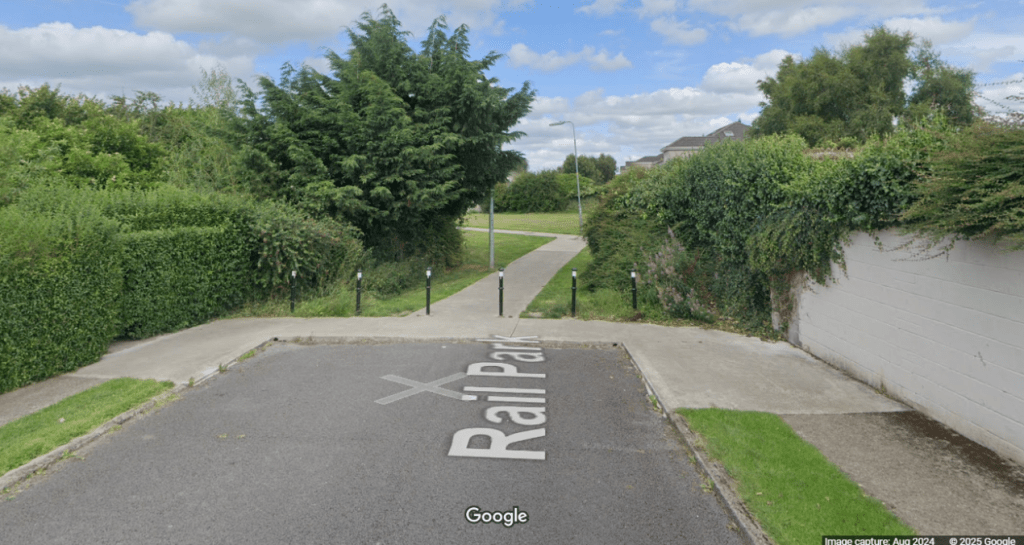
Is the Railpark housing estate the worst place to live in Maynooth? (Spoiler: It isn’t.) Then why, at a number of public meetings during the summer, did some Maynooth residents imply a feature that is working well in Railpark would mean a host of problems if applied to other areas?
The meetings were called to discuss the impact of proposals in the Maynooth and Environs Local Area Plan 2025-29. The Local Area Plan (LAP) covers a broad range of issues related to the future development of Maynooth. It includes proposals that are designed to contribute to Ireland meeting its commitment to reduce carbon emissions by 50% by 2030. However, many of the discussions focused on pedestrian and cycling permeability – the retrofitting of active travel access through existing adjacent developments, mainly housing estates.
One such proposal linked the Kilcock Road and Crewhill — a new high-density development to the north-west of the town via Maynooth University and the unconnected residential estates of Moyglare Abbey and Moyglare Village.
It was claimed that retrofitting an active travel access would lead to increased anti-social behaviour and increased littering. One attendee quoted an unnamed member of the Garda Síochána who had warned that opening up estates would lead to increased crime. It was claimed that a direct link between Moyglare Abbey and the university would lead to Moyglare Abbey turning into a car park for students. But no such link was even proposed in the LAP. Concerns were also expressed that the openings would be so wide that cars would also be able to use them and that drivers would not see cyclists at a junction due to inadequate sightlines. (For clarity – cars will not be able to use the access points.)
This proposal was designed to provide an alternative to Moyglare Road where, at peak times, there is heavy congestion on crowded footpaths, and many secondary school students cycle on the road instead of an adjacent shared path. At school closing time, traffic queues stretch to nearly a kilometre from the Kilcock Road junction to beyond the GAA clubhouse. It was pointed out that improving permeability would be good for health by reducing air and noise pollution. The high level of traffic congestion would also be reduced, but the mood of the majority who attended the meeting was to oppose the permeability links regardless of any benefits that they might bring.
The irony is that Maynooth residents don’t have to go too far to see good examples of active travel permeability. Most of the estates off the Straffan Road are permeable. On the west side, Kingsbry, Beaufield and Greenfield estates are linked. Parson Hall and Ashleigh are also linked. On the east side, Railpark estate is particularly good as it is linked to both Rockfield and Parklands, as well as having a pedestrian link to the Straffan Road.
If the fears expressed by Moyglare residents are valid, Railpark must be the worst place to live in Maynooth. In fact, it is estates like Moyglare Abbey and Moyglare Hall that are badly designed in regard to mobility. So, the LAP presents a rare opportunity to mitigate the poor outcomes of past planning decisions.
Public consultations are an important part of local democracy. However, democracy is not just about the number of submissions for and against a scheme. The proposal to provide greater permeability and increase active travel has implications for climate change and road safety as well as health in Maynooth. This concerns all the people of Maynooth and not just those who reside close to the proposed openings. The provision of permeability links is a very modest proposal to reduce our carbon emissions.
The backdrop to this includes Ireland still recovering from one of its most severe storms that was linked to two deaths, other European countries suffering extreme climate events involving multiple fatalities, and 2024 was confirmed as the warmest year on record globally. It’s also at a time when the consensus between Europe and the USA on climate is under threat like never before.
Given that the addition of a “relatively” small number of people cycling and walking provokes such opposition from people who are opposed to change and happy with the current status quo, then what will happen when people are asked to make major changes to their lifestyle?
In a recent appeal against a refusal for a proposed wind farm in Laois, the High Court stated that “rapid, far-reaching and unprecedented changes to all aspects of society and the economy” and “an immediate end to business as usual” by consenting authorities is required to cut greenhouse gas emissions and ensure planetary survival.
Maynooth University is an important institution in the town. It is one of the Irish universities that is noted for research on climate change and lecturers there collaborate with their international colleagues. It is disappointing that the university authorities did not consider the LAP important enough to make a submission. It is particularly disappointing as the university is also the biggest single generator of traffic in the town.
Ireland was fortunate to rely on expert medical advice during the Covid epidemic rather than on non-experts. Expert advice on the LAP from the university authorities could have reassured a lot of people who are fearful of or opposed to change.
Local councillors are responsible for approving Local Area Plans, and while they have a responsibility to represent the views of the public, they also have a responsibility to show leadership. Central government ministers and their departments primarily fund local government. Central government also sets down national policies so their views cannot be ignored by local government.
Prior to Christmas 2024, in their submission of amendments to the Draft LAP, the Office of the Planning Regulator, which reviews the performance of planning authorities, recommended that all the permeability links deleted by councillors be reinstated. However, on February 17th, at the meeting of the municipal district on the LAP, councillors voted to proceed with deleting 12 of the 34 walking links and 1 of the 3 cycle links that had been proposed to be abandoned.
With only five years until the next local government elections and one year after that to the 2030 target of a 50% reduction in carbon emissions, the decisions of current councils nationwide will decide where Ireland will stand by the key target date. Kildare is just the latest council to demonstrate the disconnect between government policy and the actions of local councillors. Many groups and individuals will be watching to see how this saga plays out.
This article was edited post publishing to correct an error in the numbers of links for abandonment.
Maynooth and Environs Local Area Plan (LAP)
The LAP has not yet been finalised. The amended LAP with the removal by councillors of most permeability measures went to public consultation last autumn.. The Chief Executive’s report noted the recommendation of the Planning Regulator to reinstate the measures and recommended that Proposed Material Alteration No. 33 should not be adopted by councillors
Transport is one of the most contentious sections of the LAP. Maynooth University is one of the primary generators of traffic in the town and, at the same time, is involved in research on climate change. It is particularly disappointing that the University authorities failed to make a submission on either the draft or amended Maynooth and Environs LAP.
Climate Change
In January, fierce wildfires in the Los Angeles area of California caused more than 28 deaths and billions of dollars in damages to buildings. Fires are a normal risk to California during the summer months but this is the first time that they have been so serious during the winter season. Meanwhile In Arizona, Phoenix has had no rain since last August and groundwater supplies are so depleted that the state announced that all future housing developments in the desert would have to find some other source of water – either by purchasing or importing their supply. January 2025 also saw Donald Trump sworn in as American president for the second time. Among his first executive orders, one was for the United States to give notice of withdrawal from the Paris Agreement on limiting climate change. We shall see if his policy of “Drill, baby, drill” will end up as “Burn, baby burn”.
Ireland has not escaped weather extremes either – with Storm Eowyn causing one death and nearly 20% of the population being left without power north and south. In the future something that will affect people everywhere is the increased cost of insurance. Insurance companies are facing a greater risk of extreme weather and will require higher premiums to enable higher payouts.
“An Immediate End to Business As Usual“
In a challenge to a decision of An Bord Pleanála to refuse an application for the construction of a proposed wind farm in County Laois, the High Court delivered a judgment quashing the decision and sending it back to the Bord for a fresh determination.
In a decision which will have implication for many future developments, the High Court has stated that “rapid, far-reaching and unprecedented changes to all aspects of society and the economy” and “an immediate end to business as usual” by consenting authorities is required to cut GHG emissions and ensure planetary survival. The Court went on to find that the pattern of refusals of proposed windfarm developments is “sabotaging” the compliance by the State with its national and international climate commitments.
Programme for Government
Maynooth Cycling Campaign congratulates Darragh O’Brien who has been appointed as the new Minister for Transport. However, it is disappointing that the agreed Programme for Government has reduced the focus on active travel which includes cycling and instead has emphasised the construction of new roads.
Road Fatalities
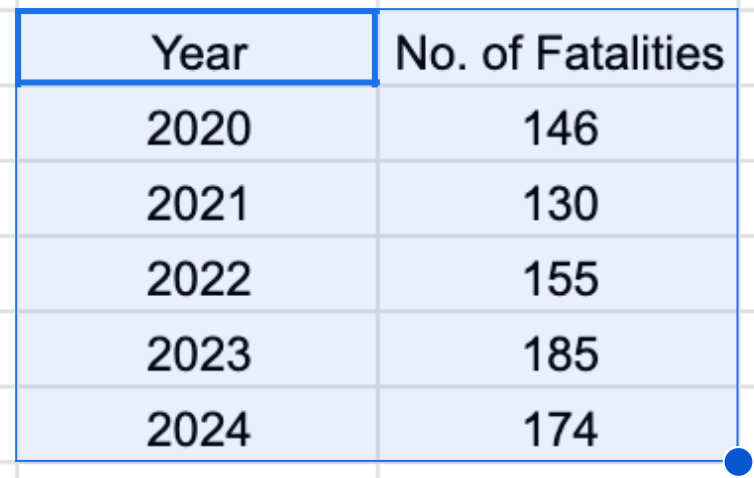
The provisional figures for road fatalities in Ireland in 2024 was 174. Under the RSA definition of road fatalities, this excludes cyclists who die more than two days after the collision or other incident. While the Road Safety Authority has spun this outcome as a 4% reduction, the figure was still the worst since 2016.
In order to reduce the number of fatalities, the government has announced that default speed limits will be reduced on urban and rural roads in 2025, Changes to the default speed limit on rural roads will be reduced from 80 kph to 60 kph on 7th February. It is proposed that the default speed limit in urban roads will be reduced later in the year. Local councillors will still have the power to retain higher speed limits if it is decided to be appropriate.
Cycling Without Age – St Brigid’s Day
This year the government has introduced a new public holiday celebrating the life of St. Brigid’s. As part of the festivities, Maynooth Cycling Campaign has been asked to take part in a Pedal Parade in Sallins on Monday 3rd February at 11:30am which promotes active travel. If you are attending the parade, we hope that you will give a shout to the Maynooth Cycling Without Age trishaw. More details are available here.
Maynooth Cycling Campaign is a non-party independent local lobby group advocating for better cycling infrastructure in Kildare.
The submission below was forwarded to Kildare County Council in early December.
SUMMARY
Retention of Permeability Measures (Table 7.3)
Perm 4, 6, 7, 10, 11, 15, 16, 17, 18, 19, 23, 24, 28, 31, 41, 42, 44, 46, 52, 54, 61, 63, 75, 86, 93, 94, 97, 98, 113, 125, 128, 134, 137, 139,
Retention of Cycling Measures (Table 7.3)
Cycle 20, 52, 57
We support the retention of all of the permeability and cycling measures. There are plenty of existing examples of permeability in Maynooth. While some are not so good in terms of width, most permeability links are good to very good and are positive features for the residential estates in question.
The proposed deletion of the permeability measures will make it more difficult to achieve any target of increased active travel.
.
OPPOSITION TO CYCLING INFRASTRUCTURE
Maynooth has a track record of opposition to proposed cycle infrastructure, especially where it involves reallocation of space from cars. This was the case
Albert Einstein is reputed to have said “Insanity is doing the same thing over and over again and expecting different results”. Kildare County Council should have learnt from these episodes that residents, especially drivers, would not meekly accept its plans for active travel without any opposition.
Kildare County Council should also have learnt from the report Active travel infrastructure design and implementation: Insights from behavioral science by the ESRI in conjunction with Fingal County Council. The report looked at the results of 180 international active travel schemes. There was lots of opposition to the schemes initially with people expecting negative effects on traffic and local businesses. The experience internationally, however, is that when implemented, active travel schemes were positively received. Most business owners associate car drivers with bigger spending. However, while active travellers spend less money per visit to local businesses, they visit businesses more often and so end up spending more.
How to allay fears? Everyone is subject to inherent bias. People make a judgment on something based on their beliefs or previous experience. Few people though have experience of the wider benefits of increased cycling but most feel that they will be disadvantaged by it. The researchers also found a second bias – the primary effect bias. Primary effect bias is where If a person’s initial reaction to a proposal is negative, it is then very difficult to get them to change their mind. Most people do not like change and fear the worst of change in their circumstances. When change is implemented, people find that it is not as bad as feared.
To overcome bias resulting in opposition to their proposals, Kildare County Council must do more to make the positive case for change. In particular, there has never been any attempt to summarise the transport strategy Maynooth & Environs Area Based Transport Assessment into a document which is circulated to every home in Maynooth and which explains in plain terms what is planned for the community, why it is necessary and what are the impacts both good and bad.
This submission concerns four areas – Targets for Travel Modes and three areas where the deletion of permeability and cycling measures are not in accordance with government strategies and policies, namely in the areas of Climate Action, Health and Road Safety.
TARGETS FOR TRAVEL MODES
The LAP does not include any targets for different modes of travel. Instead it references the targets set out in the Maynooth & Environs Area Based Transport Assessment (and the County Development Plan). See copy of Table 2-1 from the Assessment.
Table 2-1 Journeys to Work Share Targets to County Kildare in draft CDP

The Assessment includes existing modal splits for transport and as well as future targets. If a mode of transport increases, another mode or modes must reduce by an equivalent amount in order for all modes to sum up to 100%. Targets should be challenging and achievable but the future targets make no sense as they amount to more than 100%. See Table 2-1 above from the Assessment. This is not in line with best practice either nationally or internationally. Targets at a micro level (at town level) must be included in the LAP in order to allow government to monitor and report progress on an annual basis. Regardless of the future targets, the deletion of permeability measures will make achieving them even more difficult.
CLIMATE ACTION
Climate is one of the major threats to the future of Kildare, Ireland and the rest of the world. The Dáil formally recognised this threat when it declared a climate emergency in 2019. Kildare County Council also recognised the climate emergency in a vote by its elected members. The government, representing the people of Ireland, is legally committed to a 50% reduction in carbon emissions from the transport sector by 2030. The Climate Plan details a wide range of measures which includes a significant increase in the level of active travel and a consequent reduction in use of private cars.
In the 1970s, the Netherlands was the first country to explicitly attempt to decrease car use and to increase the level of cycling. The first two attempts to increase cycling had mixed results but didn’t lead to more cycling overall.
In 1979 Delft was the third city to try to increase cycling and the authorities there took a different and innovative area wide approach. The reason for this area-wide experiment was the increasing modal share of private motor traffic. The city already had an existing cycle network but Delft had noted that there were a lot of missing links. A consultant summarised the need for the Delft Cycle Plan as “The local government wished to increase the modal share of cycling!”. The two essential elements were they planned an area wide network and identified the missing links. This was the most successful plan to significantly increase the level of cycling and formed the model for other Dutch cities to follow for the next forty years.
Although considerably smaller than Delft, Maynooth has a rudimentary network with segregated or shared cycle infrastructure on the Straffan, Kilcock, Moyglare Roads and Mariavilla. Like Delft, residential estates in Maynooth do not generally require dedicated cycle facilities but if Kildare County Council is serious about significantly increasing the level of cycling in Maynooth, it must follow the best international practice in the Netherlands and address the lack of permeability.
The Climate Plans and associated documentation set out a comprehensive list of measures required to reduce carbon emissions. The Climate Plan 2024 Annex of Actions identified local authorities as having a key role in developing cycle infrastructure and achieving modal shift.
Climate Action Plan 2024
15.2.4 Shift 15.2.4.1
Active Travel Infrastructure and Accessibility Work Programme
The provision of safe and accessible walking and cycling infrastructure is key to encouraging modal shift away from private car use and towards walking and cycling. The role of local authorities in the development of active travel infrastructure cannot be overstated ….
While the use of private cars is not the only source of carbon emissions, it is a significant one. The widespread deletion of permeability measures by councillors is contrary to the government’s Climate Action Plans as it will have a negative impact on a proven strategy to increase the level of cycling.
In a recent interview on RTE, the Chair of the Climate Change Advisory Council Marie Donnelly said that the main reason for Ireland not meeting its climate targets is due to transport, where emissions are “stubbornly high”.
The Climate Advisory Council has reported that Ireland is unlikely to achieve the required 50% reduction in emissions by 2030. It has also highlighted that emissions have continued to increase in 2023 rather than decrease. It warns that the cost of failing to meet Ireland 2030 climate targets could exceed €8 billion. This is the equivalent of more than 60% of the recent Apple windfall. As several countries like Ireland are unlikely to meet their emission target, it is likely that more countries will be chasing carbon credits than will be offering them. As a result, the cost of carbon credits could rise significantly.
To maximise reduction of carbon emissions, local authorities must offer the community an alternative mode of travel to the private car. As the inclusion of permeability measures is critical to the achievement of government targets, the permeability measures should be retained.
Furthermore, Kildare County Council selected Maynooth as its model Decarbonisation Zone. As one of approximately 26 Decarbonation Zones, Maynooth is intended to be a role model for other areas within the County and indeed within the country. Blocking the development of cycling and walking networks by the deletion of permeability links will impact on decarbonising elsewhere in Kildare and in the rest of the country and would be contrary to the demonstration of best Irish practice.
HEALTH
How active are Irish people? The National Survey of Lifestyles Attitudes and Nutrition (SLÁN 2007) showed that only 41% of Irish adults took part in moderate or strenuous physical activity for at least 20 minutes three or more times a week.
The Health Behaviours in School Children (HBSC, 2006) survey revealed that over half of primary school age children did not achieve the recommended level of physical activity. By 15 years of age, almost nine out of 10 girls and seven out of 10 boys don’t achieve the recommended level.
The cost of health care provision in Ireland due to physical inactivity is not available but on the basis of international research, physical inactivity has been estimated to cost about €150-300 per citizen per year. In a worst case scenario this could imply a cost in Ireland of approximately €1.5 billion per year. (WHO, 2006 Physical Activity and Health in Europe Evidence for Action)
A fundamental part of improving community health is ensuring that people are enabled to be more active. Sports clubs and gyms encourage mobility but large sections of the population do not take part in formal or informal forms of exercise. The countries which are most successful at encouraging mobility, build it into everyday movement by enabling active travel.
HSE and Healthy Ireland
The Health Service Executive (HSE) manages public health services in Ireland. One service, Healthy Ireland brings together stakeholders including government departments, public sector organisations, businesses, communities and individuals to improve health and wellbeing and reduce the risks posed to future generations.
Healthy Ireland’s Get Ireland Active! – National Physical Activity Plan for Ireland
The National Physical Activity Plan for Ireland sets out a strategy to reduce inactivity in communities. It states:
Promoting the use of the natural and built environment and promoting active transport are the most practical and sustainable ways to increase physical activity as part of everyday routine. The built environment is an important determinant of physical activity behaviour. The way the built environment is designed, planned and built can also act as a barrier to being active and can reinforce sedentary behaviour and car dependence. (My emphasis)
Action Area 4 deals with the Environment. It includes 7 actions, of which three list local authorities as the lead partner and a further two list local authorities as partners.
National Sports Policy 2018 – 2027
The National Sports Policy 2018 – 2027 highlights the Leading Role for Local Authorities:
Local Authorities are key stakeholders in the context of the public spaces which are widely used for sport and physical activity. They manage the public parks; they are responsible for the local road network;
For the above reasons, we believe that Local Authorities are well positioned to be charged within the policy with a formal leadership role in facilitating the drive towards greater participation at a local level throughout the population.
Healthy Kildare Plan 2022-26
One of the priorities of the Healthy Kildare Plan 2022-26 is Healthy Spaces and Places. The High Level Goals includes
Improve sustainability and longevity of programmes by encouraging active travel ………
Theme: Healthy Places and Environments
Strategic Objective 6: To support the development of new spaces, places and environments that promote positive Health and Wellbeing across Kildare
Key Action 6.3 To inform and support the development of greenways, cycleways and walkways across the County and promote sustainable transport
Successive health policies and strategies all stress the important role of local authorities in increasing community health through enabling active travel.
While elected councillors have a role in representing the views of the public (which councillors have done in relation to the issue of permeability in the Maynooth LAP,) councillors also have a responsibility in implementing central government policies as well as its own policies on health. As a result, the proposed permeability measures should be retained in the LAP.
ROAD SAFETY STRATEGY
After several years when Ireland improved road safety, the number of road fatalities increased significantly and is unlikely to achieve the European target of a 50% reduction in road fatalities by 2030 relative to the base year of 2019. Much of the existing cycle infrastructure is low quality. Moyglare Road shared path is not fit for purpose at peak times. Cyclists need more and better options to reduce the risk of collisions.
Child safety was cited as a reason by some residents and parents opposed to the permeability measures. International experience shows the opposite. One of the drivers of change in the Netherlands in the 1970s was the scale of road fatalities. The deaths of over 400 children per annum gave rise to a widespread campaign “Stop de Kindermoord” or “Stop the Child Murder. The provision of permeability links in Maynooth would offer people – young and old – an alternative to roads with either low quality cycling infrastructure or with no dedicated infrastructure. The absence of such links will endanger an increased number of vulnerable road users.
General Election 2024
By the time that this appears in print, the results of the general election will be known. Three of the sitting TDs are running for election so there will be at least two new TDs in North Kildare. Maynooth Cycling Campaign would like to congratulate the winners and commiserate with the losers.
Maynooth Cycling Campaign – Public Meeting 14th November
Maynooth Cycling Campaign held a public meeting in the ICA Hall on 14th November. We would like to thank those who came along to the meeting. Among the issues discussed was Cycling Without Age (see next item below), Priorities for 2025, Amended Maynooth and Environs LAP, Priorities for 2025 and General Election 2024.
Cycling Without Age
One of the main items on the agenda was Cycling Without Age. We were happy to report that the distance travelled by the trishaw in 2024 had increased to more than 300 km. We would like to thank Hans and the rest of the St. John of God/Genil Training for working with us in offering cycle tours to people who would have difficulties in cycling on their own. We have had a great response from volunteers who would like to be trained as pilots. The big challenge for 2025 is how to attract clients from the general public. A number of ideas were put forward at the meeting. These will be developed over the winter months and, hopefully, implemented in the coming year.
Local Area Plan – Deletion of Proposed Permeability Measures
The Amended Maynooth and Environs Local Area Plan is currently open until the 6th December for consultation by the general public. The main issue for transport remains the deletion of the permeability measures. Maynooth Cycling Campaign opposes their deletion on the grounds that the deletion of such measures is contrary to government policy on climate, health and road safety.
Maynooth likes to see itself as a progressive town with two third level colleges, good rail links to Dublin but appears to be turning into just another anti-cycling town which is “addicted to fossil fuel” and which pays lip service to climate change. How else would you categorise a town where councillors
Maynooth Cycling Campaign suggests that Kildare County Council is responsible in part for the level of opposition to increased permeability as it failed to make the case for their inclusion in advance of the publication of the Local Area Plan.
Climate Change
In last month’s Newsletter Notes, we included early reports of over fifty deaths from flooding in the Valencia region as a result of heavy rainfall. This loss of life turned out to be a gross underestimate. It turns out that the number of fatalities was 216. Almost half were over 70 years of age which suggests that elderly people are a group who are at high risk from climate change. It is ironic that many of them were trapped in their cars trying to flee the flood waters.
Ireland too has seen flooding but not on the same scale as Valencia. In Listowel 70 homes were evacuated in the worst flooding for a generation. In Killybegs 16 houses and nine businesses were flooded. In England and Wales both experienced severe flooding in the same storm.
Cop29 has just finished in Baku. It was reported that 1,773 fossil fuel lobbyists attended the conference – outnumbering the number of delegates from countries participating in the conference. Despite all the talks over years , global fossil fuel emissions continue to rise. The oil companies knew that their businesses had an impact on the climate, but chose to continue plying their trade. They are doing the same today.
Maynooth Cycling Campaign is a non-party independent local lobby group advocating for better cycling infrastructure in Kildare.
Maynooth Cycling Campaign – Public Meeting 14th November
Maynooth Cycling Campaign will be holding a PUBLIC MEETING on Thursday 14th November at 8:00pm in the ICA Hall. The Agenda will include Cycling without Age, the latest on the Maynooth Local Area Plan, and Campaign priorities for 2025. EVERYONE WELCOME!!!
Representative on KCC Transport Strategic Policy Committee
The Public Participation Network (PPN) has invited volunteers to represent the PPN on various Strategic Policy Committees of Kildare County Council. After the council elections in 2019, our Chair was elected to the Transport SPC but was forced to resign as the Council introduced a requirement to prevent a member of the Transport SPC from also sitting on the Sustainability Transport Forum which had replaced/incorporated the Kildare Cycle Forum. As the Maynooth Cycling representative was the only person who was forced to resign, we are seeking removal of this requirement. Maynooth Cycling Campaign will be seeking election to the new Transport SPC and will be looking for the support of PPN groups.
Accidents KSIs
The Road Safety Authority has recently been criticised by politicians and the general public about the rise in road fatalities over the past two years. This comes after a long period of time when the number of road fatalities annually were decreasing.Elsewhere, other authorities do not assess the safety of roads on the basis of the number of fatalities but of a combination of road fatalities and the seriously injured. A recent report by Ciarán Ferrie on IrishCycle.com website looked at the record of fatalities and seriously injured (KSI).

IMAGE: Deaths and Serious Injuries 2004 to 2023 (Source: RSA Annual Collision Reports)
The report revealed that although the number of deaths fell after 2013, the number of serious injuries have risen significantly.
Local Area Plan – Deletion of Proposed Permeability Measures
Councillors have given their response to the September Report by the KCC Chief Executive on the LAP submissions. The main outcome was that a representative from each of the four political parties proposed to delete several of the permeability proposals.
The councillors and the number of deletions that they proposed are given below.
| Councillor | No. of Proposed Permeability Links Deleted | Party | No. of Party Members in MD |
| Naoise Ó Cearúil | 46 | Fianna Fáil | 3 |
| Tim Durkan | 15 | Fine Gael | 3 |
| Angela Feeney | 19 | Labour | 1 |
| Peter Melrose/Aidan Farrelly | 15 | Soc Dems | 2 |
| Other Councillors | Independent | 1 | |
| Total | 10 |
Maynooth Cycling Campaign is disappointed that an overwhelming majority of councillors supported the deletion of more than ⅓ of the over 140 measures proposed to encourage walking and cycling. The action of councillors is hard to reconcile with their vote to recognise a climate (and biodiversity) emergency in June 2019 with the agreement of all members and with fifty one people currently missing in Spain after severe flooding.
Irish Rail and Access for All
Anyone travelling regularly by train would notice that Irish Rail regularly gives updates on the location of “Out of Order” lifts at stations. In mid-October, four stations were listed – Bayside, Tara, Grand Canal and Park West. Out of order lifts are not a huge problem for able bodied people but can be a critical issue for some people with disabilities. We will be keeping on eye on what progress Irish Rail makes in repairing them
Maynooth Cycling Campaign welcomes Irish Rail’s proposal to provide lifts at Maynooth railway station. Lifts will enable people with disabilities to purchase a ticket and then access both platforms rather than just the platform adjacent to the ticket office.
Maynooth Cycling Campaign is a non-party independent local lobby group advocating for better cycling infrastructure in Kildare.
Dáil Bike Shed
There has been a lot of comment in the media about the extraordinary cost of a new bike shed at the Dáil which cost approximately 336,000 euros. The Minister for Finance was quoted as describing it “as a total waste of money”. The Minister should recognise that cyclists as well as car drivers, require parking facilities for their chosen mode of transport. The issue is not that people require cycle parking but whether what was provided was value for money.
The bike shed was designed to cater for some 36 bikes which amounts to 9,333 euros for each bike. TDs are looking for the Office of Public Works to appear before a Dáil committee to account for this expenditure. In contrast, five years ago Utrecht built a state of the art multi storey bike parking facility for 12,500 bikes at a cost of 30 million euros which works out at a cost of 2,400 euro for each bike space.
Cycling Without Age
Despite the wet weather over the summer months, the Cycling Without Age trishaw has had good usage over the summer months thanks to Genil Training/St. John of God. However, the objective was that pilots would volunteer at weekends to offer rides to members of the public who could not cycle for whatever reason. While Cycling Without Age has received broad public recognition and support, it has turned out to be a case of “Cycling Without Passengers”. Maynooth Cycling Campaign proposes to hold a public meeting in the near future to discuss where we go from here.
Trans Atlantic Way
Everyone has heard about the Wild Atlantic Way which links Donegal to Cork along some of Ireland’s most spectacular scenery. While the Wild Atlantic Route was designed primarily for car drivers, most people are not aware that there is also a 2,400km cycle race called the TransAtlanticWay which follows the same route. It consists of a single self supported stage between Derry and Cork. The race is not aimed at the common cyclist – rather the focus is on endurance cyclists. The race for individual riders was recently won by Benny Cassidy who completed the longer Cu Chulainn route in 6 days. While road racing is not within the general focus of Maynooth Cycling Campaign, we have to admire the stamina of the cyclists who not only race but also have to carry their own gear.
Maynooth and Environs Local Area Plan (LAP) 2025-2031
Everyone in Maynooth is now aware that the Chief Executive of Kildare County Council has published her response to the LAP public consultation. It must be said that any changes accepted appear to be fairly minor.
After a briefing to advise councillors, councillors can agree motions in the next number of weeks to vary the report. Approving planning policy is a reserved function for elected councillors rather than elected officials but changes have to be agreed bya majority of councillors.
Dublin Traffic Management Plan
Dublin City Council has implemented the first stage of their traffic management plan which seeks to restrict traffic rat-running through Dublin City Centre. Despite alarms expressed by various car park operators, the sky has not fallen in.
The City Council published their first report into its operation and according to the IrishCycle.com website the findings include:
● Bus journey times have reduced by over 20%
● Footfall in Dublin City Centre is up
● Traffic levels in the centre section of the quays are down by more than 60%.
This is not a surprise to Campaign members as it follows similar experiences elsewhere.
Maynooth Cycling Campaign is an non-party political cycling advocacy group.
 Maynooth Cycling Campaign