Investment in cycling is difficult to estimate. Central government provides funding, local government provides funding, other government bodies provide funding and some infrastructure and/or finance is provided by developers as part of planning conditions.
Irish cycling advocates have long been interested in the level of investment by central government but even there the exact level is difficult to uncover. Efforts by different politicians and parties to find out through parliamentary questions were unsuccessful with replies carefully crafted to avoid answering the questions. The Minister has made periodic statements about funding both inside and outside the Dáil but cycling is lumped in with walking or the Minister talks in terms of sustainable travel which also includes investment in buses and trains. If you were to ask most Irish politicians “How much does the government spend on cycling?” – they would have no idea. In countries with high levels of cycling, politicians do know – perhaps not expenditure in a specific year but they have a headline figure which the government aims for.
In Ireland, expenditure in the Department of Transport, Tourism and Sport is subdivided into five programmes – (1) Land Transport, (2) Civil Aviation, (3) Maritime Transport and Safety, (4) Sports and Recreational Services and (5) Tourism Services. Of these, Land Transport is the most important area receiving over 90% of the total budget.
The table below gives a breakdown of Land Transport expenditure for 2018. The figures are taken from the Revised Estimates Volume for Public Services 2018 which was published in December 2017. In the future, these will be reclassified as provisional figures before the actual expenditure outturns are finalised, as shown in the annual Appropriation Accounts. The government provides a similar level of detail on expenditure for all departments but does not give a breakdown of expenditure at lower levels.
| 2018 |
Current Non Pay |
Current Pay |
Pension |
Capital |
Grand Total |
| B.1 – Administration – Pay |
|
12,460 |
|
|
12,460 |
| B.2 – Administration – Non Pay |
2,237 |
|
|
295 |
2,532 |
| B.3 – Road Improvement/maintenance |
72,207 |
19,160 |
2,130 |
815,356 |
908,853 |
| B.4 – Road Safety Agencies & Expenses |
1,853 |
2,774 |
139 |
350 |
5,116 |
| B.5 – Vehicle And Driver Licencing Expenses |
15,900 |
|
|
3,500 |
19,400 |
| B.6 – Carbon Reduction |
|
|
|
5,500 |
5,500 |
| B.7 – Public Service Provision Payments |
281,713 |
|
|
18,650 |
300,363 |
| B.8 – Public & Sustainable Transport Investment Programme |
1,605 |
|
|
398,940 |
400,545 |
| B.9 – Public Transport Agencies & Expenses |
2,819 |
2,830 |
11 |
|
5,660 |
| B.10 – Miscellaneous Services |
78 |
|
|
|
78 |
| Total |
€378,412 |
€37,224 |
€2,280 |
€1,242,591 |
€1,660,507 |
TABLE 1 Land Transport Expenditure 2018 (€ 000)
(Source: Databank Department of Public Expenditure & Reform)
Most areas in Land Transport receive negligible capital investment. The two which stand out are Road Improvement/Maintenance at €815M (or 65% of the total) and Public & Sustainable Transport Investment Programme at €398 (or 32.1% of the total). This clearly demonstrates the disparity between the capital allocation for roads as opposed to all other modes of transport including cycling.
Public Transport & Sustainable Transport is the main source of funding for cycling. However, funding for cycling is also provided under other programmes. For example, in 2018 greenways were funded under the Tourism programme while investment in a velodrome appeared under Sport. This article concentrates on the departmental funding of cycling from Public Transport & Sustainable Transport but also includes Greenways.
We have identified eight areas of expenditure which involve provision for cycling but the same funding may also be used to provide for other modes of transport. In order to estimate the contribution to cycling alone, it is necessary to separate/estimate what proportion of funding goes to cycling and what goes elsewhere.
- Bus Connect
Expenditure on Bus Connect is estimated at €79M in 2018. The primary reason for this expenditure is the need to reorganise the bus service. It is considered reasonable that a proportion should be allocated to cycling as the project includes the provision of segregated cycle facilities on part of the Bus Connect network. It was decided to proportion 10% for cycling as that is the government target for cycling. There are grounds for arguing that 10% is too high and other arguments that 10% is too low but as Bus Connect is a new project, it was decided that 10% was reasonable until its outcome in relation to the provision of cycling infrastructure is clear.
- Cycling/Walking
Cycling/Walking has been allocated €8M in 2018 rising to €15 in 2019. In the absence of any further information from the Department, it was considered reasonable to divide the allocation 50:50 betweeen the two modes.
- Sustainable Transport Mobility Grants (STMG)
STMG has been allocated €14M in 2018. It may be thought that a large percentage goes to cycling but STMG also includes public transport and walking projects. The proportion of 25% was estimated on the basis of the NTA Outturn Reports.
- Smarter Travel Workplaces
The allocation for Smarter Travel Workplace is estimated at €0.60M per annum. Again, it is an area which includes other modes of transport with cycling only accounting for 33% of expenditure.
- Green Schools
The allocation for Green Schools is also modest at €1.65M but once more the proportion which is spent on cycling is low. The proportion of 33% was estimated from Annual Reports from Green Schools.
- Greenways
Greenways are funded under the Tourism heading and are primarily for recreational reasons as public lighting is not generally provided and Waterways Ireland insist on a low quality dust surface which deters many utility and sport cyclists. Greenways, if constructed to a high standard, have the potential to cater for utility cyclists. Therefore, it was thought fair to include their expenditure in order to estimate overall departmental spending on cycling.
- Cycle Right
All funding for Cycle Right goes to cycling.
- Bikeweek
All funding for Bikeweek goes to cycling.
A breakdown of Department funding for cycling for the years 2018-2021 is given in the Table 2. Some of the funding is current rather than capital spending but has been included to get an overall figure for Department spend.
| Area of Expenditure |
2018 |
2019 |
2020 |
2021 |
TOTAL |
| Bus Connect |
|
|
|
|
|
| Bus Connect |
€79.00 |
€143.00 |
€246.00 |
€282.00 |
€750.00 |
| Cycling Contribution (10%) |
€7.90 |
€14.30 |
€24.60 |
€28.20 |
€75.00 |
| Cycling/Walking |
|
|
|
|
|
| Cycling/Walking |
€8.00 |
€15.00 |
€35.00 |
€52.00 |
€110.00 |
| Cycling Contribution (50%) |
€4.00 |
€7.50 |
€17.50 |
€26.00 |
€55.00 |
| STMG |
|
|
|
|
|
| STMG |
€14.00 |
€17.00 |
€47.00 |
€57.00 |
€135.00 |
| STMG Cycling Contribution (25%) |
€3.50 |
€4.25 |
€11.75 |
€14.00 |
€33.75 |
| Smarter Travel Workplaces |
|
|
|
|
|
| Smarter Travel Workplaces |
€0.60 |
€0.60 |
€0.60 |
€0.60 |
€2.40 |
| STW Cycling Contribution (33%) |
€0.20 |
€0.20 |
€0.20 |
€0.20 |
€0.79 |
| Green Schools |
|
|
|
|
|
| Green Schools |
€1.65 |
€1.65 |
€1.65 |
€1.65 |
€6.60 |
| Green Schools Cycling Contribution (20%) |
€0.33 |
€0.33 |
€0.33 |
€0.33 |
€1.32 |
| Cycle Right |
|
|
|
|
|
| Cycle Right (100%) |
€0.65 |
€0.65 |
€0.65 |
€0.65 |
€2.60 |
| Greenways – Tourism |
|
|
|
|
|
| Greenways |
€0.00 |
€13.45 |
€15.2 |
€24.35 |
€53.00 |
| Greenways Cycling Contribution (50%) |
€0.00 |
€6.73 |
€7.60 |
€12.18 |
€26.5 |
| Bikeweek |
|
|
|
|
|
| Bikeweek (100%) |
€0.40 |
€0.40 |
€0.40 |
€0.40 |
€1.60 |
| DTTAS Expenditure on Cycling |
€16.98 |
€34.36 |
€63.03 |
€81.96 |
€196.31 |
TABLE 2 Departmental Allocation & Contribution to Cycling 2018-2021 (€ M)
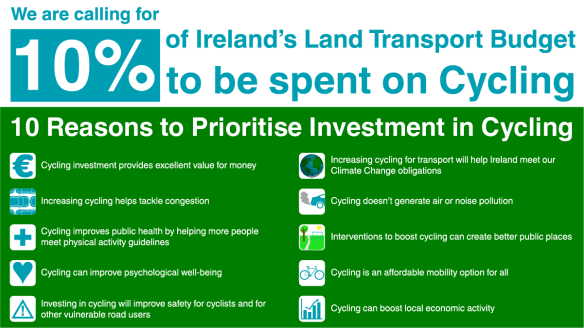
In 2018, total expenditure is estimated at €16.98M rising to €34.36M in 2019. The #Allocate4Cycling campaign seeks 10% of the Land Transport Capital budget to be devoted to cycling. As the Land Transport capital budget is estimated at €1243M and €1544M in 2018 and 2019 respectively, this level of expenditure on cycling equates to 1.37% and 2.22% for those years – a long way from what is required to significantly impact on health, congestion, sustainability and climate change.
Of the eight areas of expenditure, the total allocation for four (Smarter Travel Workplaces, Green Schools, Cycle Right and Bikeweek) is negligible at €1.6M per annum. The allocations for Greenways and Cycling/Walking are significant but most of the funding is in the latter years of the investment programme which shows a lack of priority by the Minister. While he did announce greenway funding of €53M in 2018, no significant if any funding will be spent this year as councils have until November to make an application for schemes. Furthermore, it is assumed that 50% of the Cycling/Walking allocation is for cycling. In theory it could be anything between 0.1% and 99.9% and still accord with statements by the Minister.
| |
2018 |
2019 |
2020 |
| DTTAS Expenditure on Cycling |
€9.08 |
€19.45 |
€39.40 |
| DTTaS Total Capital Voted Expenditure |
€1,243.00 |
€1,544.42 |
€1,934.52 |
| % Cycling |
0.73% |
1.26% |
2.04% |
TABLE 3 % of Departmental Expenditure on Cycling 2018-2020
Excluding Bus Connect (€ M)
By far, the largest area of expenditure is the Bus Connect project with contributions to cycling of €7.9M and €14.3M in 2018 and 2019. It hardly needs to be pointed out that Bus Connect is running into problems politically with very vocal opposition to the proposed reorganisation of bus routes. If there are delay to routes, no preliminary or detailed designs can proceed so it is more than likely that any expenditure on cycling routes adjacent to key bus routes will not happen until the end of 2019 or later. If so, the proportion of Land Transport capital expenditure allocated to cycling in 2018 and 2019 could fall as low as 0.73% and 1.30% respectively (see Table 3) and this for a mode of transport which is used for more than 40% of journeys in many Dutch and Danish cities. The Minister has been quoted as saying that his Department “gets” cycling. Unless there is openness on his intended levels of investment, its impact on levels of cycling AND a commitment to substantial funding, cycle advocates will continue to disagree.
PS For comparison, Finland, which is similar in population to Ireland, has just announced funding of €23M for a single cycle project, albeit the most expensive in its history.
 Maynooth Cycling Campaign