Waterways Ireland’s Demotion of Cycling

Waterways Ireland is in the process of revising its Byelaws. The previous ones were passed in 1988 more than 30 years ago so a revision has been long overdue.  The proposed Byelaws are arranged in some 40 sections. Most of the changes affect the boating fraternity but buried deep in the document is a clause which is aimed at cyclists.

Under Section 35 Protection of biodiversity, water quality, heritage, environment and prohibited activities,  Waterways Ireland includes subsection  (10) Prohibited Activity on canal property. The subsection refers to bicycles and powered personal transporters in two clauses

Maynooth Cycling Campaign has no issue with the first subclause. However, we strongly oppose the proposal to introduce a speed limit for cyclists on any Greenway or Blueway under the control of Waterways Ireland.

  • The general design speed for greenways is 30 km/h (ref TII Rural Cycleway Design (2022).
  • A bicycle is not legally obliged to have a speedometer. Therefore there is no way for a cyclist to know if he or she is travelling above or below a specific speed.
  • The introduction of such a proposal would discourage cyclists from using a greenway or blueway, and cause them to divert them to trafficked roads. Introducing such a proposal at a time when road fatalities are increasing sharply is wholly irresponsible.  
  • Extreme weather events are worsening as a result of climate change. The result of  suppressing the number of cyclists using the greenways and blueways will be to make it harder to meet our international obligations to reduce carbon emissions by 50% by 2030.
  • Internationally, many adult utility cyclists in urban areas travel in excess of 15 km/h. Imposing a limit of 15km/h for cyclists in rural areas in the vicinity of few other users is therefore ridiculous.
  • There is no speed limit on equivalent cycle facilities internationally. The introduction of such a speed limit would be to discourage international (as well as local) touring cyclists from using greenways along canals and waterways. This would reduce the potential financial benefits to adjacent businesses.  

Waterways Ireland claims that the revisions were introduced following research and consultation with key stakeholders. Certainly Maynooth Cycling Campaign was not consulted and neither was our parent body Cyclist.ie who, for many years, has campaigned for development of the Royal Canal as part of the trans-national EuroVelo Route 02 the Capitals Route which runs from Moscow to Galway.

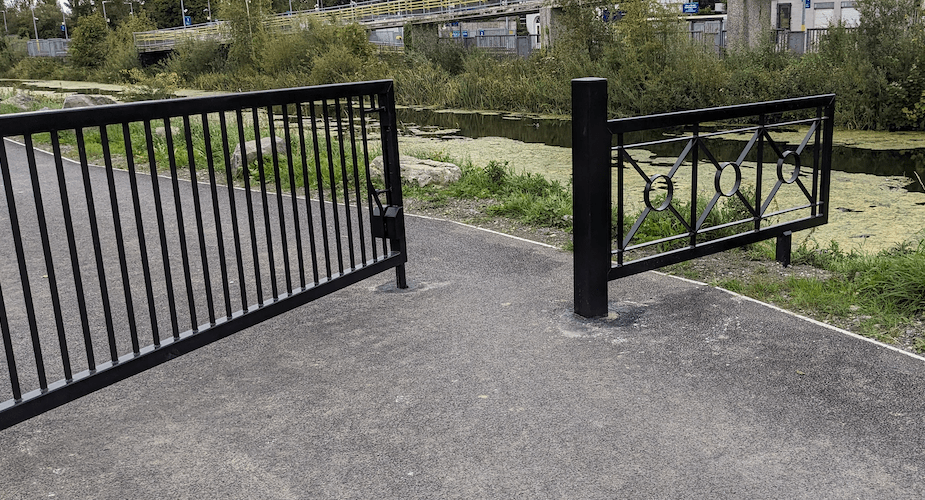
Waterways Ireland should be encouraging cyclists instead of discouraging them. Waterways Ireland is noted for an ambivalent attitude to cyclists. Cyclists are potentially a greater source of income than walkers or boaters on many waterways but Waterways Ireland want to provide low quality cycling infrastructure. This was demonstrated by their provision of kissing gates in the past. It is demonstrated by the large number of substandard gates provided between Leixlip and Kilcock. This has been repeated with the barriers on the Royal Canal at Louisa Bridge where the openings arer 1.3m and 1.0m.  It is hardly rocket science. They just need to provide bollards at 1.5m spacing to enable all types of cycles but instead of learning from their mistakes, Waterways Ireland insist on repeating them.  

The closing date for submissions on the ByeLaws was the 2nd October but Waterways Ireland has extended the date for submissions until 27th October so there is still time to make your views known. To be fair to them, Waterways Ireland has announced that they will be having discussions with Cyclist.ie.
#TimeToKissTheGatesGoodbye

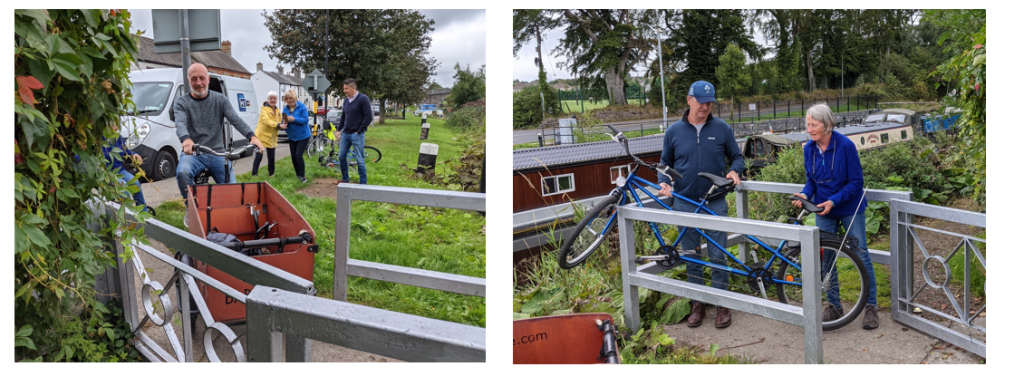
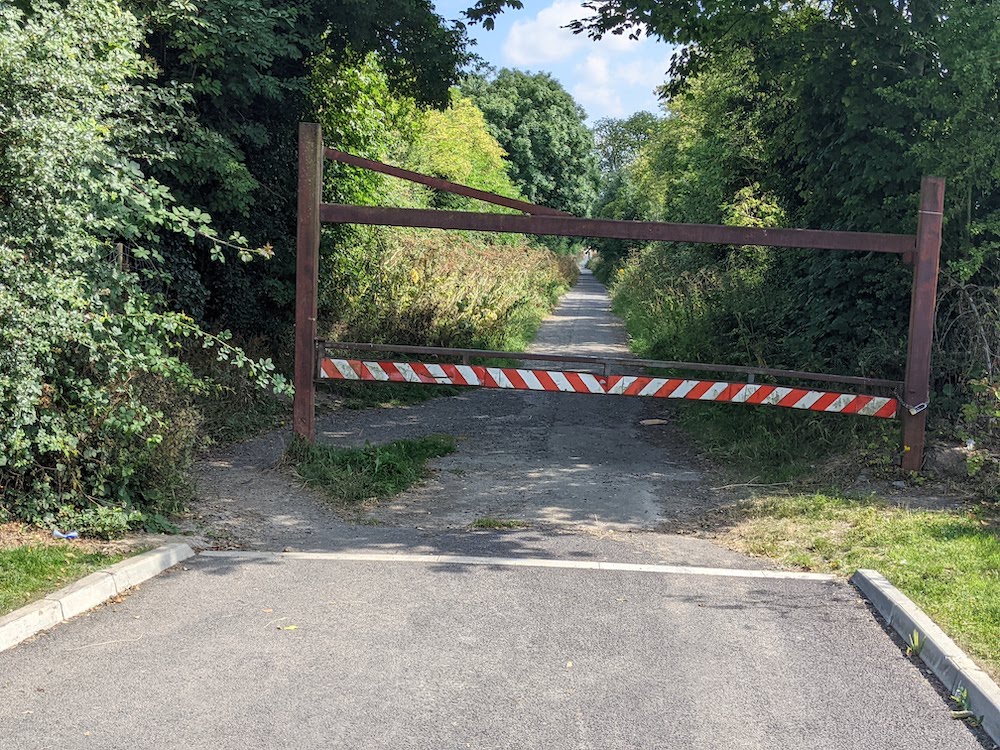
Maynooth Cycling Campaign and the Naas Access Group have joined together with others in a national campaign to #KissTheGatesGoodbye. The campaign wants the removal of barriers to towpaths and recreational areas for people with disabilities and users of non-standard bikes. We invited Kildare County Council’s Access Officer to Sallins to see for himself the difficulty that some people have in accessing the Grand Canal due to kissing gates or similar barriers. Members brought a wheelchair, a tandem and a cargo bike to demonstrate the difficulty for someone young or not able bodied to pass through the gate. We would like to thank the Access Officer for meeting us.

Kildare has relatively few of these barriers. Most are located along the Grand and Royal Canals such as at Leixlip and Sallins. Some are in lands owned by Coillte near Edenderry. A few are in miscellaneous places such as adjacent to Limetree Hall in Maynooth (See photo below).

Responsibility for the majority of such barriers in Kildare primarily lies with Waterways Ireland. Although Waterways has a responsibility for universal access in its own right, the Council also has a responsibility as planning authority to ensure that new developments are fit for purpose and do not discriminate. Maynooth Cycling Campaign calls on the Council to implement best international practice which in this case is to design an access to cater for a Bicycle Vehicle (2.5m long and 1.3m wide).

Admittedly, in some areas, there is a problem with quads and scrambler bikes. The default solution to this of bodies like Waterways Ireland is to put barriers like kissing gates in everywhere whereas the right solution is enforcement by An Garda Siochana. In February 2021,  Minister Eamon Ryan announced that An Garda Siochana would be given powers to seize scramblers and quads on private property so the issue has been getting attention at a high level of government.

In the north, some councils erect signs advising people to ring the police. It is not the emergency number ie 999 – it is a lower priority but still gives some assurance that the police takes the problem seriously.

We call on Kildare County Council (1) to replace any such accesses for which it is responsible, (2) to require third party developers such as Waterways Ireland to design for “Bicycle Vehicles” in new developments and (3) to urge Waterways Ireland to replace other existing substandard accesses.

How to Create Conflict between Walkers and Cyclists

In a recent episode of Tracks and Trails on RTE, Aobhinn Garrihy and John Burke walked part of the Wicklow Way which was established by JB Malone in the late 1970s.

At one point they were looking at a map and realised that the way for walkers was segregated from the way for mountain bikers. John Burke remarked that keeping them apart was “great’ as he was sure “the bikers and walkers do not want to meet”.

The commentator then remarked that in that area, bikers and walkers were kept apart “for safety reasons”.  Further on Robin Seymour, the Irish international mountain biker, stated that there “probably was a lot of conflict before designated spaces”.

I do not know when it was decided to segregate the two but it is amazing that three ‘ordinary’ people recognise that mixing walkers and cyclists together give rise to conflict. In contrast organisations such as local authorities and Waterways Ireland which are responsible for the provision of cycle infrastructure see nothing wrong with force high levels of walkers and cyclists together on narrow footways and towpaths. This use of shared paths follows UK practice dating from the 1980s at a time when cycling was viewed as a child’s pastime – one that they would grow out of in adulthood when they would buy a car.  In Ireland we have chosen to follow the practice of the major European country with the worst modal share for cycling and where the modal share for cycling nationally is unchanged since 2000 rather than countries which enable high levels of cycling. It is hardly surprising then that levels of cycling nationally in Ireland remain low. In the Netherland and Denmark, the authorities recognise that walking and cycling are different modes and require their own space. We should emulate them.