We commend the recent report by Seán Ó Broin on Survey of Car Parking and Bicycle Facilities in Maynooth and agree with many of his conclusions. However, we strongly oppose his suggestion that
There is no point in the Local Authority incurring expenditure on the provision of additional lane facilities within Maynooth in the absence of adequate facilities at starting ……. and finishing points
While the provision of cycle parking is an essential element in enabling cycling, the cost of an individual parking stand is minor compared to the cost of providing high quality cycle infrastructure. It remains the single most important element in enabling everyday cycling.
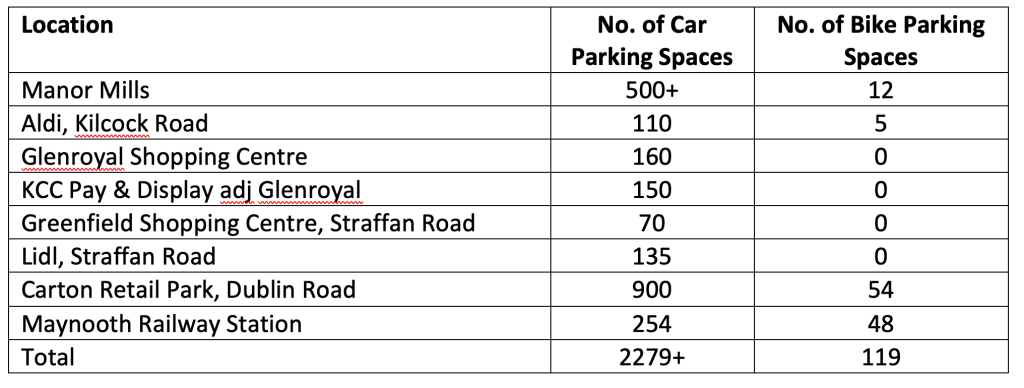
Car and bicycle parking is available at the following locations:
Table 1: The Availability of Car & Bicycle Parking in Maynooth
While most of the locations have a lack of adequate / suitable parking facilities, parking is sufficient at a number of the remaining places. Specifically, it is our opinion that
At Manor Mills, the parking hoops are poor quality “wheel bender” frames which are poorly located as they are remote from the shopping centre entrances.
At Aldi, the cycle stands are substandard. Each should be able to cater for two bikes but have been placed too close together at 500mm apart rather than 1000mm.
The KCC Pay & Display Car Park is not a natural location for bike parking as there is no “destination” nearby. Cyclists would generally choose to park adjacent to their destination or even better at the entrance to their destination. Bike parking at a remote location would only be used if it offered increased cycle security – which the Pay and Display Car Park does not do.
Carton Retail Park has bike parking but it is remote from the shops and is open to all weather conditions. The bike lockers are adjacent to one of the entrances to the Tesco supermarket. However, cyclists have to pay for the lockers whereas parking for car users is free.
There are also a number of individual Sheffield stands which are located in small groups along Main Street, on Straffan Road and at the Harbour Field. They are sufficient in number.
Parking is normally dealt with as a conditions of planning and the County Development Plan lays down a minimum standards of provision for the parking of both cars and bikes. However, while parking for cars is rigorously enforced, parking for bikes is often overlooked and no enforcement action is taken to ensure that planning conditions are met in full.
The big lie of road design is that designs are future proofed to take account of future demand. It is true that they are future proofed but they are future proofed on the assumption that use of private vehicles will increase. They are not future proofed in accordance with government policies to decarbonise transport or on health objectives.
Approximately eight years ago, the Department of Transport, Tourism and Sport (DTTAS) in Ireland developed a suite of papers which led to the Strategic Framework for Investment in Land Transport (SFILT) and in 2015 the Strategic Investment Framework for Land Transport (SIFLT). Both SFILT and SIFLT largely reflected 20th century thinking on investment in transport with a roads first policy. This was despite active travel having been identified as a major contributor to combating obesity and growing concern among public health experts about sedentary lifestyles and the impact on both adults and children. The suite did include a paper on climate change but the paper was published before the 2015 Paris Agreement and the 2018 Citizen’s Assembly report.
In 2016, the DTTAS published the Common Appraisal Framework for Transport Projects and Programmes. Its purpose was
….. to develop a common framework for the appraisal of transport investments that is consistent with the Public Spending Code (PSC) and also elaborates on the Public Spending Code in respect of the appraisal of transport projects and programmes to assist scheme promoters in constructing robust and comparable business cases for submission to Government.
In essence, it set down the parameters for the assessment of road schemes based on the roads orientated SFILT/SIFLT. Needless to say, the Department of Transport, Tourism and Sport (DTTAS) had identified a large number of major road schemes across the country and in 2018 the Common Appraisal Framework was used to justify their inclusion in the National Development Plan.
After the general election in 2020, the new Programme for Government included an unprecedented increase in funding for walking and cycling for which all government parties deserve credit. However, since then there has been pushback by officials and politicians who continue to prioritise roads. The Department of Public Expenditure and Reform published a Review of the National Development Plan (Review to Renew) in which the Strategic Investment Priorities list National Roads as the second priority behind Housing and Sustainable Urban Development, but ahead of Environmentally Sustainable Public Transport in fourth place, Climate Action in eighth place and Education, Health and Childcare in tenth place.
The cross-party Joint Oireachtas Committee on Transport adopted a similar line. The Committee claims to accept the objective of decarbonisation of transport to meet national targets and/or that the carbon impact of projects should form part of project appraisal. However, in a submission to Review to Renew, the Chair of the Committee, Kieran O’Donnell T.D., listed the priorities as
(i) The national road network,
(ii) Environmentally sustainable public transport and
(iii) Airports and ports.
The Committee claims that the national road network is the key to regional connectivity, not only for motorised vehicles, but also for cyclists. (Only the 1% of cyclists “brave cyclists” would agree with that statement.)
The Committee also expressed concern that the current Minister for Transport had revised SIFLT and that the revision, now called the National Investment Framework for Land Transport in Ireland (NIFTI) was already being used to assess projects. The Committee welcomed the commitment from the Minister that the NIFTI will go to public consultation and will be approved by the government before finalisation of the Review to Renew but it put down a marker that it intends to engage further with the Minister and his Department on this strategy.
In planning future transport needs, two key steps are the use of databases to estimate current car trip generation and the extension of car trip generation to future decades. In plain English, this means estimating how many trips will result from a proposed development in the current year and how many additional trips will result in the future, typically a period of twenty or thirty years.
Irish engineers generally use a largely UK database such as TRICs to predict the number of journeys generated by private vehicles. However, the result of Ireland emulating a country with one of the highest car dependency rates in Europe (rather than a country such as the Netherlands with one of the lowest), reinforces the status quo and in Ireland in the last twenty years has contributed to flatlining in the proportion of people cycling nationally.
TII sets out the calculation of future demand on national roads for the next 30 years in its Project Appraisal Guidelines for National Roads Unit 5.3 – Travel Demand Projections. As it specifies a growth rate in future years of between 1% and 3% per annum depending on the county and assumed growth rate, TII are in theory designing roads on the basis of up to 90% more trips in 2051 than at present. In recent years, the TII has published National Road Indicators annually which report the actual growth of traffic on the national road network. The results are shown in Table 1:
Year
2015
2016
2017
2018
2019
Annual Growth
4.1%
4.6%
3.0%
0.5%
2.5%
Table 1: Annual Growth of Traffic on the National Road Network
So between 2015 and 2019, the actual annual growth of traffic on national roads is even greater than the TII’s highest prediction with some regions of the country experiencing rates in excess of 5% per annum. This gives rise to questions about the sustainability and cost benefit analysis of current road plans.
Phil Goodwin is emeritus professor of transport policy at a number of UK universities and some twenty years ago was one of the first academics to report on the phenomenon of “evaporating” or “disappearing traffic“. In an article last year on the appraisal of road schemes,he challenged the cost of carbon used in the cost benefit analysis of new roads and how the increase of carbon emissions from cars using new roads is minimised by comparison to the percentage of overall carbon emissions. This is in contrast with employment, where additional employment, whether for 10 or 1000 new jobs, is welcomed as a positive thing rather than comparing the increase as a percentage of overall employment levels. In response to the largest ever road building programme in the UK, he wrote
The new decarbonisation strategy requires that we will use cars less, by a substantial amount.
A similar reduction is required in Ireland. The Appraisal Guidelines refers to four scenarios – Sustainable & Urban Communities, Global Communities, Dispersed Communities and Car focussed Communities but it appears that local authorities, which are responsible for planning transport infrastructure only concentrate on the last scenario – Car Focussed Communities – in developing their Transport Strategies.
Neither the Department of Transport nor the Joint Oireachtas Committee on Transport acknowledges in a meaningful way the central role of transport in creating unhealthy communities and the financial burden it imposes on society. If this government is to be successful, the current road projects in the National Development Plan must be reviewed with revised appraisals and realistic models to ensure that future investment is in accordance with current government objectives rather than ones that belong in the past.
(A default limit does not prevent a different limit being introduced)
Maynooth Cycling Campaign joins Love 30, The Campaign for Lower Speed Limits, in calling on the Oireachtas to provide for a default urban speed limit of 30 km/h in the forthcoming Road Traffic (Miscellaneous Provisions) Bill.
Ireland was a signatory in February 2020 of the Stockholm Declaration of the Third Global Ministerial Conference on Road Safety, which was subsequently endorsed by the General Assembly of the United Nations. Paragraph 11 committed to:
“mandate a maximum road travel speed of 30 km/h in areas where vulnerable road users and vehicles mix in a frequent and planned manner, except where strong evidence exists that higher speeds are safe, noting that efforts to reduce speed in general will have a beneficial impact on air quality and climate change as well as being vital to reduce road traffic deaths and injuries;”
Love 30 calls on the Minister for Transport, Eamon Ryan, and on the Minister of State at the Department of Transport, Hildegarde Naughton, to fulfil the commitment in the Stockholm Declaration by including provision for a default speed limit of 30 km/h in built-up areas.
It will then be for councils to decide which roads should have a different speed limit. A default limit does not prevent a higher limit being introduced where it is deemed necessary and safe, but the ultimate benefit of a low speed limit would be a cleaner environment and improved safety for people walking and cycling while also protecting our right to health and wellbeing. 30 km/h speed limits have long been recognised for the safety benefits they offer and in addition can assist in reducing noise and emissions and can help to make our towns and cities more pleasant places to live, work and play.
Many cities including London (20 mph), Brussels, Milan, Santander, Bilbao, Paris, Washington DC (20 mph), Boulder (Colorado, 20 mph), Wellington, have introduced widespread 30 km/h limits. Several countries are introducing default 30 km/h speed limits in all urban areas including Netherlands, Spain, and Wales (20 mph). Some locations have speed limits as low as 10 km/h. Love 30 believes that Ireland should follow this best international practice and legislate for a default 30 km/h limit in built-up areas.
Joan Swift of Love 30 Sligo said: “Ireland needs to move quickly to implement the Stockholm Declaration and introduce default 30 km/h speed limits in all built-up areas. We have fallen behind our UK and EU neighbours where 30 km/h is increasingly becoming the norm in town centres and in residential areas. The Welsh Parliament has voted for a 20-mph default urban speed limit and more than a hundred French cities have introduced default 30 km/h limits.”
Mairéad Forsythe of Love 30 Dublin said: “We need 30 km/h speed limits on our residential roads, outside our schools and in the centres of our cities, towns, and villages so that people can move about more safely and enjoy a more people-friendly space. This is more important than ever during COVID-19 restrictions when there has been a surge in the number of people moving about outdoors on foot and by bicycle”
Who are we? Love 30 is an alliance of organisations and individuals who support the concept of lower speed limits in urban areas. We are campaigning for the introduction of more 30 km/h zones in urban areas, but particularly in town centres, residential areas, and near schools and other places of public assembly. You can find more information at www.love30.ie or contact us at info@love30.ie .
Maynooth has finally seen Kildare County Council’s Transportation Department react to the Covid-19 health emergency with works on the Dublin Road, Mill Street and Laurence’s Avenue
Although the Dublin Road work s limited, Maynooth Cycling Campaign welcomes the pop-up cycle lane which has appeared on part of one side of the road. While it will not attract many more cyclists, it will give more space to pedestrians and reduce the risk of a collision between cyclists and motorised vehicles – at least when they are travelling towards Carton Park Shopping Centre.
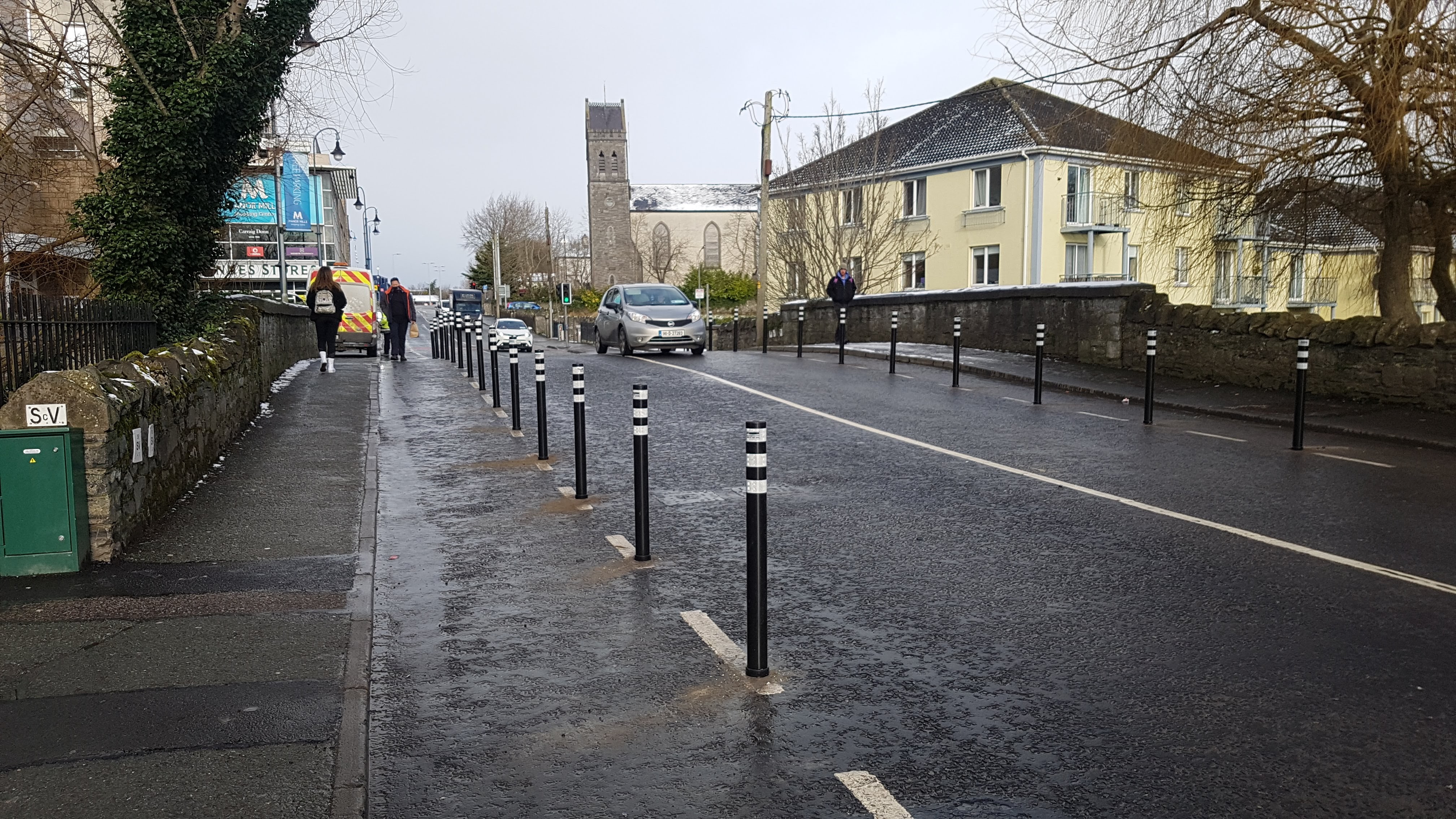
Bollards have also appeared on Mill Street to form a pop-up footpath at the Rye Bridge on Mill Street on space which had formerly been allocated for cycling. Several cyclists thought that it was a pop-up cycle lane. They were astonished to learn that the space was to be reallocated from cyclists to pedestrians and that cyclists were expected to move out to the traffic lane and “share the road” with cars. Most other councils are improving conditions for pedestrians AND cyclists, rather than pedestrians OR cyclists. Legibility is an important aspect of road safety. Legibility means that road users can “read” where they are supposed to go – be they pedestrians, cyclists or drivers. While he changes was intended to benefit pedestrians, it is doubtful that many cyclists will swing out into the traffic lane.
When the work was announced as part of the July Stimulus, a requirement was for the work to be completed before the end of November but was only carried out in February. Thankfully Kildare’s Fire Service is more responsive to an emergency than the Transportation Dept.
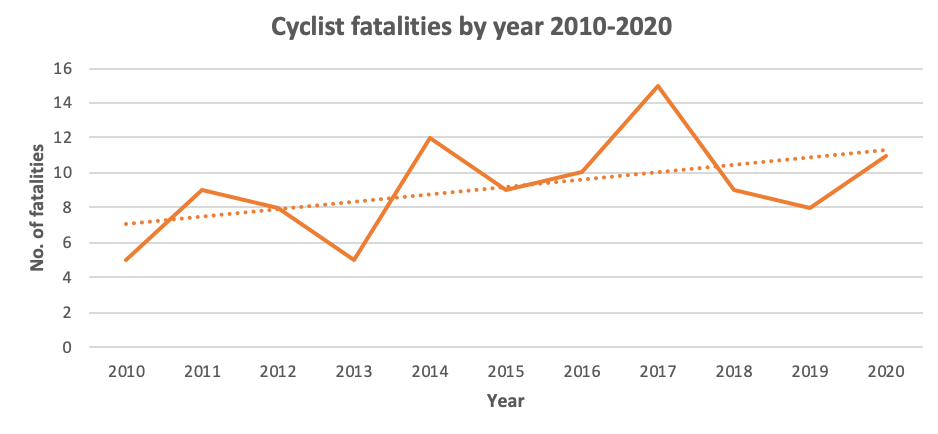
Cyclist fatalities in Ireland have been increasing over the last ten years. In the Netherlands, increased cycling led to a reduction in fatalities due to their high quality infrastructure and Sustainable Safety policies.
Sustainable Safety is one of the corner stones of the Dutch road safety policies. Its ultimate goal is to make traffic so safe that everybody can get home safely. Not only fit able-bodied people or drivers in protected vehicles, but every road user – the schoolchild, the commuter, the commercial driver and the active senior, whether they walk, cycle or participate in traffic in any other way. I’ve published about Sustainable Safety before, in 2012 and in 2017, but the policy was updated in 2018. That is why I want to start this year with another look at Sustainable Safety. First, I would like to wish you all the very best for this new year! I also – as you will have noticed – updated the look of my blog.
The three editions of the Dutch Sustainable Safety policies from the 1990s, 2005/2006 and 2018 respectively.
Another year over and another year with a continuing upward trend in cyclist fatalities.
With a 3% level of cycling in Ireland, it is expected that the number of cyclists fatalities would be statistically insignificant from year to year ie it would follow a random pattern with fatalities increasing some years and decreasing other years. The number of fatalities (solid line above) confirms this pattern.
The trend line (dotted) looks at longer term patterns and show a continuing increase in cyclist fatalities. Admittedly, using a different baseline, say 1990, would show a different picture but the graph above uses a baseline of 2010 as that is the year with the minimum number of cyclist fatalities and minimum level of cycling as measured by the 2011 National Census.
From the 1970s when the Netherlands prioritised cycling and began to provide high quality infrastructure, cyclist fatalities dropped despite increased cycling. Irish local authorities have still to recognise the link between high quality infrastructure and the safety of cyclists. Despite increased cycling during the pandemic, the removal of “emergency” cycle infrastructure and opposition to reallocation of road space shows that we have quite a way to go.
The concerns of drivers in Horsham are similar to the concern of drivers in Maynooth. The reaction of politicians to the concerns are similar too.
In the time that they have developed six vaccines, Horsham Council has at least provided emergency pop-up cycle lanes, albeit on a temporary basis, whereas Maynooth is still waiting for its emergency cycle lanes.
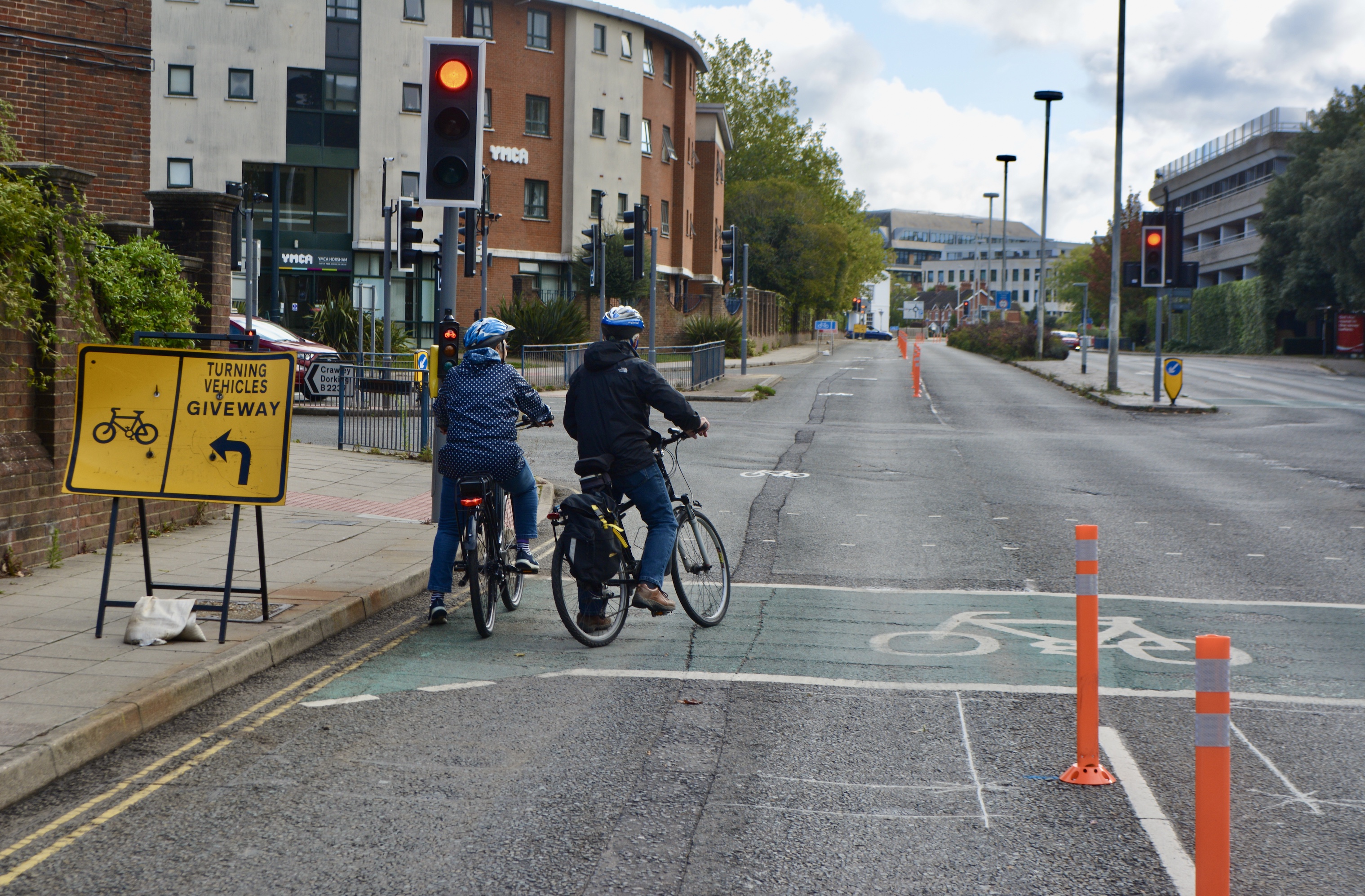
Between the end of September and the end of November this year, Horsham briefly had a pop-up cycle lane, created in the space of less than a day by the addition of some bolt-down plastic wands and painted markings, converting one lane of our four/five lane wide inner ring road into a cycle lane.
The Albion Way pop-up lane. Note that, thanks to a watering down of the original scheme, it only went in one direction, and was therefore unlikely to attract people who weren’t already inclined to cycle here before the protection was added.
The reaction to this scheme (and the others across the major towns and cities of West Sussex) was predictably vitriolic and the County Council, whose commitment to active travel is as shallow as a film of diesel on a puddle, rapidly announced they were removing every single one of them – spitefully, even the one…
Last January, the WHO declared the Covid-19 outbreak as a global health emergency. When it spread to western Europe in February and March, most governments imposed lockdowns, and encouraged people to avoid crowds and observe social distancing. They also encouraged people to walk or cycle where feasible and provided funding to improve facilities for active travel.
By the end of March, the Dutch engineering consultancy Mobycon, had produced guidance Making Safe Space for Cycling in 10 Days: A Guide to Temporary Bike Lanes from Berlin. The title came from the time required for a German local authority to provide temporary bike lanes.
During the summer, the Irish government through the National Transport Authority provided funding to improve facilities for walking and cycling and invited applications for suitable schemes. Kildare County Council were awarded funding for a number of schemes for Maynooth and other Kildare towns which included temporary cycle lanes. The funding was conditional on the work being carried out by the end of November. (In reality, councils knew that they have until the end of January to complete them.) However, in the four months since July, no Covid works have taken place in the town. In contrast, Dublin City Council publishes progress reports on Covid-19 schemes on a monthly basis.
One would hope that in the case of an invasion, that the army in Kildare will react faster to an emergency than the council.
At the recent meeting of Cyclist.ie to develop future strategy, there was discussion on the role of Cycling Officers in local authorities. Some of the comments showed a lack of awareness of Cyclist.ie’s position on the matter so this article was designed to clarify the subject. Cycle campaigners agree that there should be Cycling Officers in all local authorities but what should their background be and what should they do?
Cycling Officers were explicitly mentioned in the 2009 National Cycle Policy Framework where their sole task was defined as setting up a Cycle Forum but, since then, most local authorities have ignored the Department of Transport calls to appoint one. Where they have been appointed, some have an administrative background while others have a technical background and the underlying grade of appointed Officers includes Senior Executive Engineer, Administrative Officer and Road Safety Officer with some working in “Sports Partnership” rather than “Transport”. In Kildare, the post of Cycling Officer was incorporated with the Road Safety Officer and the necessary qualifications uniquely included needing a driving licence but did not include being able to cycle.
In the past, the policy of Cyclist.ie was that the Cycling Officer should be appointed at an appropriate grade without specifying what that grade should be. At the October 2019 Council meeting of Cyclist.ie, a motion was passed that the Cycling Officer should be at Director of Services level and that the role of the Cycling Officer should be:
(1) to achieve an increased level of cycling and
(2) report progress or lack of it on an annual basis.
In large part, this was because in local authorities no-one is responsible for increasing the level of cycling. It also avoids the question of whether the required skillset should be technical or administrative. What is more important is the enthusiasm of the person for the job!
In 2005, following a road traffic crash in County Meath in which five schoolgirls were killed, safety procedures changed radically when Directors of Services in local authorities were given responsibility for new road safety procedures. This was a radical departure and led to an increased emphasis on health and safety in the upper levels of local authority senior management. In (most) local authorities, an equivalent radical departure is required in relation to cycling. Cycling Officers at Director of Services level with responsibility for increasing the level of cycling would be one step in ensuring that high quality is an integral part of new cycling infrastructure as low quality will not attract a high number of users.
Since the passing of the motion by Council, the Cyclist executive has raised the issue in its Pre-Budget submission to government but the Department of Transport has given no indication that it accepts Cyclist.ie’s position. Under it does, efforts to improve quality of cycling infrastructure will be handicapped.
In 2019, with the assistance of parliamentary questions by TDs of all parties as well as independents, Cyclist.ie estimated that the Department of Transport, Tourism and Sport (DTTAS) spent 1.4% of its capital budget on cycling in 2018. This article carries the results of a similar exercise for 2019 funding. Again it focuses on the DTTAS and ignores the funding of cycling by other government departments such as the Departments of Health or Education.
DTTAS funding for cycling is generally provided under the heading of Land Transport but additional funding for cycling (greenways) was also provided under the heading of Tourism.
The principal source of data for Land Transport funding was the National Transport Authority (NTA) 2019 Annual Report Sustainable Transport Measures Grant. The NTA lists all scheme according to the implementing local authority or other recipient. Some of their schemes are cycle only, while others are for more than one mode of transport. The proportion allocated to cycling was estimated on the basis set out in the following table:
The main categories of multi-mode projects were – greenways, shared paths, shared space and BusConnects. Greenways and shared paths were divided on the basis of 50:50 expenditure while shared space was divided on the basis of 331/3 : 331/3 : 331/3 . BusConnects was more problematic as its proportion of cycling can vary significantly. However, it was decided to proportion 10% of funding for cycling for a number of reasons. In particular, the primary objective was the need to reorganise the bus service but It was considered reasonable that a proportion should be allocated to cycling as the project includes segregated cycle facilities. It was decided to proportion 10% for cycling as that was the 2009 government target for cycling. There are grounds for arguing that 10% is too high and other arguments that 10% is too low but as BusConnects is a new project, it was decided that 10% was reasonable until its outcome in terms of provision of quality cycling infrastructure is clearer.
The NTA reported that in 2019 total expenditure on sustainable transport schemes was €39.6 million. Each NTA scheme was considered in turn and the appropriate percentage was applied in accordance with the type of scheme. In this way, NTA expenditure on cycling was estimated at €17.9 million or 45% of NTA STMG grants. Tourism allocated €9.8 million to greenways, of which €4.9 million was deemed to be for cycling. Other cycling related spending by the DTTAS and NTA at €1 million included Cycle Right and Bikeweek, and was assumed to be 100% cycling related. Green Schools spending, with a budget of €2 million, was assumed to be 331/3% cycling related. Combining Land Transport and Tourism funding, total DTTAS expenditure on cycling in 2019 was estimated at €24.48 million.
The total Land Transport capital expenditure for 2019 was €1493 million. In calculating the appropriate amount, this figure was increased to take into account the Tourism expenditure on greenways so the overall total figure for expenditure by the DTTAS was €1,503 million. On this basis, the estimated proportion of DTTAS expenditure on cycling increased in 2019 from approximately 1.3% to 1.6% – a modest increase, which with ex-Minister Ross’s record, should surprise no-one.
APPENDIX 1 ESTIMATE OF CYCLING RELATED NTA GRANT
Ref
Grant Recipient
NTA Grant
Cycling RelatedNTA Grant
% Cycling related/NTA Grant
CCC/
Cork City Council
€6,808,976
€3,048,419
44.8%
CCO/
Cork County Council
€1,327,678
€138,104
10.4%
DDC
Total
€15,956,908
€7,929,682
49.7%
DCU
DCU Cycle Parking
€62,104
€62,104
1
DLRCC
Dun Laoghaire Rathdown
€1,413,278
€956,874
67.7%
FCC
Fingal County Council
€2,292,155
€1,143,944
49.9%
GCC
Galway County Council
€620,140
€280,757
45.3%
KCC
Kildare County Council
€728,138
€380,136
52.2%
LCCC
Limerick City & County Council
€3,327,944
€1,290,217
38.8%
MCC
Meath Coiunty Council
€2,650,571
€245,323
9.3%
NTA Regional Bikes Capital Costs
Capital Costs
€309,854
€309,854
SDCC
South Dublin County Council
€1,758,660
€1,174,077
66.8%
An Taisce
Greenschools Cycle & scooter parking
€124,617
€62,309
50.0%
UCD
Ped Cycle facility
€119,884
€59,942
50.0%
WCC
Wicklow County Council
€399,077
€138,974
34.8%
WDCC
Waterford City and County Council
€1,722,907
€701,068
40.7%
Grand Total
€39,622,891
€17,921,782
45.2%
A breakdown of expenditure within local authorities is available here.
APPENDIX 2 SUMMARY OF DTTAS EXPENDITURE ON CYCLING
Year
2018
2019
Gross Voted Capital* €000s
DTTAS – Dept Total Gross Voted Capital
€2,005,308
€2,343,869
DTTAS – Land Transport Total Gross Voted Expenditure
€1,660,507
€1,934,981
DTTAS – Total Land Transport Gross Voted Capital
€1,242,591
€1,493,523
DTTAS – Tourism Greenways Gross Voted Capital
€3,255,000
€9,798,000
DTTAS – Total Land Transport+Greenways Gross Voted Capital
€1,245,846
€1,503,321
* Source Databank
NTA Expenditure on Cycling
NTA Annual Expenditure STMG
€34,700
€39,622
% Cycling
45.2%
NTA Cycling Expenditure
€17,921
Walk/Cycle
€21,600
(€26,850)
Bus
€4,100
(€2,600)
Traffic Management
€6,900
(€7,480)
Alternative Estimate of NTA Expenditure on Cycling*
€13,205
*Note – NTA expenditure on cycling was calculated differently in 2018 and 2019.
Other DTTAS/NTA Expenditure
Cycle Right/Bikeweek
€1,000
€1,000
Green Schools
€2,000
€2,000
Greenways
€3,255
€9,798
Other DTTAS/NTA Expenditure
€3,288
€6,559
Total DTTAS Expenditure on Cycling
€16,492
€24,480
% Total DTTAS Expenditure on Cycling*
1.3%
1.6%
Note there is a discrepancy in the 2018 estimates of percentage expenditure on cycling between 1.4% at the start of the article and 1.3% at the end. This is due to slight differences in the method of calculation.




 The Albion Way pop-up lane. Note that, thanks to a watering down of the original scheme, it only went in one direction, and was therefore unlikely to attract people who weren’t already inclined to cycle here before the protection was added.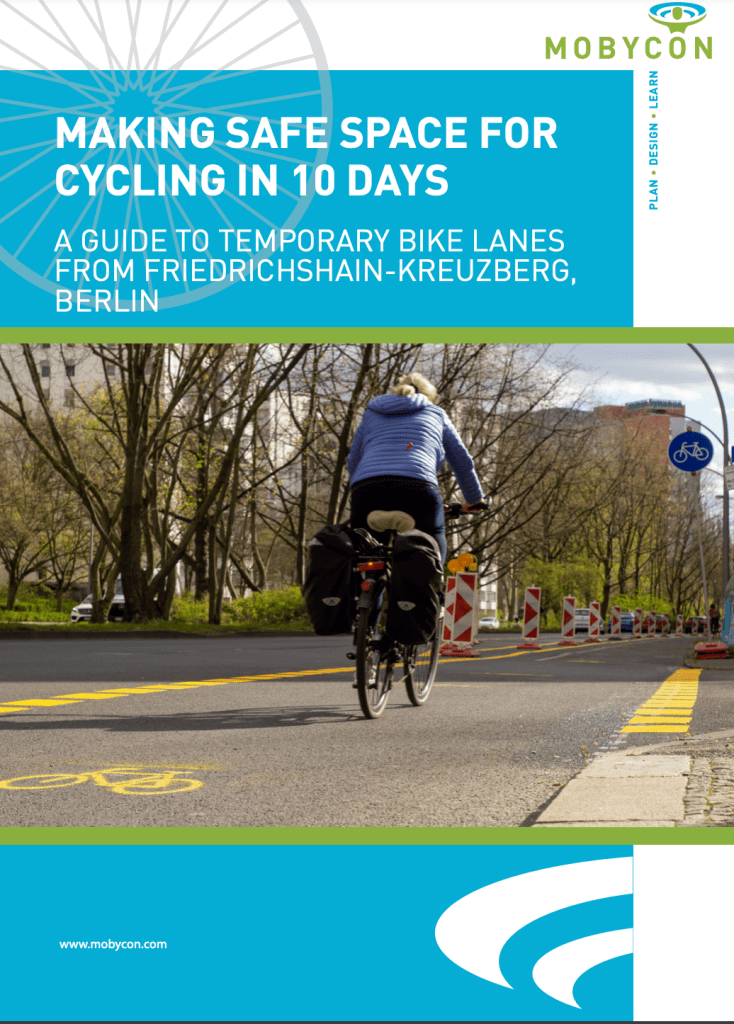


 Maynooth Cycling Campaign