The past year has seen the completion or significant completion of two major schemes in and around Maynooth. The two are the Royal Canal Greenway between Leixlip and Maynooth and the Mill Street refurbishment. Both are a huge improvement on what was there previously.
We welcome the Greenway and its completion from the Dublin border to Athlone. We hope that the second half from Athlone to Galway will progress in the coming year. We welcome the fact that after many years, Kildare County Council is now providing access gates with the proper spacing in accordance with the National Cycle Design manual. However, it is frustrating that while the section closer to Leixlip has been finished with a high quality sealed blacktop surface, the other section closer to Maynooth is left with a dust surface. Next door, Meath County Council has just completed a new greenway which is totally sealed. Several years ago, the Danish authorities announced that as part of their efforts to decarbonise, that they would sealed “superhighways” in order to enable more cycling by 2030. It is not as if Ireland is projected to meet its targets in relation to climate change action and can afford not to maximise cycling and walking..
In 2026, we are looking forward to working with Maynooth Tidy Towns and Maynooth Sustainable Energy Community in 2026 on a sustainable transport project which also involves the Maynooth schools.
AGM
Maynooth Cycling Campaign held its AGM on 11th November in the ICA Hall, Leinster Street and a new Management Committee was agreed. We welcome Michael Murphy to the Committee and thank Karen Moore for her work over the past years. If any one else wishes to join the Management Committee, you will be more than welcome!
Funding for Local Climate Action
The Department of Climate, Energy and the Environment has given Kildare County Council an allocation of €897,000 for climate related projects by communities to improve their local area. The project themes include community energy and travel. KCC has published on its website a list of successful applicants from the first round. The most popular application involved solar panels on community premises which are very welcome. The only applications relating to transport were for cycle parking.
Bollards at Moyglare Road.
From some of the comments on social media about parking by non-residents in housing estates, you would think that this was the major parking issue in the town. An increasing number of drivers are ignoring the efforts by Kildare County Council to discourage parking by the addition of more bollards on the shared path opposite St.Mary’s Boys School. Drivers parking their car can take up over half the width of the path. Maynooth Cycling Campaign has lodged a complaint to the Leixlip Gardai and look forward to their intervention.
Cycling Without Age
Last March, we received a grant of €200 from Kildare Community allocation for servicing of the trishaw. Unfortunately, during the year the trishaw developed two problems which cost €265. We applied for the additional funding of €65 from the Community fund but were refused. Maynooth Cycling Campaign is not sustainably funded from our membership. The Council has already cost the Campaign nearly €500 as it declined to accept our existing insurance under the Irish Cycling Campaign. The trishaw is owned and insured by Kildare County Council. If we are not reimbursed for the €65, we will have to reconsider our involvement with Cycling Without Age.
Maynooth Cycling Campaign is an independent local lobby group for better cycling facilities in Maynooth and Kildare generally. If you would like to support our efforts, we welcome new members. Why not join us – you can find details here.
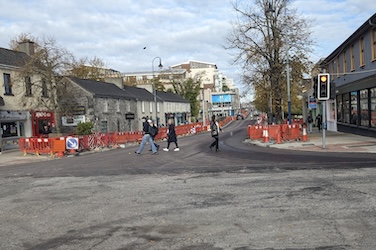
An atypical view of Mill Street during reconstruction works at 9:45am on a single morning at 9:45am but an actual picture as opposed to an AI generated or photoshopped one.
There have been a lot of complaints in recent weeks of congestion in Maynooth, especially at peak times. Most put the blame on Kildare County Council’s redesign of Mill Street and/or its construction. Everyone is entitled to their opinion but many of the comments are ill-informed.
In Maynooth town centre, traffic lanes carry up to nearly 20,000 vehicles per day, the majority of which are private cars. This is more than six times the threshold for a major road as defined under the Environmental Noise regulations. Congestion is caused by too many cars which is why Irish political parties and governments across the world (except in the USA) want to reduce private traffic in favour of more space-efficient and sustainable mobility. During the reconstruction of Mill Street, drivers of cars and other motorised vehicles continue to have use of two lanes as they had before and will have afterwards. Pedestrians, on the other hand, are often unable to use one side of the street, the temporary paths are often barely wide enough for two people to pass and the surface leaves a lot to be desired. As for cyclists, they are directed to dismount and push their vehicle.
Mill Street-Main Street Junction
Engineers can model how much space vehicles of different sizes and types need to manoeuvre around a corner or bend. If they haven’t modelled it, they should determine what is required before blindly butchering the newly constructed paths.
Drivers need time to get used to new layouts.
Tyre marks on kerbs are examples of bad driving and show that the kerb is doing what it is supposed to do – namely protect people on the footpath.
The width of junctions shouldn’t be decided by bad drivers.
Last week, watching traffic during the evening peak, for about 30 minutes, 150 vehicles turned left from Mill Street to Main Street. These included three buses, two of which were blocked from accessing the junction by car drivers wanting to turn right and one bus which was able to continue. While the two buses blocked about five cars each, 138 cars were able to get through. Many of the cars were only single occupancy compared to the buses that appeared to be carrying multiple passengers. So who is holding up who?
The junction can cope with a number of right turning cars but on a number of occasions when there were too many or when they were badly positioned, even cars had difficulty in getting past. In many urban areas, right hand turns are banned or restricted in the interest of traffic flow.
On some turns of the lights, traffic from Parson Street received a green light to continue to Main Street but ignored the Yellow Box. They stopped in the middle of the junction because the street ahead was already full. When the lights turned to green for left turning traffic from Mill Street, they were unable to proceed. This had nothing to do with the corner or narrowness of the street and everything to do with too many cars.
If two people want to pass through a doorway at the same time, one will wait while the other person passes through. If two large vehicles, one from Main Street and one from Mill Street can’t take a turn at the same time, a competent driver will do the same – give way to the first with a delay of about 10 seconds.
Width of Mill Street
I do not know what post construction width KCC has proposed for Mill Street but the full width will not be available during construction due to the need to protect construction staff.
There are 3m wide traffic lanes in New York which are wide enough for American traffic.
In Utrecht, a road has recently been reconstructed with two traffic lanes which are each 2.75m wide, admittedly with a 1m strip in between. The road was designed for cars, lorries and buses.
Waze’s Driver Satisfaction Index – which analyzes the driving experiences of 65 million monthly users in 38 countries and 235 cities across the globe – named the Netherlands as the most satisfying place in the world to drive in 2015 and 2016 so the provision of cycle facilities does not necessarily mean worse conditions for drivers.
Governments traditionally constructed wider roads. The excessive space can clearly be seen after a snowfall by the amount of road with undisturbed snow. Now, they construct narrower roads in order to reduce the speed of traffic and to decrease the number of pedestrian and cyclist fatalities.
In north Kildare, the M6 Motorway is often congested with traffic stretching back to Maynooth and with a queue of cars from the intersection as far back as Taghadoe. There is congestion in both Celbridge and Leixlip although those towns have no current comparable works to Maynooth. Some of the comments on the Notice Boards refer to taking an hour to drive from one side of Maynooth to the other. We live in a democracy so people are free to continue to do that if they so wish. However, with the future development of housing and the resulting additional traffic as well as the need for parking, a one hour delay is going to become a lot more common unless there is significant take-up in active and sustainable travel. More people will choose walking and cycling as the active travel networks expands due to continuing political support. If not, the big losers will be drivers who have no choice but to drive.
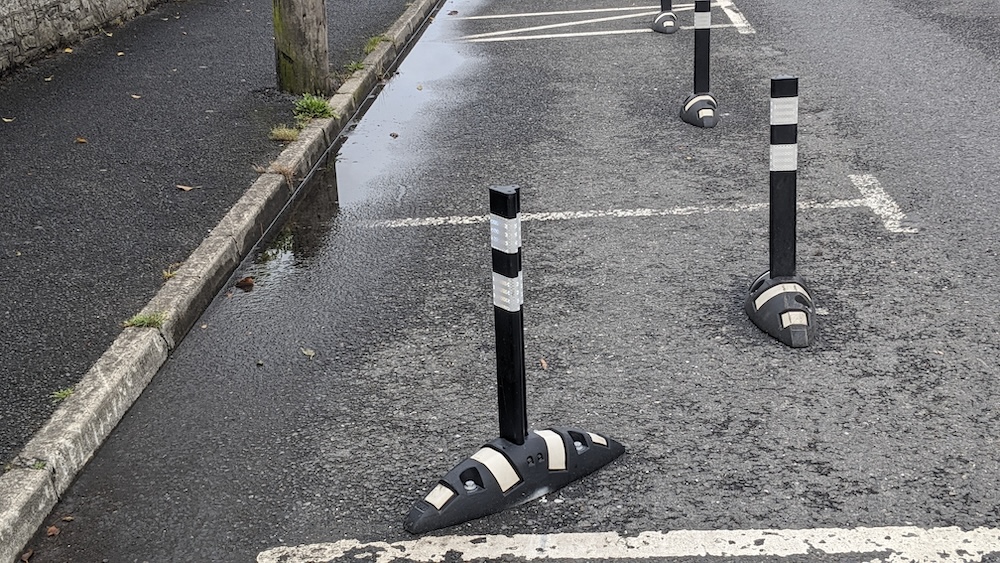
During Covid, as a temporary measure to encourage cycling, Kildare County Council provided plastic bollards to reallocate space from drivers to cyclists/pedestrians. Since then, vehicles have damaged many of them with the result that in May this year, Kildare County Council replaced bollards with “orcas” in a number of locations including on the Straffan and Dublin Roads.
An orca is a moulded plastic separator which is placed along the white line of a cycle lane to discourage drivers from drifting (or parking) on it. While it is an overstatement to label them as “killer orcas”, the positioning of orcas on the Dublin Road, while unlikely to lead to a fatality, could result in a nasty collision for a cyclist. Firstly, the cycle lane is defined by a line of orcas which is positioned 1.7m from the kerb. This contrasts with the former width which delineated space for parked cars of 2.4m. Reallocation of some of this 0.7m difference would have given cyclists more space. Secondly, at entrances to eight private properties, additional orcas are positioned at a 45o angle to the footpath which leaves a gap of only 0.8m between the kerb and orca on the left hand side and a gap of 0.4m between the orca and edge on the right hand side of the cycle lane. The Cycle Design Manual specifies a desirable minimum width is 2m for cycle lanes with an absolute minimum width of 1.5m.
In Dublin CIty, the Council places orcas on the white line which minimises the reduction in effective width of cycle lane. On the Straffan Road, Kildare County Council positions orcas on the inside of the white line which further reduces the effective width for cycling.
Celbridge Road
As a planning authority, Kildare County Council granted planning permission to Gaelscoil Ui Fhiaich and Maynooth Educate Together school on the Celbridge Road some 25 years ago. It is unacceptable that there are still no safe cycling (or walking) facilities to the schools despite the authorities being aware of a number of road safety incidents. Kildare County Council did attempt to design facilities in2019 but the quality of the design was very poor. More recently, Kildare County Council employed consultants to produce a high quality design but the NTA has declined to provide funding for the scheme. Maynooth Cycling Campaign is concerned about what elements of the design may be removed in order to meet the NTA approval. We have asked Kildare County Council for a copy of the published design in order to ensure that safety or quality is not compromised in the next chapter of the saga.
Royal Canal Greenway
Maynooth Cycling Campaign welcomes the reopening of the upgraded Royal Canal towpath between Maynooth and Leixlip. We welcome that Kildare County Council has provided access gates in accordance with the Cycle Design Manual which is in contrast to the substandard gates provided elsewhere. We welcome too that there are lengthy sections which have been black topped but disappointed that the Council failed to continue that quality of surface for the entirety of the scheme.
Mill Street
Work continues on Mill Street. The section on the east side between Manor Mills and Main Street is substantially complete and work has started on the equivalent section on the west side. Preliminary work has also started on the proposed pedestrian bridge over the Lyreen River adjacent to Manor Mills.
The quality of design and construction is generally very high but it is disappointing that the design of the Pound Lane junction continues to prioritise traffic from Pound Lane rather than people on Mill Street. Best international practice and the latest edition of Ireland’s Cycle Design Manual are that footpaths and cycle tracks on a main route should continue across a minor junction. In other words, drivers should cross a footpath and cycle track rather than pedestrians and cyclists having to cross a road. The Manual also states
….. it is recommended that all dedicated cycle facilities …… in urban areas in Ireland should be red in colour.
Coloured surfacing of various colours is used in several countries not because it looks nice but for reasons of road safety – to draw attention to vulnerable road users. Cycle lanes were coloured red on the Straffan Road so it again begs the question “What is the policy of Kildare County Council”?
Mobility Hubs
In June, IrishCycle.com reported that Minister for Transport, Darragh O’Brien, would announce a pilot project of mobility hubs in Carlow town, Cork city, Dundalk, Dún Laoghaire-Rathdown, and Sligo town. This was the pilot ahead of a proposed wider rollout of hubs in some 300 centres across the country.
Mobility hubs are defined as locations where people can access multiple types of transportation modes in a central location. While we wish them every success with the pilot hubs, we are disappointed that Maynooth is not included. For a number of years, we have heard whispers of discussions on a bike share scheme between various partners – Kildare County Council, Maynooth University, the NTA and the Department of Transport but nothing firm has materialised. Hopefully something definitive will result from this latest initiative.
Maynooth Cycling Campaign is an independent local lobby group for better cycling facilities in Maynooth and Kildare generally.
Last month, Maynooth Cycling Campaign announced that we would be screening the award winning film MOTHERLOAD in May. Make a note in your diary! We are delighted to announce that it will be screened at 8:00pm on Thursday 15th May as part of Bikeweek 2025. The venue will be confirmed at a later date.
The film will be of particular interest to people who may be considering a cargo bicycle instead of a second car and who would like more information of what a Bike Library may offer.
In January, two people lost their lives in Storm Éowyn and the financial damage is estimated to be in the range of €300M.
In March, Professor Peter Thorne from Maynooth University’s Icarus Climate Research Centre appeared on RTE’s Nine O’Clock News. He stated that ‘Governments have to act now. If we don’t, things will get worse very very quickly …….. The temperature rise is not linear- its impacts are very non-linear. They are going to increase very quickly.’
The Climate Change Advisory Council stated that the government must invest now to rapidly improve its preparedness and ability to respond to extreme weather events. It called on the government to stop procrastination on the decisions that are needed.
The Climate Change Advisory Council in conjunction with the Fiscal Council and Climate Change Advisory Council also recently issued a joint report. Their report, ‘A colossal missed opportunity‘, sets out potential costs for Ireland from missing agreed EU targets. These could amount to staggering payments of between €8bn and €26bn to Europe.
In view of the rejection by Maynooth MD councillors of measures to increase bike use in the Maynooth & Environs Local Area Plan (LAP), perhaps the political parties will indicate who they think should pay the cost of larger fines – people who supported additional permeability measures to promote cycling under the LAP or people who opposed the measures?
Increase in Private Cars
In the Irish Republic, between 2000 and 2020, the number of private vehicles registered for tax rose by 63% from 1,319,250 to 2,215,1127. No one was asked to approve this increase. No one was asked about the impact on road accidents or road fatalities. No one was asked about the worsening air and noise pollution. Yet people are getting in a twist over a relatively small increase in the number of cyclists.
KCC & the Sustainable Transport Forum
When Kildare County Council abolished the Kildare Cycle Forum, it announced that the forum would be incorporated into a new Sustainable Transport Forum (STF). It took some two years for the Transport Strategic Policy Committee to establish the new forum. During the term of the last council, the last STF meeting took place in February 2024. The minutes from that meeting have still not been circulated.
Maynooth Cycling Campaign is particularly interested in the minutes as we were able to raise an issue of particular interest and importance concerning climate targets. We are waiting to see if the minutes will refer to the matter. Since the local government elections in May 2024, the Transport SPC has met once in February but the re-establishment of the Sustainable Transport Forum was not on the agenda. It suggests that a forum of sustainable transport stakeholders is not a high priority of Kildare County Council.
Maynooth Cycling Campaign is a non-party independent local lobby group in Kildare.
Is the Railpark housing estate the worst place to live in Maynooth? (Spoiler: It isn’t.) Then why, at a number of public meetings during the summer, did some Maynooth residents imply a feature that is working well in Railpark would mean a host of problems if applied to other areas?
The meetings were called to discuss the impact of proposals in the Maynooth and Environs Local Area Plan 2025-29. The Local Area Plan (LAP) covers a broad range of issues related to the future development of Maynooth. It includes proposals that are designed to contribute to Ireland meeting its commitment to reduce carbon emissions by 50% by 2030. However, many of the discussions focused on pedestrian and cycling permeability – the retrofitting of active travel access through existing adjacent developments, mainly housing estates.
One such proposal linked the Kilcock Road and Crewhill — a new high-density development to the north-west of the town via Maynooth University and the unconnected residential estates of Moyglare Abbey and Moyglare Village.
It was claimed that retrofitting an active travel access would lead to increased anti-social behaviour and increased littering. One attendee quoted an unnamed member of the Garda Síochána who had warned that opening up estates would lead to increased crime. It was claimed that a direct link between Moyglare Abbey and the university would lead to Moyglare Abbey turning into a car park for students. But no such link was even proposed in the LAP. Concerns were also expressed that the openings would be so wide that cars would also be able to use them and that drivers would not see cyclists at a junction due to inadequate sightlines. (For clarity – cars will not be able to use the access points.)
This proposal was designed to provide an alternative to Moyglare Road where, at peak times, there is heavy congestion on crowded footpaths, and many secondary school students cycle on the road instead of an adjacent shared path. At school closing time, traffic queues stretch to nearly a kilometre from the Kilcock Road junction to beyond the GAA clubhouse. It was pointed out that improving permeability would be good for health by reducing air and noise pollution. The high level of traffic congestion would also be reduced, but the mood of the majority who attended the meeting was to oppose the permeability links regardless of any benefits that they might bring.
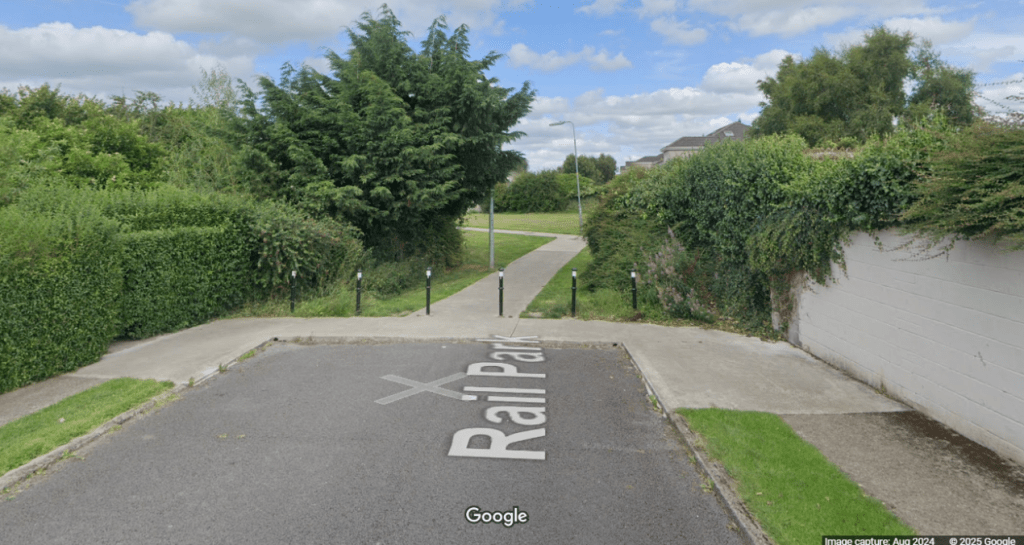
The irony is that Maynooth residents don’t have to go too far to see good examples of active travel permeability. Most of the estates off the Straffan Road are permeable. On the west side, Kingsbry, Beaufield and Greenfield estates are linked. Parson Hall and Ashleigh are also linked. On the east side, Railpark estate is particularly good as it is linked to both Rockfield and Parklands, as well as having a pedestrian link to the Straffan Road.
If the fears expressed by Moyglare residents are valid, Railpark must be the worst place to live in Maynooth. In fact, it is estates like Moyglare Abbey and Moyglare Hall that are badly designed in regard to mobility. So, the LAP presents a rare opportunity to mitigate the poor outcomes of past planning decisions.
Public consultations are an important part of local democracy. However, democracy is not just about the number of submissions for and against a scheme. The proposal to provide greater permeability and increase active travel has implications for climate change and road safety as well as health in Maynooth. This concerns all the people of Maynooth and not just those who reside close to the proposed openings. The provision of permeability links is a very modest proposal to reduce our carbon emissions.
The backdrop to this includes Ireland still recovering from one of its most severe storms that was linked to two deaths, other European countries suffering extreme climate events involving multiple fatalities, and 2024 was confirmed as the warmest year on record globally. It’s also at a time when the consensus between Europe and the USA on climate is under threat like never before.
Given that the addition of a “relatively” small number of people cycling and walking provokes such opposition from people who are opposed to change and happy with the current status quo, then what will happen when people are asked to make major changes to their lifestyle?
In a recent appeal against a refusal for a proposed wind farm in Laois, the High Court stated that “rapid, far-reaching and unprecedented changes to all aspects of society and the economy” and “an immediate end to business as usual” by consenting authorities is required to cut greenhouse gas emissions and ensure planetary survival.
Maynooth University is an important institution in the town. It is one of the Irish universities that is noted for research on climate change and lecturers there collaborate with their international colleagues. It is disappointing that the university authorities did not consider the LAP important enough to make a submission. It is particularly disappointing as the university is also the biggest single generator of traffic in the town.
Ireland was fortunate to rely on expert medical advice during the Covid epidemic rather than on non-experts. Expert advice on the LAP from the university authorities could have reassured a lot of people who are fearful of or opposed to change.
Local councillors are responsible for approving Local Area Plans, and while they have a responsibility to represent the views of the public, they also have a responsibility to show leadership. Central government ministers and their departments primarily fund local government. Central government also sets down national policies so their views cannot be ignored by local government.
Prior to Christmas 2024, in their submission of amendments to the Draft LAP, the Office of the Planning Regulator, which reviews the performance of planning authorities, recommended that all the permeability links deleted by councillors be reinstated. However, on February 17th, at the meeting of the municipal district on the LAP, councillors voted to proceed with deleting 12 of the 34 walking links and 1 of the 3 cycle links that had been proposed to be abandoned.
With only five years until the next local government elections and one year after that to the 2030 target of a 50% reduction in carbon emissions, the decisions of current councils nationwide will decide where Ireland will stand by the key target date. Kildare is just the latest council to demonstrate the disconnect between government policy and the actions of local councillors. Many groups and individuals will be watching to see how this saga plays out.
This article was edited post publishing to correct an error in the numbers of links for abandonment.
The submission below was forwarded to Kildare County Council in early December.
SUMMARY
Maynooth Cycling Campaign supports the retention of all of the removed permeability and cycling measures on the grounds that their deletion is contrary to government policy on climate, health and road safety.
We support the retention of all of the permeability and cycling measures. There are plenty of existing examples of permeability in Maynooth. While some are not so good in terms of width, most permeability links are good to very good and are positive features for the residential estates in question.
Although not explicitly appearing in the LAP, the LAP references the targets for future modes of travel in the Maynooth & Environs Area Based Transport Assessment. Unfortunately these do not make mathematical sense given that the totals sum up in excess of 100%. Best national and international practice is that they amount to 100% and if one mode of travel increases in percentage, another mode must decrease by an equivalent amount. Targets at a micro level (at town level) rather than at national level must be included in the LAP in order to allow government to monitor and report progress on an annual basis.
The proposed deletion of the permeability measures will make it more difficult to achieve any target of increased active travel.
.
Maynooth Cycling Campaign suggests that Kildare County Council could have done much more to prepare local people for the prospect of increased permeability as it failed to make the case for their inclusion in advance of the publication of the Local Area Plan.
Although child safety was cited as a reason by residents and parents opposed to some of the permeability measures, international experience shows that dedicated cycling and walking linkages promote child safety by keeping them away from busy roads and intersections.
OPPOSITION TO CYCLING INFRASTRUCTURE
Maynooth has a track record of opposition to proposed cycle infrastructure, especially where it involves reallocation of space from cars. This was the case
On the Straffan Road when officials proposed to remove the turn right turning lane into residential estates.
On Carton Avenue when officials proposed to turn the footpath into a shared path.
On Parsons Street when it was proposed to trial the restriction of motorised traffic to flow in one direction.
Albert Einstein is reputed to have said “Insanity is doing the same thing over and over again and expecting different results”. Kildare County Council should have learnt from these episodes that residents, especially drivers, would not meekly accept its plans for active travel without any opposition.
Kildare County Council should also have learnt from the report Active travel infrastructure design and implementation: Insights from behavioral science by the ESRI in conjunction with Fingal County Council. The report looked at the results of 180 international active travel schemes. There was lots of opposition to the schemes initially with people expecting negative effects on traffic and local businesses. The experience internationally, however, is that when implemented, active travel schemes were positively received. Most business owners associate car drivers with bigger spending. However, while active travellers spend less money per visit to local businesses, they visit businesses more often and so end up spending more.
How to allay fears? Everyone is subject to inherent bias. People make a judgment on something based on their beliefs or previous experience. Few people though have experience of the wider benefits of increased cycling but most feel that they will be disadvantaged by it. The researchers also found a second bias – the primary effect bias. Primary effect bias is where If a person’s initial reaction to a proposal is negative, it is then very difficult to get them to change their mind. Most people do not like change and fear the worst of change in their circumstances. When change is implemented, people find that it is not as bad as feared.
To overcome bias resulting in opposition to their proposals, Kildare County Council must do more to make the positive case for change. In particular, there has never been any attempt to summarise the transport strategy Maynooth & Environs Area Based Transport Assessment into a document which is circulated to every home in Maynooth and which explains in plain terms what is planned for the community, why it is necessary and what are the impacts both good and bad.
This submission concerns four areas – Targets for Travel Modes and three areas where the deletion of permeability and cycling measures are not in accordance with government strategies and policies, namely in the areas of Climate Action, Health and Road Safety.
TARGETS FOR TRAVEL MODES
The LAP does not include any targets for different modes of travel. Instead it references the targets set out in the Maynooth & Environs Area Based Transport Assessment (and the County Development Plan). See copy of Table 2-1 from the Assessment.
Table 2-1 Journeys to Work Share Targets to County Kildare in draft CDP
The Assessment includes existing modal splits for transport and as well as future targets. If a mode of transport increases, another mode or modes must reduce by an equivalent amount in order for all modes to sum up to 100%. Targets should be challenging and achievable but the future targets make no sense as they amount to more than 100%. See Table 2-1 above from the Assessment. This is not in line with best practice either nationally or internationally. Targets at a micro level (at town level) must be included in the LAP in order to allow government to monitor and report progress on an annual basis. Regardless of the future targets, the deletion of permeability measures will make achieving them even more difficult.
CLIMATE ACTION
Climate is one of the major threats to the future of Kildare, Ireland and the rest of the world. The Dáil formally recognised this threat when it declared a climate emergency in 2019. Kildare County Council also recognised the climate emergency in a vote by its elected members. The government, representing the people of Ireland, is legally committed to a 50% reduction in carbon emissions from the transport sector by 2030. The Climate Plan details a wide range of measures which includes a significant increase in the level of active travel and a consequent reduction in use of private cars.
In the 1970s, the Netherlands was the first country to explicitly attempt to decrease car use and to increase the level of cycling. The first two attempts to increase cycling had mixed results but didn’t lead to more cycling overall.
In 1979 Delft was the third city to try to increase cycling and the authorities there took a different and innovative area wide approach. The reason for this area-wide experiment was the increasing modal share of private motor traffic. The city already had an existing cycle network but Delft had noted that there were a lot of missing links. A consultant summarised the need for the Delft Cycle Plan as “The local government wished to increase the modal share of cycling!”. The two essential elements were they planned an area wide network and identified the missing links. This was the most successful plan to significantly increase the level of cycling and formed the model for other Dutch cities to follow for the next forty years.
Although considerably smaller than Delft, Maynooth has a rudimentary network with segregated or shared cycle infrastructure on the Straffan, Kilcock, Moyglare Roads and Mariavilla. Like Delft, residential estates in Maynooth do not generally require dedicated cycle facilities but if Kildare County Council is serious about significantly increasing the level of cycling in Maynooth, it must follow the best international practice in the Netherlands and address the lack of permeability.
The Climate Plans and associated documentation set out a comprehensive list of measures required to reduce carbon emissions. The Climate Plan 2024 Annex of Actions identified local authorities as having a key role in developing cycle infrastructure and achieving modal shift.
Climate Action Plan 2024
15.2.4 Shift 15.2.4.1
Active Travel Infrastructure and Accessibility Work Programme
The provision of safe and accessible walking and cycling infrastructure is key to encouraging modal shift away from private car use and towards walking and cycling. The role of local authorities in the development of active travel infrastructure cannot be overstated ….
While the use of private cars is not the only source of carbon emissions, it is a significant one. The widespread deletion of permeability measures by councillors is contrary to the government’s Climate Action Plans as it will have a negative impact on a proven strategy to increase the level of cycling.
In a recent interview on RTE, the Chair of the Climate Change Advisory Council Marie Donnelly said that the main reason for Ireland not meeting its climate targets is due to transport, where emissions are “stubbornly high”.
The Climate Advisory Council has reported that Ireland is unlikely to achieve the required 50% reduction in emissions by 2030. It has also highlighted that emissions have continued to increase in 2023 rather than decrease. It warns that the cost of failing to meet Ireland 2030 climate targets could exceed €8 billion. This is the equivalent of more than 60% of the recent Apple windfall. As several countries like Ireland are unlikely to meet their emission target, it is likely that more countries will be chasing carbon credits than will be offering them. As a result, the cost of carbon credits could rise significantly.
To maximise reduction of carbon emissions, local authorities must offer the community an alternative mode of travel to the private car. As the inclusion of permeability measures is critical to the achievement of government targets, the permeability measures should be retained.
Furthermore, Kildare County Council selected Maynooth as its model Decarbonisation Zone. As one of approximately 26 Decarbonation Zones, Maynooth is intended to be a role model for other areas within the County and indeed within the country. Blocking the development of cycling and walking networks by the deletion of permeability links will impact on decarbonising elsewhere in Kildare and in the rest of the country and would be contrary to the demonstration of best Irish practice.
HEALTH
How active are Irish people? The National Survey of Lifestyles Attitudes and Nutrition (SLÁN 2007) showed that only 41% of Irish adults took part in moderate or strenuous physical activity for at least 20 minutes three or more times a week.
The Health Behaviours in School Children (HBSC, 2006) survey revealed that over half of primary school age children did not achieve the recommended level of physical activity. By 15 years of age, almost nine out of 10 girls and seven out of 10 boys don’t achieve the recommended level.
The cost of health care provision in Ireland due to physical inactivity is not available but on the basis of international research, physical inactivity has been estimated to cost about €150-300 per citizen per year. In a worst case scenario this could imply a cost in Ireland of approximately €1.5 billion per year. (WHO, 2006 Physical Activity and Health in Europe Evidence for Action)
A fundamental part of improving community health is ensuring that people are enabled to be more active. Sports clubs and gyms encourage mobility but large sections of the population do not take part in formal or informal forms of exercise. The countries which are most successful at encouraging mobility, build it into everyday movement by enabling active travel.
HSE and Healthy Ireland
The Health Service Executive (HSE) manages public health services in Ireland. One service, Healthy Ireland brings together stakeholders including government departments, public sector organisations, businesses, communities and individuals to improve health and wellbeing and reduce the risks posed to future generations.
Healthy Ireland’s Get Ireland Active! – National Physical Activity Plan for Ireland
The National Physical Activity Plan for Ireland sets out a strategy to reduce inactivity in communities. It states:
Promoting the use of the natural and built environment and promoting active transport are the most practical and sustainable ways to increase physical activity as part of everyday routine. The built environment is an important determinant of physical activity behaviour. The way the built environment is designed, planned and built can also act as a barrier to being active and can reinforce sedentary behaviour and car dependence. (My emphasis)
Action Area 4 deals with the Environment. It includes 7 actions, of which three list local authorities as the lead partner and a further two list local authorities as partners.
National Sports Policy 2018 – 2027
The National Sports Policy 2018 – 2027 highlights the Leading Role for Local Authorities:
Local Authorities are key stakeholders in the context of the public spaces which are widely used for sport and physical activity. They manage the public parks; they are responsible for the local road network;
For the above reasons, we believe that Local Authorities are well positioned to be charged within the policy with a formal leadership role in facilitating the drive towards greater participation at a local level throughout the population.
The development and evaluation of interventions aimed at reducing sedentary behaviour in children and adults is a priority.
There is a growing body of evidence linking sedentary behaviour with chronic disease morbidity and mortality in adults and preliminary evidence to suggest sedentary behaviour may also be a health risk in children and young people.
Healthy Kildare Plan 2022-26
One of the priorities of the Healthy Kildare Plan 2022-26 is Healthy Spaces and Places. The High Level Goals includes
Improve sustainability and longevity of programmes by encouraging active travel ………
Theme: Healthy Places and Environments
Strategic Objective 6: To support the development of new spaces, places and environments that promote positive Health and Wellbeing across Kildare
Key Action 6.3 To inform and support the development of greenways, cycleways and walkways across the County and promote sustainable transport
Successive health policies and strategies all stress the important role of local authorities in increasing community health through enabling active travel.
While elected councillors have a role in representing the views of the public (which councillors have done in relation to the issue of permeability in the Maynooth LAP,) councillors also have a responsibility in implementing central government policies as well as its own policies on health. As a result, the proposed permeability measures should be retained in the LAP.
ROAD SAFETY STRATEGY
After several years when Ireland improved road safety, the number of road fatalities increased significantly and is unlikely to achieve the European target of a 50% reduction in road fatalities by 2030 relative to the base year of 2019. Much of the existing cycle infrastructure is low quality. Moyglare Road shared path is not fit for purpose at peak times. Cyclists need more and better options to reduce the risk of collisions. Child safety was cited as a reason by some residents and parents opposed to the permeability measures. International experience shows the opposite. One of the drivers of change in the Netherlands in the 1970s was the scale of road fatalities. The deaths of over 400 children per annum gave rise to a widespread campaign “Stop de Kindermoord” or “Stop the Child Murder. The provision of permeability links in Maynooth would offer people – young and old – an alternative to roads with either low quality cycling infrastructure or with no dedicated infrastructure. The absence of such links will endanger an increased number of vulnerable road users.


 Maynooth Cycling Campaign