NEWSLETTER NOTES for November 2025

AGM

Maynooth Cycling Campaign will be holding its AGM at 8:00pm on Tuesday 11th November in the ICA Hall, Leinster Street. Everyone is welcome!

Funding for Local Climate Action 

The Department of Climate, Energy and the Environment has given Kildare County Council an allocation of €897,000 for climate related projects by communities to improve their local area. The project themes include community energy and travel. Maynooth Cycling Campaign welcomes suggestions for projects from members and non-members. The scheme is open until 22nd December.

Mill Street

There have been a lot of complaints on social media in recent weeks of congestion in Maynooth, especially at peak times. Most put the blame on Kildare County Council’s redesign of Mill Street and/or its construction. Everyone is entitled to their opinion but many of the comments are ill-informed. 

Last month, Maynooth Cycling Campaign website published “Mill Street An Alternative View” which gives a different opinion to drivers. One of the key questions is whether or not the Mill Street/Main Street junction was modelled for buses and if it was constructed in accordance with the design. 

Default speed limit

A coalition of road safety campaigners including the Irish Cycling Campaign is calling on the Minister for Transport, Darragh O’Brien to issue a commencement order without delay for the default urban speed limit of 30km/h as defined in the Road Traffic Act 2024. By issuing a commencement order the Minister would require local authorities to apply a default 30km/h to the 85 currently defined built-up areas (defined in the Local Government Act 2001). This is a straightforward process for local authorities and would mean that 85 cities and towns would get the immediate benefits of safer 30km/h speed limits. Maynooth Cycling Campaign supports this call. While regrettably this would not include Maynooth itself, our neighbours in Leixlip, Newbridge and Naas would benefit from its implementation. The full Press Release is available here.

Parking and its Cost 

A secure car parking space in Manor Mills has recently been advertised for sale at a cost of €25,000. In the past when local authorities specified minimum car parking standards rather than maximum car parking standards as they do now, the cost to developers of not providing a car parking space was €10,000. While housing costs have increased significantly, it seems that the cost of car parking has kept pace. 

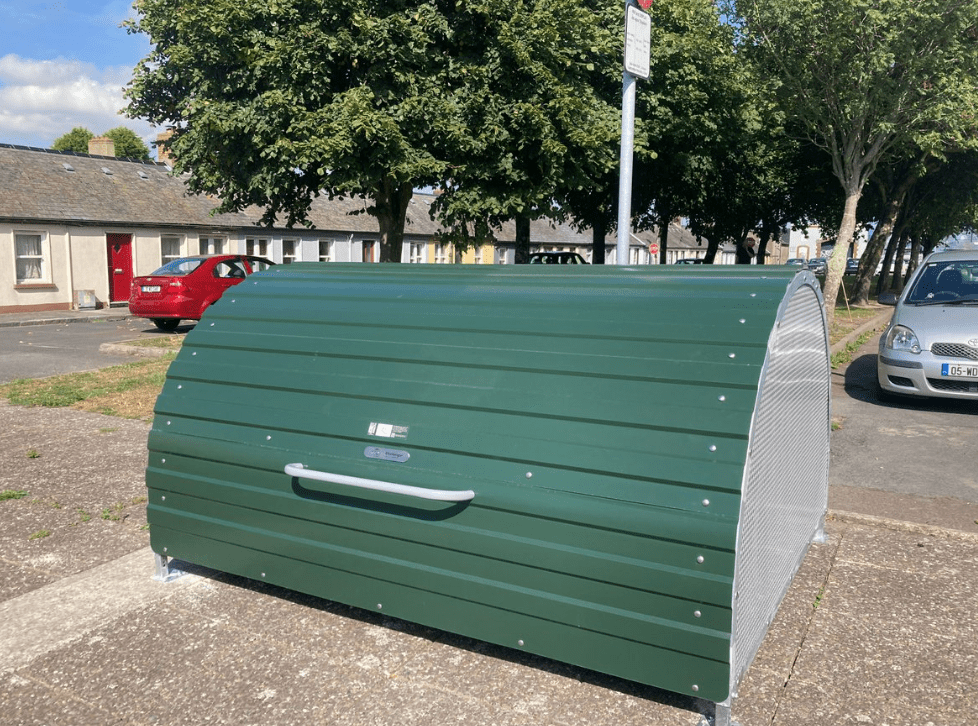
In contrast, Kildare County Council charges an annual fee of €5 for a Resident’s Parking Permit. Admittedly, this does not guarantee a parking place, but it is in effect another subsidy for car owners. It compares to a charge of €100 per year by Dublin City for a place in a bike hanger.

Bollards at Moyglare Road

And still on the theme of parking – Maynooth Cycling Campaign welcomes the erection of bollards adjacent to St. Mary’s Boys School in order to deter parking on the shared path for pedestrians and cyclists. However some drivers, who are slow to take the hint, have simply parked further away. It is time for the Garda Siochana to do their job properly and enforce the law in relation to parking. In Japan, if there is no sign to indicate that you are allowed to park, you have to assume that it is prohibited. Perhaps it is time to introduce this rule to Ireland.

Most Dangerous Junction in Maynooth

Is the Glenroyal junction on the Straffan Road the most dangerous junction in Maynooth for vulnerable road users? On two occasions recently, our attention has been drawn to incidents where drivers leaving the Glenroyal broke red lights at speed and proceeded through a second set of lights narrowly missing pedestrians who had begun to cross the Straffan Road after receiving a green light. 

Is the Glenroyal junction on the Straffan Road the most dangerous junction in Maynooth for vulnerable road users? On two occasions recently, our attention has been drawn to incidents where drivers leaving the Glenroyal broke red lights at speed and proceeded through a second set of lights narrowly missing pedestrians who had begun to cross the Straffan Road after receiving a green light. 

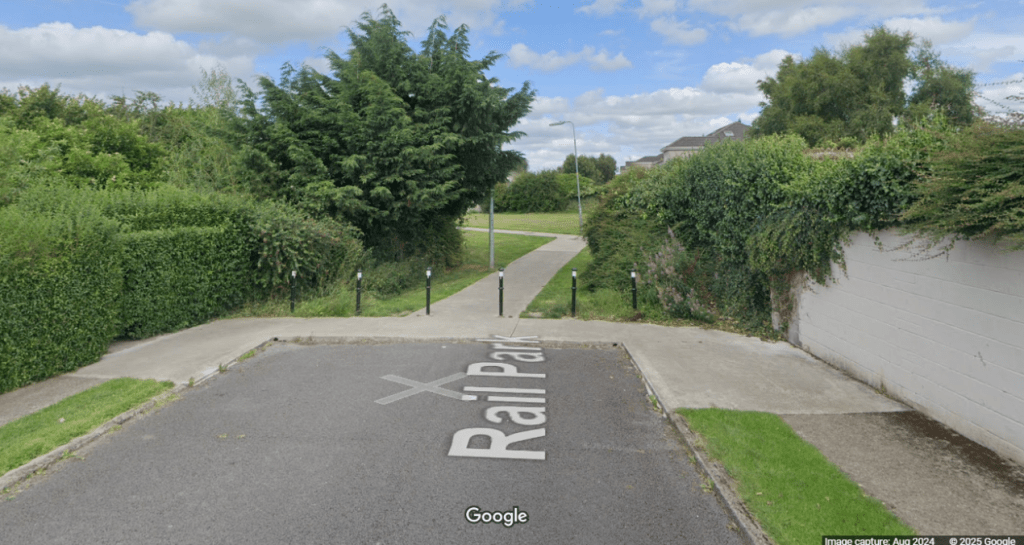
Is Railpark the worst place to live in Maynooth? And is walking and cycling access at fault?

The meetings were called to discuss the impact of proposals in the Maynooth and Environs Local Area Plan 2025-29. The Local Area Plan (LAP) covers a broad range of issues related to the future development of Maynooth. It includes proposals that are designed to contribute to Ireland meeting its commitment to reduce carbon emissions by 50% by 2030. However, many of the discussions focused on pedestrian and cycling permeability – the retrofitting of active travel access through existing adjacent developments, mainly housing estates.

One such proposal linked the Kilcock Road and Crewhill — a new high-density development to the north-west of the town via Maynooth University and the unconnected residential estates of Moyglare Abbey and Moyglare Village.

It was claimed that retrofitting an active travel access would lead to increased anti-social behaviour and increased littering. One attendee quoted an unnamed member of the Garda Síochána who had warned that opening up estates would lead to increased crime. It was claimed that a direct link between Moyglare Abbey and the university would lead to Moyglare Abbey turning into a car park for students. But no such link was even proposed in the LAP. Concerns were also expressed that the openings would be so wide that cars would also be able to use them and that drivers would not see cyclists at a junction due to inadequate sightlines. (For clarity – cars will not be able to use the access points.)

This proposal was designed to provide an alternative to Moyglare Road where, at peak times, there is heavy congestion on crowded footpaths, and many secondary school students cycle on the road instead of an adjacent shared path. At school closing time, traffic queues stretch to nearly a kilometre from the Kilcock Road junction to beyond the GAA clubhouse. It was pointed out that improving permeability would be good for health by reducing air and noise pollution. The high level of traffic congestion would also be reduced, but the mood of the majority who attended the meeting was to oppose the permeability links regardless of any benefits that they might bring.

The irony is that Maynooth residents don’t have to go too far to see good examples of active travel permeability. Most of the estates off the Straffan Road are permeable. On the west side, Kingsbry, Beaufield and Greenfield estates are linked. Parson Hall and Ashleigh are also linked. On the east side, Railpark estate is particularly good as it is linked to both Rockfield and Parklands, as well as having a pedestrian link to the Straffan Road.

If the fears expressed by Moyglare residents are valid, Railpark must be the worst place to live in Maynooth. In fact, it is estates like Moyglare Abbey and Moyglare Hall that are badly designed in regard to mobility. So, the LAP presents a rare opportunity to mitigate the poor outcomes of past planning decisions.

Public consultations are an important part of local democracy. However, democracy is not just about the number of submissions for and against a scheme. The proposal to provide greater permeability and increase active travel has implications for climate change and road safety as well as health in Maynooth. This concerns all the people of Maynooth and not just those who reside close to the proposed openings. The provision of permeability links is a very modest proposal to reduce our carbon emissions.

The backdrop to this includes Ireland still recovering from one of its most severe storms that was linked to two deaths, other European countries suffering extreme climate events involving multiple fatalities, and 2024 was confirmed as the warmest year on record globally. It’s also at a time when the consensus between Europe and the USA on climate is under threat like never before.

Given that the addition of a “relatively” small number of people cycling and walking provokes such opposition from people who are opposed to change and happy with the current status quo, then what will happen when people are asked to make major changes to their lifestyle?

In a recent appeal against a refusal for a proposed wind farm in Laois, the High Court stated that “rapid, far-reaching and unprecedented changes to all aspects of society and the economy” and “an immediate end to business as usual” by consenting authorities is required to cut greenhouse gas emissions and ensure planetary survival.

Maynooth University is an important institution in the town. It is one of the Irish universities that is noted for research on climate change and lecturers there collaborate with their international colleagues. It is disappointing that the university authorities did not consider the LAP important enough to make a submission. It is particularly disappointing as the university is also the biggest single generator of traffic in the town.

Ireland was fortunate to rely on expert medical advice during the Covid epidemic rather than on non-experts. Expert advice on the LAP from the university authorities could have reassured a lot of people who are fearful of or opposed to change.

Local councillors are responsible for approving Local Area Plans, and while they have a responsibility to represent the views of the public, they also have a responsibility to show leadership. Central government ministers and their departments primarily fund local government. Central government also sets down national policies so their views cannot be ignored by local government.

Prior to Christmas 2024, in their submission of amendments to the Draft LAP, the Office of the Planning Regulator, which reviews the performance of planning authorities, recommended that all the permeability links deleted by councillors be reinstated. However, on February 17th, at the meeting of the municipal district on the LAP, councillors voted to proceed with deleting 12 of the 34 walking links and 1 of the 3 cycle links that had been proposed to be abandoned.

With only five years until the next local government elections and one year after that to the 2030 target of a 50% reduction in carbon emissions, the decisions of current councils nationwide will decide where Ireland will stand by the key target date. Kildare is just the latest council to demonstrate the disconnect between government policy and the actions of local councillors. Many groups and individuals will be watching to see how this saga plays out.

This article was edited post publishing to correct an error in the numbers of links for abandonment.

Maynooth Cycling Campaign’s Political Asks

SUMMARY

  1. Celbridge Road – our top priority is for the delivery of improved cycling and walking provision at  Celbridge Road where two primary schools are located.
  2. “Leprechaun” Climate Targets  – for Kildare County Council to get rid of “Leprechaun” Climate Targets -targets which are unachievable as adding up the percentage modes of travel comes to 150% rather than 100% of journeys.
  3. WHO’s H.E.A.T. tool – for Kildare County Council to introduce WHO’s H.E.A.T. tool to calculate the benefits of active travel schemes and to estimate reductions in carbon emissions as carried out in multiple countries.
  4. Reporting of Committee Minutes – for Kildare County Council to publish draft minutes of SPC and Sustainable Transport Forum meetings within 2 weeks as opposed to the current practice of circulating them nearly three months after the meeting.
  5. Kiss the Gates Goodbye – for Kildare County Council (1) to identify substandard accesses to greenways and other active travel routes which are barriers to entry by cyclists and mobility impaired people; and (2) to seek funding for their removal.
  6. Safety Concerns at Moyglare Educational Campus – we support the concerns of the three school principals as detailed in their letter dated 21st April to Kildare County Council re taking in charge, pedestrian crossing, shared paths and Moyglare Road traffic calming.

FURTHER DETAILS

1.         Celbridge Road

Celbridge Road forms part of the R405 regional road. Two primary schools open onto it – with more than 850 pupils attending Gaelscoil Uí Fhiaich and Maynooth Educate Together. Kildare County Council  granted planning to them more than 20 years ago, yet planning permission was granted despite having no cycle facilities and substandard walking facilities. Kildare County Council proposed a scheme some three or four years ago – a design that we opposed on account of its very poor quality. The scheme has been redesigned but now has been held up for reasons of cost.

The EPA in their recent report on progress on meeting 2030 carbon reduction targets stated that even if everything proposed was actually carried out, Ireland’s emissions would still only reduce by 29% instead of 51%.  The continuing failure to provide quality walking and cycling to school cannot be allowed to continue – Celbridge Road should be the number one active travel priority. 

2.         “Leprechaun” Climate Targets 

As part of its action on Climate Change, the Kildare County Development Plan 2023-2029 gives most recent estimates of how Kildare people travel using different modes. It also includes a number of targets for future change in modes of travel.

The baseline figures for existing modes were derived from the Census 2016 results. The baseline figures and proposed targets are as follows:

Mode of Travel To Work  Baseline    Target  

Walking
6%10%
Cycling1%20%
Bus5%13%
Train 5%14%
Car Share4%8%
Car74%50%
TOTAL95%115%
(Note – An estimated 4% of people were working from home giving a total of 99% with a 1% rounding error.)
Mode of Travel To Education  Baseline    Target  
Walk28%50%
Cycling2%15%
Public Transport20%25%
Car50%40%
TOTAL100%130%

The baseline travel percentages are fine. They essentially add up to 100% for travel to work and 100% for travel to education. The Census gives the actual numbers so, if you want, you can combine the work and education numbers and calculate the overall percentages.

The problem is with the targets. At the draft stage of the County Development Plan, Maynooth Cycling Campaign thought that it was an error  but after raising it for a second time, the Council stated that they should be

“…. aiming for as high as possible for the sustainable modes and less high for the unsustainable ones”.

This is true but the targets should also be “reasonable” and “achievable”. They should be challenging for those who have to achieve them but not something so unrealistic that those who have to achieve them, throw in the towel at the start.  The key principle is that the total target  percentages should add up to 100% so if you increase the percentage target for some modes of travel, you MUST decrease the percentage target for other modes of travel. The European Cyclists’ Federation which has more than 40 years of working for increased cycling  has identified monitoring and reporting as a key requirement in effecting modal change.  Adopting modal share percentages in excess of 100% makes no sense except as a “Get Out of Gaol” ticket for the future failure of KCC to deliver on the said targets. It will also impact  unfavourably on Kildare’s contribution to the Irish government’s commitment of a 50% reduction in carbon emissions by 2030.

Leprechaun economics was a term coined by Nobel winning economist Paul Krugman to describe the 26.3 per cent rise in Irish 2015 GDP, later revised to 34.4 per cent. The adoption of Leprechaun targets is related to Leprechaun economics in that both are factual but both have a tenuous link to reality. 

3.         WHO’s H.E.A.T. tool

The World Health Organisation (WHO) developed a spreadsheet to calculate the benefits of active travel schemes and to estimate reductions in carbon emissions.

In Kildare, there is rarely a measurement of existing levels of walking or cycling and no forecast for future use of proposed active travel infrastructure. As a result there is no benchmark to assess the success of a scheme or even to alert if levels of walking or cycling are reduced.

4.         Reporting of Committee Minutes

After committees meetings of, for example, SPC and Sustainable Transport Forum, Kildare County Council circulates draft minutes some 10-12 weeks later to committee members for review, The  minutes are then approved at the next meeting which often takes place 13 weeks after the previous one and may be uploaded to the Council website any time after that. Some minutes are  uploaded quickly afterwards while others are not uploaded unless someone draws attention to their absence.

There is no good reason why draft minutes could not be uploaded to the Council website within 2 weeks of a meeting. The current practice is indicative that the meeting is a talking shop and one where no followup actions are required to be carried out as a matter of urgency.

5.         Kiss the Gates Goodbye

Kildare County  Council, unlike many other local authorities,  has responsibility for very few roads or footways which contain barriers like kissing gates to active travel.

However as a Planning Authority, Kildare County Council has overseen and/or granted permission to Waterways Ireland for substandard accesses on and to the Royal and Grand Canals. In particular, there is a series of substandard accesses which are not to best international practice or meet Irish standards between Leixlip and Kilcock on the Royal Canal Greenway. Recent works on the Royal Canal at Louisa Bridge and on the Grand Canal at Sallins and elsewhere also ignore the advice by the Minister for Transport that accesses should be designed in line with the principles of universal access. The result is that Maynooth Cycling Campaign is unable to travel from Maynooth to Kilcock along the greenway with our Cycling Without Age trishaw.

Kildare County Council should identify substandard accesses to greenways and other active travel routes which are barriers to entry by cyclists and mobility impaired people, and seek funding for their removal.

6.        Safety Concerns at Moyglare Educational Campus

Kildare County Council should consider the concerns expressed by the school principals and propose how best to reduce the risk of harm to pupils.  In our view, Kildare County Council’s  choice of a shared path in a location with very high numbers of pedestrians was predictable – with pupils cycling on the road,  pupils cycling on the footpath opposite intended for pedestrians only and pupils taking alternative on-road routes where possible. Cyclists, elderly pedestrians and disability groups dislike shared paths. In Denmark and the Netherlands, the authorities segregate pedestrians and cyclists because of the risk of a collision arising from the different speeds. If Kildare County Council wants to emulate the level of cycling in such countries, councillors should not approve such schemes except in exceptional circumstances. It is accepted that there are locations where there are no reasonable alternatives.

Bikeweek Film Screening of MOTHERLAND

The screening of the film MOTHERLOAD on Thursday16th, as part of Bikeweek, has regrettably been cancelled. We apologise for any inconvenience.

It is hoped to show it at a later date in the year.

TRANSPORT EMISSIONS CONTINUE IN THE WRONG DIRECTION 

Cyclist.ie Press Release – Urgent Pivots in Policy, Practice and the Sponsorship of Media Programs Needed

Cyclist.ie is incredibly concerned by the latest data released by the Environmental Protection Agency (EPA) that show transport as by far the worst performing sector in Irish society and the economy in terms of tackling its emissions. 

The EPA’s data, as issued on 13 July 2023 (see [1] and [2] below), show that transport emissions increased by 6 per cent in 2022; transport’s emissions were 10.978 Mt CO2 eq in 2021 and this increased to 11.634 Mt CO2 eq in 2022. The EPA reports that “overall higher transport activity – both private cars and freight transport – is eroding the impact of electric vehicles.” 

Cyclist.ie is deeply disturbed by the absence of real and urgent action in transforming our transport system so that we can enter a rapid period of decarbonising the sector. We know from our legally binding sectoral emissions ceilings that transport needs to halve its emissions from 12 MtCO2eq (2018 figures) to 6 MtCO2eq by 2030 [2]. Furthermore, we are all acutely aware that the EPA’s figures have been released in the week that a heat wave is sweeping across parts of southern Europe, and temperatures are expected to surpass 40C (104F) in parts of Spain, France, Greece, Croatia and Turkey. [3] 

National Cycling Coordinator with Cyclist.ie and An Taisce, Dr. Damien Ó Tuama, stated “we are simply on the wrong trajectory with transport. At this point, emissions from transport need to be reducing every single year from here on in – not rising by 6% in a single year”. He continued: “We need rapid action in multiple domains immediately. We need to be increasing further the spend on high quality active travel schemes and the ‘quick-wins’ with enhancing public transport provision. When are we going to see a halt to the domination of our airwaves by adverts urging us to buy ever-bigger Sports Utility Vehicles for our micro-urban trips? When are we going to have our most popular public radio and TV shows not sponsored by car companies with the inevitable framing of ‘normal life’ as being characterised by owning super-sized 2000+ kg metal boxes?” 

Cyclist.ie asks – “where are the political and business leaders articulating a vision of a low carbon future where one can lead a fulfilled life without owning climate destructive personal transport vehicles? Where is the moral leadership on all of this?” Cyclist.ie points to the leadership shown in Paris recently where city hall is to impose higher parking fees on owners of SUVs in its battle to reduce pollution in the capital [4]. Vice-Chairperson of Cyclist.ie, Dave Tobin, added “We need similar policies introduced in Irish cities so as to completely rebalance how mobility happens. Without such urgent action, we are complicit in passing on a burning planetary ball to our children to deal with.” This is the opposite of the mature and responsible approach we now need. 

ENDS

Notes for Editors
Cyclist.ie – the Irish Cycling Advocacy Network, which brings together 35 groups/branches around Ireland who are campaigning locally on cycling safety and promotion, is the organised voice for cycling advocacy in Ireland. It was founded in 2008, building on the campaigning work of its founding member groups, who themselves came into being in the early and mid 1990s in response to the virtual exclusion of cycling and walking from transport policy and practice, and to the massive danger posed to walkers and cyclists by the systematic growth in motorised mobility. https://cyclist.ie/  

[1]  https://www.epa.ie/news-releases/news-releases-2023/irelands-2022-greenhouse-gas-emissions-show-a-welcome-decrease-but-much-work-remains-to-be-done.php 

[2] https://www.epa.ie/our-services/monitoring–assessment/climate-change/ghg/latest-emissions-data/

[3] https://www.bbc.com/news/world-europe-66183069

[4] https://www.gov.ie/en/press-release/dab6d-government-announces-sectoral-emissions-ceilings-setting-ireland-on-a-pathway-to-turn-the-tide-on-climate-change/

[5] https://www.theguardian.com/world/2023/jul/11/paris-charge-suv-drivers-higher-parking-fees-tackle-auto-besity

PICNIC IN THE PARK

Maynooth Community Council working in partnership with Kildare County Council invite you to a great day out, the “Picnic in the Park”, on June 18th-there will be good food, ice cream, face painting, nature walks and various acts. Community groups will have their stalls for you to chat to them about all the wonderful and diverse activities that take place in our town.

With the focus this year is on sustainability and climate action, the event has a serious side and officials from the Climate Action Section will be present. With our interest in the the promotion of cycling as part of decarbonisation of transport, Maynooth Cycling Campaign will be there so if you are passing, why not drop in for a chat and find out our plans fpr the future.

Hangers as a Solution to Bike Storage

On-street parking may be a given for cars, but for bikes, it is not an option due to the threat of theft.  Most homeowners will wheel their bikes around through the side gate for storage in a locked shed, but what are residents in terraced houses or apartments with perhaps shared or first floor entrances to do? The answer is either to store the bicycles in the house, wheel them through living areas or lock them to an outside railing and hope for the best.

For the recreational weekend cyclist, wheeling a very light bike through the house is not a problem, but for commuting cyclists, perhaps with multiple bikes for the school run, this is not feasible to do twice a day.

One solution that has been rolled out by Dublin City Council and more recently by Waterford Council are bike hangers (which are also known as bike bunkers). These hangers are designed to fit in a parking space, have space for eight bikes, and enclose bikes in a lockable hood to allow access to only those with a key.

A solution for Maynooth?

In Maynooth, most housing estates do come with side access, but there are a few areas of terraced housing and high density apartments that this solution is tailor made for. Maynooth Cycling Campaign have approached Councillors with a proposal for a trial installation at Leinster Cottages, just behind the Main Street, with the Councillors and area engineer responding positively with possibly the main barrier being the administrative burden.

There are other bicycle storage solutions in Maynooth at both Tesco and the train station; the one at Tesco is operated by a private company and so is pay by the hour, so unsuitable for long term habitual storage.  The train station lockers are based on a similar model.  Both of these models allot a large enclosed storage area for a single bicycle tenant, and so are aimed at the owners of expensive bicycles, as the alternative of chaining the bicycle to a rack is riskier but free of charge.  They are not a suitable model for households which may have multiple kids bikes and need to store overnight, every night.

Maynooth Cycling Campaign are currently looking for other suitable locations around the town with terraced houses or apartments without street access to a garden.  If you have need for a bike hanger and think that there is a suitable location near you, please let us know at maynoothcycling@gmail.com.

What’s wrong with electric cars? Are they a (small) step forward or a red herring?

Any contemporary discussion about the environmental, health and social problems associated with mass car use will inevitably turn to electric vehicles (EVs). Plainly there may be some advantages to their use compared to that of current petrol or diesel (ICE) cars – but how much? More importantly, does the focus on EVs overall hold the potential for being a major diversion from where our concerns should be, rather than their use being some kind of step forward. Will EVs turn out to be a part of the problem rather than its solution?


What are the advantages of EVs?

(Note: when referring to electric vehicles (EVs) I mean the “best” electric vehicles, namely pure electric rather than hybrid or plug-in hybrid. I also refer essentially to cars and vans, although the same claims for EVs apply to electric motorcycles: there are prospects for electric HGVs, although our concern is now for the replacement of diesel and petrol driven (ICE) cars and vans.)

EVs have three potential advantages over internal combustion engine (ICE) vehicles:
1. Cutting greenhouse gas emissions. By running off electricity potentially produced by fuels (nuclear, solar or other renewables like wind) other than fossil fuels (FFs) like oil, they have the potential to reduce greenhouse gas (GG) emissions. The transport sector is a major contributor to GG emissions, so obviously any reduction in these emissions from it may have the potential for cutting GG emissions overall. This is the principal reason for producing and using EVs. Relatively minor advantages are:
2. Cutting noxious emissions. Eliminating pollutants such as the NOx (nitrogen oxide) gases can play a big part in cleaning up the air we breathe.
3. Reducing noise pollution. While less of a public health problem than the above, this is still an issue. Safety concerns, particularly for visually impaired people, can be addressed by installing (minor) sound making devices to alert other road users.
Other issues are:
4. Energy security. A disadvantage of ICE vehicles is dependence on oil. Although oil is unlikely to “run out”, there are still advantages from not being dependent on oil: however, the UK is far from being self-sufficient in energy and this is not an issue that gets much discussion in current debates.
5. UK employment. At the 2019 Labour Party conference the shadow Chancellor John McDonnell announced a proposal for interest free loans for EV purchase that “will stimulate the automotive industry”. The RDRF does not see that as a reason for supporting EVs – other means can and should be sought to provide employment for motor industry workers.

What EVs do NOT address.

There are a number of problems associated with mass motorisation which EV proponents do not mention. To be fair, these proponents do not claim that EVs will do so, but we need to consider them for two reasons.

Firstly, there is a very real danger that in the rush to embrace a supposedly “clean” (or “cleaner”) “solution” to a problem of mass motor vehicle use these other problems will (continue to be) overlooked or dealt with inadequately. Secondly, there is an even more obvious danger that at least one of the problems – congestion – may be exacerbated by EV uptake to an extent which will minimise a key EV potential advantage, namely GG emission reduction. Since the principal alleged benefit of EVs is GG emission reduction, the most important section will be on this.

1. Road Danger.

Road danger from the (mis)use of motor vehicles is obviously something our organisation is interested in. As our followers know, it is not the same as aggregated “Road Traffic Collision” statistics, and is not being tackled appropriately by Government – not least by the absence of proper quality metrics. It is, above all, a moral issue about the supposed “right” of some road users to endanger, hurt or kill others.

I won’t spend time and space here detailing what road danger means. Suffice it to say that the massive advocacy of EVs seems to be part of a wider assumption that there is a fundamental “right” to drive, which is a key obstacle to reducing danger at source. In addition, we should note that fear of road danger is a key obstacle in achieving the higher levels of walking and cycling required for a genuinely sustainable transport policy.

2. Noxious emissions.

This is a key explanatory image for the EV question – the source of electricity production is critical in assessing the impacts of EVs, particularly with the GG emissions question.
Having said that, even when dirty sources (particularly coal) are used for electricity production for EVs, the noxious emissions from power stations will not have the same adverse effects as they would have from tail pipes, because the power stations are sited further away from people. So the noxious emissions, particularly smog producing NOx, will indeed be less.
That still leaves the fact that EVs release particle pollution into the air from the wearing of tyres, brakes and road surfaces. Already more particle pollution comes from wear than from the exhausts of modern vehicles.

The trend towards open disc brakes rather than sealed drums could be making the situation worse. For the effects of these very small particles see this article . With regenerative braking (where the electric motor puts the EV into reverse) this is supposed to not be so bad – but the extra weight of the batteries could (according to one study ) mean more particle pollution compared with the petrol or diesel vehicles that we buy today. Of course, this may all be alleviated by changes in EV technology in the future.

3. Consumption of space – congestion.

Cars and vans consume enormous amounts of space. This can be for parking, taking away space which could be used for housing, green space, or for other modes of transport when on the road. Or it can be in traffic restricting the efficiency of the journeys of other road users. These problems will remain with EVs, and in fact they could be become greater with the prospect of cheap EVs from China.

But it gets worse. We have to consider the effects of EVs in the general traffic mix, with ICE vehicles still being produced until 2035 (according to the latest Government pronouncements). This means that ICE vehicles will still be around as a major part of the motor traffic mix for another twenty years or so. It is generally assumed that congestion exacerbates the emissions problems of motor traffic (whether GG or noxious) – so for the next decade, or even two decades, the introduction of EVs could contribute to additional emissions as the remaining non-EVs carry on with their emissions.

A key report (if not the key report) is by Professors Phil Goodwin and Jillian Annable (Chapter 4 here ) , whose conclusion is quoted sympathetically in the August 2019 Parliamentary Select Committee’s report on “Clean Growth: Technologies for meeting the U.K.’s emissions reduction targets,”
It is worth quoting in full:

“This chapter reinforces the growing consensus that the ambition in relation to fuel switching and vehicle efficiency could and should be strengthened. We nevertheless question the almost exclusive reliance upon technical improvements for two main reasons.
• The Department for Transport’s (DfT) own scenario forecasts show that the uptake of ULEVs is likely to put upward pressure on traffic growth by lowering the costs of motoring. ‘Clean’ growth involves more than attending to the carbon implications; it means considering the combined effects of continued car dependency leading to more urban sprawl, inactive lifestyles and congestion together with the lifecycle impacts of vehicles and batteries, charging infrastructure, and road and car parking capacity.
• The almost exclusive reliance on technical solutions will only be able to produce the necessary reductions if the DfT’s lower traffic growth futures are assumed. Evidence suggests a lower rate of demand for passenger mobility is credible, but this would require a different policy package to achieve and ‘lock in’ the new demand patterns. Thus, whether we assume underlying high growth trends whereby technological developments cannot hope to mitigate the externalities from traffic demand, or we assume that lower or even negative rates of growth could instead be enabled, a different suite of policies focused on shaping the demand for travel is required.”

4. Physical health of EV users.

The latest major call for a move to active travel – cycling and walking – from sedentary motor vehicle use comes from the BMA in October 2019, who want an annual £1.2 billion  budget for active travel in the UK. We have seen numerous reports on the health risks of inactive travel since Adrian Davis’ report for the BMA “Road Transport and Health” in 1997. Life years lost in the current road transport system are associated primarily with climate change (mostly in the future); inactivity; then noxious emissions and deaths/injuries from road crashes; and investment put into road building and other support for mass motor vehicle use which could go into health care.

Here is just one of many illustrations of the health benefits of shifting from car use to cycling:

5. Local environmental damage and road building.

The amount of space taken by mass motor vehicle usage is evident in the continuing costly programmes to accommodate (and also generate) motor traffic, with inevitable adverse effects on local community and the local environment. Despite warnings for the last half century, the continuing centrality of car dependence leads to urban sprawl and forms of low density development that have adverse environmental effects. For example, it is generally assumed that low density building is more inefficient in terms of provision of energy, and it makes public transport and walking and to some extent cycling) less attractive as transport options.
Also, the processes of building roads and associated infrastructure like car parks are themselves GG emitting processes.

6. Financial cost to society.

Mass motorisation imposes what conventional economists call “external costs” to society. Monetising these adverse effects (damage to public health, the environment, casualties from collisions etc.) is a dubious activity, although decisions on transport projects are often supposedly based on cost benefit analyses that do this. It is, however, worth looking at the costs to society, not least as a part of the dangerous “Road Tax” myth which facilitates motorist entitlement on the basis that drivers have somehow paid for the “right” to drive.

Here I just want to point out that the money paid by drivers has been repeatedly cut by Government since the Conservative/Liberal Democrat regime of 2010, with an amount lost to the Exchequer of some £100 billion. With EVs replacing ICE vehicles that amount would rise again: the mainstream Institute for Fiscal Studies has warned of an extra annual £28 billion loss of revenue:

“Cuts to fuel duties over the last two decades have contributed towards revenues’ being £19bn a year lower than they would have been. Another 2p cut, as reportedly mooted by the prime minister, would cost a further £1bn a year. The bigger challenge is that revenues are now set to disappear entirely over coming decades as we transition to electric cars. The government should set out its long-term plan for taxing driving, before it finds itself with virtually no revenues from driving and no way to correct for the costs – most importantly congestion – that driving imposes on others.”

All of this is without the costs to the Exchequer of road building planned and maintenance that happens without a significant reduction in motor traffic; existing EV subsidy or schemes such as interest free loans for EV buyers suggested by the current Opposition. These costs are also evident in:

7. Provision of a charging network.

Such a network’s installation involves massive cost. It also involves an addition to the demands for scarce street space in urban areas, competing with the needs of other road users. There are other problems with trip hazards highlighted by visually impaired road users.

8. Use of scarce resources

August 2019 Parliamentary Select Committee’s report on “Clean Growth: Technologies for meeting the U.K.’s emissions reduction targets”  refers to the United States Geological Survey which warns of a likely future shortage of the minerals required for electric vehicle batteries. Globally, the supplies of lithium, cobalt, graphite and nickel that could be economically extracted equate to just 30 years of car production at the current rate, but this supply could be adversely impacted by strife in the regions where the minerals are mined. This also applies to other kinds of battery use, including those for e-bikes. Historically fears of resources running out have often proved unjustified, although concerns may be relevant here.

9. Miscellaneous car culture problems.

These are just some of the problems of a car-centred society – here are more:
(a) Personal alienation.
Separation from other human beings and the everyday social interaction that has characterised human societies for millennia is a key feature of car culture. Earlier this year the then Transport Minister Jesse Norman said of EVs:
“Just swapping thirty million petrol and diesel vehicles for thirty million electric ones would do nothing to solve our problems of congestion, obesity, or growing social individualism (my emphasis). In fact, it might well be a policy failure of epic proportions”.

(b) Children’s independent mobility.
The now classic 1990 study by Adams, Hillman and Whitelegg showed how fear of motor traffic has restricted children’s independent mobility with attendant adverse physical and psychological health effects

(c) (Hyper)mobility.
For the wider ramifications of the continued push for ever increasing personal mobility, see the work of John Adams on hypermobility and John Whitelegg 

…and finally:

10. Greenhouse Gas (GG) emissions.

This is, after all, the central justification for the roll out of EVs. I have shown above that introducing EVs into a traffic scenario with no big reduction in overall motor vehicle use will not result in sufficient reduction in GG emissions to meet Government targets (quite apart from the other adverse effects of continuing high levels of mass motorisation). Indeed this is the conclusion of the Labour and Conservative (and one Liberal Democrat and one SNP) MPs in the August 2019 Parliamentary Select Committee’s report on “Clean Growth: Technologies for meeting the U.K.’s emissions reduction targets,”
as well as the academics’ CREDS report .

Let’s look in more detail at what the introduction of EVs means for GG emissions.
A crucial issue is what the energy source is: at present the UK grid has about half its electricity supplied by non-FF sources. We also have to consider the production, transport and disposal emissions involved in the life-cycle (“cradle to grave”) of EVs. So consider this illustration:

(click to enlarge all images)

The CO2 emissions from production and disposal (in blue) mean that even with the energy source being completely from renewables (middle column), CO2 emissions from EVs through their life cycle will be about 30% of a petrol driven car (and about 36% of a diesel car). But we’re a long way from totally renewable energy sourcing: in 2017, at the EU average the EV CO2 emissions were about 75% and 80% that of petrol and diesel cars. At the moment in the UK we are at about a 25% cut in CO2 emissions for an EV compared to petrol driven car. That is not very dramatic in the context that I have described above. So much for “zero emission” cars.

But what about a future where the UK grid becomes more based on non FF sources? Firstly, there is the question of priorities: if we are going to move to cleaner energy, where do we think it is most important that it should be used? Energy is used primarily for domestic (heating, lighting, cooking etc.) use; then there are industrial, commercial uses, street lighting, powering railways etc. Are these uses not more important than personal motor vehicular transport? So here’s a thought: if we are to have EVs, shouldn’t their owners pay the full costs of the additional “clean” energy that they would have to use in order to fulfil their potential? (When I say “costs” I mean the costs of installing and operating the solar/wind/wave or whatever green energy source is used – also, why not internalise the external costs, such as disruption to local communities of building the power stations?).

Then there’s the issue of exactly how much reduction in GG emissions we should be aiming for. Even if we go for an officially agreed target such as the Paris accords, and press for international agreements to be supported globally, such targets are inevitably compromises. Furthermore, there will be plenty of debate (see for example this discussion) as to whether we are actually progressing towards these targets, as the Government claims that we are. And all this is without questioning claims such as the supposed “zero-emissions” of nuclear power (as done e.g. by Jacobson ).

So, in summary, GG emission reduction from EVs is minimal and cut further by not reducing the amount of motor traffic including ICE vehicles or making changes (such as higher density housing) to be part of that reduction.

(One more point: any meaningful discussion about climate change has to look at us as members of the world population. If we assume that adults in the UK should have the easily available use of motor vehicles, there is no reason why people in other countries should not. In the UK we have about one car for every two people. Very roughly calculated, there are about 1.2 billion cars in a world populated by 7.6 billion people, or one for every six people. Bringing the world’s population “up” to UK levels would mean an extra 2.5 billion cars on the planet (with associated roads and infrastructure). That is impossible with any realistic attempt to cut GG emissions.)

Red herrings and the driver sense of entitlement.

Let’s look at the context into which EVs are being introduced: it is one of a culture where the unwarranted domination by the car is taken for granted by all too many. Indeed, the word “culture” in its sociological or anthropological sense directs us to precisely the unstated assumptions of a society. Our job is to highlight and criticise those background assumptions.

Consider the response to the UK Government’s consultation on introducing EVs (including green number plates for EVs) in October 2019 from the RAC:

While the sentiment seems right, there are question marks as to whether drivers would see this as a badge of honour or alternatively it could foster resentment among existing drivers of petrol and diesel vehicles. Incentives may make a difference in the short term and the possibility of free parking and the permission to use bus lanes at certain times could encourage some to switch, however many drivers remain cool on the idea even with this encouragement.”
“We continue to believe that the best way of encouraging drivers to ‘go electric’ is for the Government to be providing the right financial incentives at the point of purchase, and investing in better charging infrastructure.

In other words, we are supposed to worry that drivers may “feel resentment” by seeing green number plates on some vehicles, reminding them that their vehicle pollutes even more. We should also expect drivers to want even more money being given to them (“right financial incentives”), as well as even more perks such as use of bus lanes and extra subsidy for parking, and for them to feel even more unhappy (“cool”) if they don’t get them! Such is driver entitlement – an entitlement which in our view is utterly unjustified.

Or see the comments from the Minister:

Local Transport Today (LTT 784 25/10/2019)

Note that he thinks there is ‘Absolutely no disadvantage at all’, despite everything I have pointed out above, and key elements of which (such as the August 2019 Parliamentary Select Committee’s report on “Clean Growth”) he would be sure to know about. Also, the traditional car supremacist assumption that “everybody” drives: about a quarter of the UK adult population does not have a full driving licence, with plenty of licence holders not having access to a car and yet more not driving as their form of transport on any given day. Yet we are supposed to think that “most people” will be driving EVs in a “very short period of time”.

Now, when he spoke to the same Select Committee on 16th October 2019 (referred to here ) he said he was very keen to support cycling – but cycling remains at a tiny modal share with no obviously appropriate level of investment to genuinely support cycling as an everyday form of transport, while the foreground is full of support of EVs, as well as the actual or proposed investment behind them.

And that’s the whole point. What is actually happening is that sustainability and active travel get the fine words – and have done by Ministers to no adequate effect for some 35 years (in 1984 I was at a conference where the then Minister, Lynda Chalker, promised to “encourage” cycling) with minimal genuine support – while motoring gets the actual support.

The red herring effect is already visible. EV drivers have the prospect of extra free parking and use of bus lanes, as well as consideration of a higher speed limit on motorways. But this effect goes much deeper than that. Throughout my career I have been informed by drivers that they are “good drivers” because they don’t drink and drive, or that they are sensitive to the environment because their car is “small”. Any actual or alleged alleviation of a problem created by driving is seen as some sort benevolent progress which should allow further pampering of the motorist, or at the least a refusal to criticise the transport status quo. At present that looks very much like happening with EVs.

Or consider the transport activist Joe Dunckley’s tweet:
“The general/media narrative lately seems to have taken to treating private transport emissions as if that problem can be ignored now, because [waves hands] “electric cars are coming”, without ever checking that the problem is not in fact getting worse.”

The context for his tweet is the news about the massive contribution to emissions of various kinds from SUVs  – we have had more fuel efficient ICE cars for a while, but without the necessary restrictions on car ownership and use (particularly cost) we end up with mass SUV use. Such is the effect of red herring trailing. Then there is the Director of the so-called “Green Alliance” calling for the Minister to “make EVs available to everyone.

EVs in this context are thus set to become very much part of the problems of mass motorisation.

Trailing a red herring: The term was popularized in 1807 by English essayist William Cobbett, who told a story of having used a kipper to divert hounds from chasing a hare.

So should we oppose the introduction of EVs?

EVs could be part of a sustainable and healthy future transport scenario, but only if a number of conditions are met. If there is:

• The introduction of a well-integrated and appropriately financed transport strategy. This would be based on the significant reduction in car, van, taxi and motorcycle mileage and a reduction in their modal share, with a big increase in walking, cycling, and public transport modes.

• The financial costs of new green energy supply required to fuel EVs being fully met by the driver and/or owner, with additional internalisation of external costs (such as effects on the local environment of installing new power stations) meaning that drivers pay an additional nominal sum as well. If ICE vehicles were then to become obviously cheaper and more attractive, their price (and other restrictions on their use would have to be increased).

• Space re-allocation from motor vehicles to walking, cycling and public transport (through low car access housing and retail developments, introduction of protected cycle lanes, reduction in car parking at current origins and destinations, widespread filtered permeability, bus lanes etc.)

• High level traffic law enforcement targeting those most likely to endanger others on the road, backed up by well publicised deterrent sentencing.

• Proper financing for local public transport, as well as for cycling and walking.

– then the remaining cars (often through shared car schemes), vans and taxis could be EVs – but there would be far fewer of them and doing much lower mileage than at present.  Earlier this year Transport for Quality of Life suggested that for net zero emissions by 2045,  the level of traffic reduction needed by 2030 should be anywhere between 20% and 60%, depending on factors including the speed of the switch to electric vehicles and how fast the electricity powering them is decarbonised.

That is a very big “if”. There are those such as Cllr. Jon Burke of LB Hackney  who plan a roll out of on-street charging – but also plan a 25% reduction in car ownership in the Borough and oppose additional subsidy to EVs. That kind of thinking could work, but is regrettably the exception which proves the rule. There are also issues such as how to price ICE vehicles at the same time – increasing their costs as well.

But those issues need to be confronted and are not even apparently part of Governmental thinking. As John Dales  puts it : “No one with real authority and power seems to be driving the comprehensive change in transport and travel that the environmental, public health, population growth and economic challenges we face demand.”

Conclusion

Photo: Getty Images: Sean Gladwell

Are you thinking of buying an EV? Our society would be far better off if you drove your current car much less (and more carefully) than you do now. Much more importantly, you need to campaign for a society with real (financial and other) disincentives to drive and incentives to use the sustainable and healthy alternatives. If you already drive the least possible amount and shift to an EV, remember that benefits in terms of greenhouse gas and noxious emissions are small.
With the current transport status quo, even significant changes to EVs will have small beneficial results for the reasons explained above, as well as not confronting most of the main problems associated with mass car use.

Unless that status quo changes – and the indicators are not good – then EVs will be part of the problem, although with the changes I have indicated necessary in place, they could be a (small) part of the solution. And if buying an EV now gives you that nice warm feeling from doing something you think is good, then the red herring will have been very effectively trailed.

Dr Robert Davis, Chair RDRF , 28/10/2019
Global Coalition Calls on Governments at COP26 to Boost Cycling Levels

(ECF Press Release)

Today, the European Cyclists’ Federation (ECF) and a global coalition of pro-cycling organisations are publishing an open letter calling on governments attending COP26 in Glasgow to commit to significantly increasing the number of people who cycle in their countries in order to reach global climate goals quickly and effectively.

The world needs much more cycling if we are to combat climate change. Without quicker and more determined action by governments worldwide to cut transport carbon emissions, we will be dooming present and future generations to a world that is more hostile and much less inhabitable.

CO₂ emissions from the transport sector continue to increase. Meanwhile, the transition to zero-emission cars and trucks will take decades to complete and will not solve other problems like traffic congestion and sedentary lifestyles. Despite this, COP26 Transport Day on 10 November is set to focus exclusively on the electrification of road vehicles as a solution to the climate crisis we are facing today.

ECF and its allies believe cycling represents one of humanity’s greatest hopes for a shift towards a zero-carbon future. Bicycle use produces zero emissions, delivers far-reaching positive societal impacts and – most importantly – is a technology that is already widely available today. The world cannot afford to wait decades for fossil-fuel cars to be fully phased out and replaced by electric vehicles. We must urgently leverage the solutions that cycling offers by radically scaling up its use.

The signatories to the open letter call on governments and leaders attending COP26 to declare commitments to significantly boost cycling levels at home and collectively commit to achieving a global target of higher cycling levels. The letter was sent to governments and transport ministers ahead of COP26. 

Jill Warren, CEO of the European Cyclists’ Federation: “There is no conceivable way for governments to reduce CO₂ emissions quickly enough to avoid the worst of the climate crisis without significantly more cycling. The devastating effects of accelerating global warming should be clear to everyone, and boosting cycling levels is the best way to quickly cut carbon emissions from transport on a massive scale.”

Henk Swarttouw, President of European Cyclists’ Federation and of the World Cycling Alliance: “Cycling should be a cornerstone of global, national and local strategies to meet net-zero carbon targets. At COP26, governments must commit to providing the financing and legislation for safe and equitable space for cycling everywhere. Citizens are ready for the change; now our leaders need to enable it.”

About the European Cyclists’ Federation:

With over 60 member organisations across more than 40 countries, the European Cyclists’ Federation (ECF) is the world’s largest and best-known cyclists’ advocacy organisation. Our aim is to improve and increase cycling by influencing policy and harnessing the power of the European cycling movements.

ACTIVE TRAVEL COALITION CALLS FOR FASTER ROLLOUT OF CYCLE ROUTES

Active Travel Coalition Press Release – for Immediate Use

In the lead-up to COP26, and the World Health Organisation’s call for more cycling to improve health through increased physical activity and improved air quality [1], a newly-formed Active Travel Coalition is today seeking urgent action on the rollout of safe cycle routes nationwide.

The Active Travel Coalition is bringing together health, medical, environmental and cycling campaigners to call on the Irish government to show leadership on cycle infrastructure to enable families make the switch from the car to active travel modes of walking & cycling.

The coalition says that many people want to make the switch to cycling but are put off by the lack of safe, segregated cycle routes.

The Active Travel Coalition is seeking:

●        Faster rollout of the proposed high-quality ‘Safe Routes to School’ cycle path network.

●        Trial infrastructural change legislation & re-allocation of road space for walking & cycling.

●        Commitment from local and national politicians to lead the move to greater Active Travel.

●        Continued strong funding coupled with rigorous oversight for safe cycle route development.

●        Creation of networks of cycle routes, not just one-off routes that don’t interconnect.

Between 1991 and 2016 walking and cycling to school in Dublin fell from 64% to 46% while the percentage being driven to school increased from 17% to 41% [2]. Dr. Una May, Director of Participation and Ethics at Sport Ireland said “Sport Ireland research [3] shows that only 1 in 3 adults and 1 in 5 children meet recommended daily physical activity levels. Reaching the physical activity guidelines will require a mix of sport, recreational physical activity and regular active travel. Investments in active travel infrastructure can increase cycling to school and work, helping increase the number of children and adults meeting the recommended daily physical activity levels.”

According to Mark Murphy, advocacy officer with the Irish Heart Foundation, “30 minutes of moderate intensity activity, such as walking or cycling, five days a week, reduces your risk of developing heart disease and stroke, and contributes to overall improved levels of health. However, we know that if we want more people cycling, particularly school children, we need a major expansion of safe cycling tracks”.

Ireland’s policy is to reduce carbon emissions in 2050 by 80% on 1990 levels. Oisín Coghlan from Friends of the Earth says “transport accounts for 20% of emissions in Ireland. Given our carbon reduction targets in transport, a modal shift away from the private car is needed towards sustainable modes. Segregated cycle tracks, particularly in Dublin, are urgently needed to support this”.

Research from the National Transport Authority shows that 11% of adults cycle daily in Dublin but 46% would like to cycle or cycle more if they felt safer [4]. Dublin Cycling Campaign’s David Timoney says that we know from research and from the cycle traffic on the Grand Canal and Dun Laoghaire & Seapoint cycle tracks that segregated routes enable people of all ages and abilities to cycle.”

Dr. Sean Owens from the Irish College of General Practitioners says “the strongest evidence for reduced incidence of diabetes, obesity & cardiovascular disease is lifestyle measures centred around physical activity and healthy diets. Getting our patients, our families and our staff on their bikes for pleasure, or for a commute, is a triple win; better health for patients and families, better for the environment and better value for the public purse”.

Only 1 in 4 adults and 1 in 10 teenagers who cycle in Dublin are female. Mairead Forsythe from ‘Women on Wheels’ says that “the figures show a major gender gap in cycling in Dublin and while the barriers to more women and girls cycling are varied, the number 1 barrier is fear of mixing with motor traffic.”

Colm Ryder from Cyclist.ie and the Rural Cycling Collective adds that “In many areas developing cycle infrastructure will require a re-allocation of road space from the motor vehicle to active travel. We need to adapt our private car use to achieve the critical goals of an improved and safer public realm and more efficient movement of people around our towns, cities and rural areas“.

*The Active Travel Coalition consist of the following organisations:

Irish Heart Foundation, Irish Cancer Society, Diabetes Ireland, Irish College of General Practitioners, Sport Ireland, Cyclist.ie, Dublin Cycling Campaign, Women on Wheels, Irish Pedestrian Network, Friends of the Earth, Irish Doctors for the Environment & Faculty of Sports & Exercise Medicine (RCPI & RCSI).

For further information contact:

Dublin Cycling Campaign: David Timoney (083.333.9283 & davidtimoney@yahoo.com).

Cyclist.ie: Colm Ryder (087.237.6130 & colmryder@gmail.com)

ENDS

[1] https://www.euro.who.int/en/health-topics/environment-and-health/Transport-and-health/news/news/2021/6/promoting-cycling-can-save-lives-and-advance-health-across-europe-through-improved-air-quality-and-increased-physical-activity

[2] https://www.cso.ie/en/index.html

[3] Sport Ireland 2018 CSPPA and 2019 ISM studies.

[4] https://www.nationaltransport.ie/bike-life-2019-dublin-metropolitan-area/