ACTIVE TRAVEL COALITION CALLS FOR FASTER ROLLOUT OF CYCLE ROUTES

Active Travel Coalition Press Release – for Immediate Use

In the lead-up to COP26, and the World Health Organisation’s call for more cycling to improve health through increased physical activity and improved air quality [1], a newly-formed Active Travel Coalition is today seeking urgent action on the rollout of safe cycle routes nationwide.

The Active Travel Coalition is bringing together health, medical, environmental and cycling campaigners to call on the Irish government to show leadership on cycle infrastructure to enable families make the switch from the car to active travel modes of walking & cycling.

The coalition says that many people want to make the switch to cycling but are put off by the lack of safe, segregated cycle routes.

The Active Travel Coalition is seeking:

●        Faster rollout of the proposed high-quality ‘Safe Routes to School’ cycle path network.

●        Trial infrastructural change legislation & re-allocation of road space for walking & cycling.

●        Commitment from local and national politicians to lead the move to greater Active Travel.

●        Continued strong funding coupled with rigorous oversight for safe cycle route development.

●        Creation of networks of cycle routes, not just one-off routes that don’t interconnect.

Between 1991 and 2016 walking and cycling to school in Dublin fell from 64% to 46% while the percentage being driven to school increased from 17% to 41% [2]. Dr. Una May, Director of Participation and Ethics at Sport Ireland said “Sport Ireland research [3] shows that only 1 in 3 adults and 1 in 5 children meet recommended daily physical activity levels. Reaching the physical activity guidelines will require a mix of sport, recreational physical activity and regular active travel. Investments in active travel infrastructure can increase cycling to school and work, helping increase the number of children and adults meeting the recommended daily physical activity levels.”

According to Mark Murphy, advocacy officer with the Irish Heart Foundation, “30 minutes of moderate intensity activity, such as walking or cycling, five days a week, reduces your risk of developing heart disease and stroke, and contributes to overall improved levels of health. However, we know that if we want more people cycling, particularly school children, we need a major expansion of safe cycling tracks”.

Ireland’s policy is to reduce carbon emissions in 2050 by 80% on 1990 levels. Oisín Coghlan from Friends of the Earth says “transport accounts for 20% of emissions in Ireland. Given our carbon reduction targets in transport, a modal shift away from the private car is needed towards sustainable modes. Segregated cycle tracks, particularly in Dublin, are urgently needed to support this”.

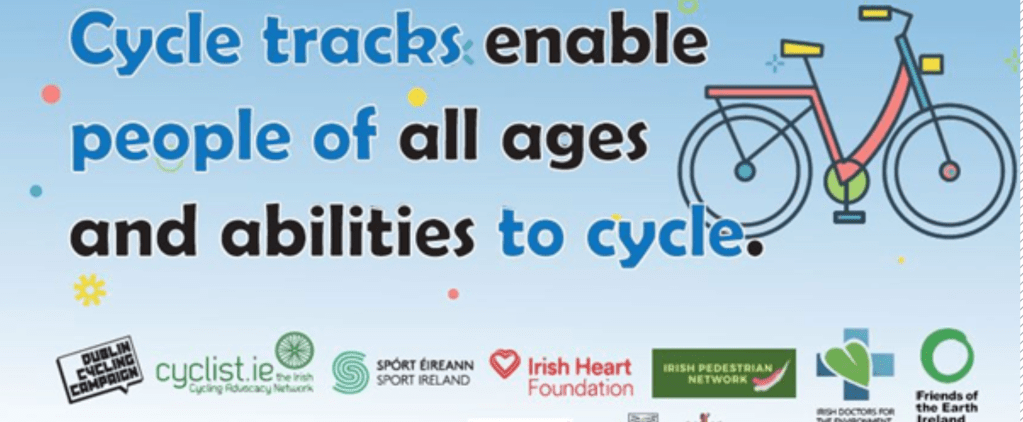
Research from the National Transport Authority shows that 11% of adults cycle daily in Dublin but 46% would like to cycle or cycle more if they felt safer [4]. Dublin Cycling Campaign’s David Timoney says that we know from research and from the cycle traffic on the Grand Canal and Dun Laoghaire & Seapoint cycle tracks that segregated routes enable people of all ages and abilities to cycle.”

Dr. Sean Owens from the Irish College of General Practitioners says “the strongest evidence for reduced incidence of diabetes, obesity & cardiovascular disease is lifestyle measures centred around physical activity and healthy diets. Getting our patients, our families and our staff on their bikes for pleasure, or for a commute, is a triple win; better health for patients and families, better for the environment and better value for the public purse”.

Only 1 in 4 adults and 1 in 10 teenagers who cycle in Dublin are female. Mairead Forsythe from ‘Women on Wheels’ says that “the figures show a major gender gap in cycling in Dublin and while the barriers to more women and girls cycling are varied, the number 1 barrier is fear of mixing with motor traffic.”

Colm Ryder from Cyclist.ie and the Rural Cycling Collective adds that “In many areas developing cycle infrastructure will require a re-allocation of road space from the motor vehicle to active travel. We need to adapt our private car use to achieve the critical goals of an improved and safer public realm and more efficient movement of people around our towns, cities and rural areas“.

*The Active Travel Coalition consist of the following organisations:

Irish Heart Foundation, Irish Cancer Society, Diabetes Ireland, Irish College of General Practitioners, Sport Ireland, Cyclist.ie, Dublin Cycling Campaign, Women on Wheels, Irish Pedestrian Network, Friends of the Earth, Irish Doctors for the Environment & Faculty of Sports & Exercise Medicine (RCPI & RCSI).

For further information contact:

Dublin Cycling Campaign: David Timoney (083.333.9283 & davidtimoney@yahoo.com).

Cyclist.ie: Colm Ryder (087.237.6130 & colmryder@gmail.com)

ENDS

[1] https://www.euro.who.int/en/health-topics/environment-and-health/Transport-and-health/news/news/2021/6/promoting-cycling-can-save-lives-and-advance-health-across-europe-through-improved-air-quality-and-increased-physical-activity

[2] https://www.cso.ie/en/index.html

[3] Sport Ireland 2018 CSPPA and 2019 ISM studies.

[4] https://www.nationaltransport.ie/bike-life-2019-dublin-metropolitan-area/

Model for Cycling in Rural Ireland now needs Cash Injection

Clon Bikes

Today, Clonakilty is best known for its black pudding and its characteristic Irish architecture. It possesses no greenways or cycle lanes but despite this, the people of Clonakilty have come together as a community to promote cycling in a way that would put to shame government supported SmarterTravel towns such as Westport or Dungarvan. It holds an annual Bike Festival (just over) which went global this year. It has its own community bike workshop ‘The Bike Circus’ which also runs an active apprenticeship program. The town has a chapter of Cycling without Age/Wind in Your Hair and has its own Trio E-bike which they use to bring out elderly and sick from hospital or nursing homes. The most remarkable aspect of the cycling culture of the town, however, is that they have their own bike share with almost no financial assistance from Cork County Council or the Department of Transport, Tourism and Sport.

Tom O’Donovan of O’Donovan’s Hotel was one of the founders who established the Clonakilty Bike Share 6 years ago with some 60 bikes. He recalls that Cork County Council refused to give them public space for bike hubs so a number of hotels offered a section of their car parking area. With contributions from the hotels and private local sponsors and a small financial contribution from government bodies, they purchased bicycles, paid for parking racks and developed a website through which people could book and pay for renting. Most of the work was carried out by community volunteers so any money raised from renting was reinvested in the scheme. While the bike scheme originated in Clonakilty, it soon spread out to hotels in a number of locations across West Cork as far as Courtmacsherry and Rosscarbery. The scheme allowed users to stay overnight in different places and ensured that more money was retained in the local community than from individual day trippers.

Clonakilty also procured funding to erect directional signage designating a number of nearby cycling routes along quiet roads. Although funding has been available from late 2018 the County Council Area Engineer refuses to erect the signage as he is concerned about the legal consequences to Cork County Council of encouraging cycling on quiet roads. (Apparently, he has no concerns about the consequences to the Council of cyclists travelling on heavily trafficked national or regional roads). The Area Engineer and his Senior Engineer, want an independent safety assessor to tell them that it is safe before they agree to erect the signage. If they have such doubts about the safety of the roads, it is potentially negligent for them not to alert the public in general and cyclists in particular as to the nature of hazard and the risks of exposure.

The Clonakilty bike share was already facing increased maintenance costs due to an ageing fleet of bikes. Now, the rising cost of insurance is the straw that breaks the camel’s back and Clonakilty has been forced to shelve its bike share. Clonakilty is a model for a small community based cycling town. At a time when

(1)  A new Programme for Government prioritising cycling has been agreed
(2)  Over €1 million has been invested in bike share schemes in Cork, Limerick and Galway
(3)  Due to Covid-19, the health authorities urge people to walk or cycle where possible,
4)  The NTA are offering funding to encourage active travel and
5)  Cork City proposes to expand its bike share,

it is ironic that the Clonakilty bike share would be allowed to fail. While West Cork politicians have been vocal in their support, Clonakilty has received almost no state funding. Clonakilty’s most famous cyclist is of course Michael Collins who was born nearby. Looking down from heaven (or up from the other place if that is your politics), what must he think of Cork County Council and current councillors.

PRESS RELEASE Cyclist.ie Welcomes the Programme for Government Commitment to Active Travel

Cyclist.ie, the Irish Cycling Advocacy Network, has been calling for a revolution in the funding of cycling and walking for many years. We are seeking a 10% allocation for cycling from our government’s transport budgets.

We are delighted to see that the initial figures emerging from the government formation talks appear to have recognised this urgent need to invest in ‘active travel’ (walking and cycling) by allocating €360 million per annum towards cycling and walking schemes [1]. Cyclist.ie welcomes this commitment.

Cyclist.ie has consistently highlighted the multiple benefits of investing in cycling – across economic, societal and environmental headings. On the public health side, regular cycling for everyday journeys builds exercise into our busy lives and it can be easier to maintain compared to recreational physical activity. Economically, each kilometre driven by a car incurs an external cost of €0.11, whereas cycling and walking bring benefits of €0.18 and €0.37 per kilometre, respectively (see New study reveals the social benefits of cycling and walking in the EU). On the emissions reduction front and responding to the Paris Climate Agreement, cycling and walking are an essential part of the solution in decarbonising our mobility system and hence are a critical part of the overall transport mix. This has been recognised in many progressive countries in North West Europe since the mid 1970s.

It is estimated that spending on cycling currently amounts to less than 2% of transport capital spending, as shown in Cyclist.ie’s 2020 Budget submission. Meanwhile the Third Report and Recommendations of the Citizens’ Assembly, the Joint Oireachtas Committee on Climate Action [https://data.oireachtas.ie/ie/oireachtas/committee/dail/32/joint_committee_on_climate_action/reports/2019/2019-03-28_report-climate-change-a-cross-party-consensus-for-action_en.pdf] and the 2019 Climate Action Plan all endorsed the spending of 10% of the transport budget on cycling.

Our expectations are that this funding will be spent on high quality cycling infrastructure in our towns and cities so that we can grow cycling to levels common in many continental countries. We also urgently need to redress the gender balance in cycling (currently only 27% of all persons commuting are female, as per Census 2016 data). As Dr. Damien Ó Tuama, National Cycling Coordinator with Cyclist.ie summed it up, “we need to renormalise cycling to the shops, to school, to work and for other daily activities”.


Open Letter to KCC : CHANGE OUR STREETS – MAKE SAFER STREETS FOR ALL

NOTE If you like the NEW NORM with reduced traffic and more Kildare people walking and cycling, we invite you to email maynoothcycling@gmail.com (or Shamrock Spring at shamrockspring@gmail.com) to demonstrate your support for Change Our Streets. We will add your name to the list of supporters.

Make Walking And Cycling Safer To Go To Work, To Shops And Pharmacies, To Volunteer And To Exercise


Dear Mr. Carey,

We are an alliance of Kildare groups and residents, led by Maynooth Cycling Campaign and Kildare Environmental Network. We live, work, trade or shop in Kildare. We want our Council to urgently Change Our Streets by reallocating space for people on foot and on bikes during this long COVID-19 pandemic and beyond.

We want to express sympathy with those who have died of COVID-19, their families, friends, and colleagues. Using our expertise in road safety to help ease social anxieties around social distancing, we wish to give support to people with an added reason to walk or cycle.

The World Health Organisation (WHO) says that ‘whenever feasible, consider riding a bicycle or walking to provide physical distancing and daily physical activity’ during the COVID-19 emergency. In Ireland, we have seven exceptions to the ‘Stay at Home Order’, including exercising within 5 km from home.

We want safer streets for all ages and all abilities in our ‘new normal’. We are supported by doctors, nurses, health professionals, resident associations, community groups, businesses and associations. [Note: health professionals – to be finalised]

We have two requests to reduce preventable deaths and injuries, and create pedestrian- and cycle-friendly streets:

1.    Reallocate road space to people walking and cycling.
2.    Temporarily lower the speed limit to 30 km/h in urban areas.

We ask that Kildare County Council arranges a Transport SPC meeting as a matter of urgency and that the agenda be devoted to Change Our Streets. [Note: This paragraph to be finalised]

How COVID-19 Impacts on the Use Of Public Space

  • An increasing number of Kildare residents live in apartments with no access to a private garden. Over 9% of households in Kildare do not have access to a car. Children need 60 minutes of daily exercise. Access to green and blue spaces has detectable mental and physical health benefits.
  • There is an increase in individuals and families walking and cycling in their local areas, whether for exercise or essential journeys. 
  • Healthcare workers and other essential workers have reported incidents of feeling unsafe while walking or cycling to work.
  • There is a lack of space for social distancing across the county for people walking and cycling. Narrow footpaths and painted cycle lanes do not provide the space to adhere to HSE social distancing guidelines.
  • There are road safety issues with the reduced vehicle traffic. Most significant of which is speeding but also red light breaking and phone use by motorists.
  • People queuing outside shops that have in-store limits, are lining up on narrow footpaths next to wide roads with multiple parking and driving lanes.
  • Public transport numbers are down as people stay home. There is a risk that levels of private car traffic may increase sharply in the intervening period before a vaccine is found and widely distributed.
  • With an increase in unemployment, and good summer weather ahead, the bicycle offers an affordable transport option to many who may not have considered cycling to date.
  • The demand for parking has drastically reduced.

Kildare County Council has closed or restricted access to playgrounds, skateparks and outdoor gyms, even to people living within 5 km. Residents of places with natural beauty are concerned that people in groups are travelling by car to these pleasant places for exercise.


Make Safer Streets for All – Reallocating Road Space to People Walking and Cycling
Expedient, wide-ranging action will reconfigure Kildare’s public spaces to decrease public health risk, social anxiety and the risk of increased traffic levels as the restrictions begin to be lifted over the coming months and years.

These types of measures have already been rolled out internationally, especially in the German capital Berlin. In Ireland, Dublin City and Fingal County councils have started to reallocate road space.

We ask Kildare County Council to implement temporary measures, including:

  • Install temporary cycle lanes along the key traffic routes where feasible.
    • Example: Main Street Newbridge, Main Street Celbridge, Newbridge Road Naas and Dublin Road Maynooth
  • Widen or introduce footpaths using cones on busy streets, outside lines of shops or areas with queues, or thoroughfares to shops and essential businesses. This may need the reallocation of space from on-street parking and loading bays.
    • Example: SuperValu Main Street South, Naas.
  • Temporary use of cones, bollards and planters to filter through-traffic in housing estates, and so make roads safe for children playing and people exercising.
    • Examples: Laurence’s Avenue and Rail Park Maynooth, and Monread Naas.
  • Automate pedestrian signal crossings during daylight hours and increase pedestrian crossing times in urban areas. Add signage to prevent people pressing the buttons.
    • Example: as Greystones Municipal District and other councils have done.
  • Temporary suspension of extra lanes alongside roads with shared walking / cycling facilities or narrow footpaths. Turn the extra lane into a barrier / cone-protected cycle lane and, if shared facilities are present, temporarily designate the shared facilities as pedestrian-only.
    • Examples: New Caragh Road Naas adjacent to the Newbridge Road.
  • Removal of turn right lanes where footpaths are narrow and/or there is no cycle facility.
    • Example: New Caragh Road Naas adjacent to Newbridge Road
  • Revise traffic management arrangements in order to change a two way road with no cycle facilities with a one way road and two cycle lanes (one a contra-flow cycle lane).
    • Example Newtown Road, Maynooth
  • Temporary pedestrianisation of roads and creating ‘quiet streets’ to connect residences and essential destinations.

Lower the Speed Limits
In relation to urban areas, we request the introduction of a temporary blanket 30 km/h speed limit on all local and regional roads during the pandemic. In addition, drop the speed limit on roads with 60 km/h areas to 50 km/h and 80 km/h to 60 km/h. This will make walking and cycling more pleasant, reduce the risk of collisions, and reduce the severity of injury on impact, should any collisions occur. Professor John Crown of St Vincent’s University Hospital has made a similar call.

The Isle of Man introduced a temporary speed limit island-wide to 40 mph at the end of March, following NHS doctors stating that this is the number one action to ‘lower the baseline’ of critical care admissions.

Brussels will introduce a city centre speed limit of 20 km/h from May 1 until the end of August. Milan’s ambitious Strade Aperte (Open Streets) plan has 20 km/h speed limits at its heart. This is to make living in urban areas more pleasant during the coronavirus.

Change Our Streets – Make Safer Streets For All
The Minister for Health says that physical distancing measures will be with us until a vaccine is available. We know that this will, at least, be months from now.

In general, please:
• Keep stable or expand the resources budgeted for footpath and cycling schemes.
• Bringing forward of timelines for National Transport Authority cycling schemes.
• Include footpath widening as part of footpath repair schemes.
• Include reallocation of space as part of road maintenance schemes.

This COVID-19 crisis offers a unique opportunity to implement and trial low or zero-cost solutions for a more resilient, pleasant and accessible public realm in Maynooth and other urban centres in Kildare. We can create a liveable city whose streetscape is designed with empathy and flexibility for the mental and physical wellbeing of all who live here.

We, the undersigned, strongly request that you consider, plan and implement these measures in the interests of public health and safety.


CC Mr. Tadhg McDonnell, Director of Services for Transportation


Change Our Streets


Hello – You are invited to the following event:  CHANGE OUR STREETS

Event to be held at the following time and date:

                            Tuesday, 5 May 2020 from 19:00 to 19:45 (BST)

Tickets on Eventbrite – https://www.eventbrite.ie/e/lets-change-our-streets-tickets-104165200920?

Let’s Get Moving

          Tune in – Tuesday’s meeting is devoted to Sustainable Transport solutions

 We invite you to watch IN ADVANCE a short film (15mins) by Streetfilm        https://vimeo.com/76207227 on Groningen best cycling city in the world.

          Then from 7:00pm on Tuesday, we will meet on Zoom to discuss ways to                                #ChangeOurStreets to more sustainable future.

         *    What drives Dutch bike culture, socio-economic rewards of cycling, health                           effects of clean air and bonus lower noise pollution brings.
          *   How complementing wider investment into cycling infrastructure can help                          create  more  value in future.
          *  Lessons for Kildare

 Do share this event on Facebook and Twitter.

We hope you can make it.

All the Best,

Gerry Dornan, Maynooth Cycling Campaign

Deirdre Lane, ShamrockSpring 

Party Rankings on Cycling Policies – Check Them Out!

We are urging all cyclists to get out and vote on Saturday for the

political parties that have promised to make a difference for everyday

cyclists. Check out our comparative ratings of the political party

manifestos above, and think about how you cast your vote! These

ratings are based simply on what the various parties have outlined in

their manifestos in relation to proposed investment and policies to

grow cycling in Ireland. **YOU BIKE – YOU VOTE!**

Matrix

Cyclist.ie – Political Asks in GE2020

(This article was previously published in GreenNews.ie in a series under the heading of  “What the experts want from GE 2020 “. In this case the expert is Cyclist.ie, the Irish Cycling Advocacy Network, which is represented by Martina Callanan of the Galway Cycling Campaign.)

Over the past three weeks, as in all election cycles, we have become accustomed to the knock at the door from canvassers or candidates themselves are they vie for our number one at the ballot box.

We have asked leading climate and biodiversity experts to tell us the key policy asks that they have raised with candidates when they come a-knocking.

Next up is Martina Callanan who represents Galway Cycling Campaign on the executive council of Cyclist.ie, the Irish Cycling Advocacy Network, whose vision is for cycling to become a normal part of transport and everyday life in Ireland.

The network sees cycling as a vital part of building healthier and less polluted communities, and has developed 10 election asks that it Martina has boiled down to three kernel points below.

Make cycling a normal everyday activity

Cycling is a critical part of the transport equation in combating Climate Change. We need everyday cycling to be better and safer, more convenient, and easier. Hopping on your bike should be a more attractive option for the so-called first-mile and last-mile journeys.

No more slashing of funding or paltry rises: major investment is needed to shift people away from car dependency, especially for short journeys under 5km. This means greater investment in cycling infrastructure and promotion.

We need our next Government to allocate a minimum 10 per cent of transport funding to cycling immediately as promised under the National Climate Action Plan. Currently, cycling is allocated a tiny two per cent of our transport spend.

We do not need to reinvent the wheel. Bike safety is highest in countries and cities where bike use is high and people cycling have interconnected networks of segregated routes such as in the Netherlands, Denmark, and Bristol and Manchester in the UK.

It’s as easy as ABC: Allocate 10 per cent of transport funding to cycling; Build safer infrastructure, and everyone will cycle more.

Build safe segregated networks

Manifestos that mention school cycle buses should make us weep with rage. There should be no need for parents and adults to marshal kids to school on bikes, forming human shields between small soft bodies and big, motorised, metal boxes. Cycle buses must not become the norm.

What we need are safe routes to schools and throughout populated areas: networks of segregated cycle paths along roads; safe junction design with priority signalling for people on bikes; and quiet routes through permeable neighbourhoods. Let’s get designing and building!

Increasing cycling numbers in Ireland will cut congestion, improve public health, and reduce pollution. To get more people cycling, we need to make it an easier and safer choice. Let’s have real cycle networks, safe school routes, and coordinated planning, policy and policing that protects us.

Design fit-for-purpose planning, policy and policing system

The 3 Ps of Planning, Policy and Policing seem a little dry at first glance – but these are the actions that make the good things happen.

Planning – Building safer cycling infrastructure should be guided by our National Cycle Manual. This design guidance needs urgent updating to upgrade our standards and bring us into line with best international practice.

Policy – We need joined-up thinking for everyday cycling across a myriad of Departments – Transport, Health, Environment, Housing, Education, and Justice. We need a resourced National Cycling Office, preferably within the Department of Transport to coordinate policy and ensure action.

Policing – We have road traffic legislation that considers people who cycle and walk, but enforcement needs greater priority. People who cycle are frustrated and frightened by illegal parking in cycle lanes and dangerous overtaking.

COP-25 Report (Prof. John Sweeney): Naming and Shaming the Countries that have held the World to Ransom

15th December 2019
Prof. John Sweeney’s final report on the UNFCCC COP-25 Meeting in Madrid, December 2019.

See also his three previous reports : No Real Progress in Week 1, Waiting for Leadership and the EU’s Green New Deal, Deadlock at COP – Can the Chilean President Deliver Progress on Key Issues?

And so after two weeks of negotiations, COP25 finally came to a fractious end on Sunday, some 40 hours past the scheduled close. As the remaining bleary-eyed delegates gathered for the final plenary, the stands were being dismantled, the protesters had departed and the motto of the meeting “Time for Action” had a hollow ring to it. Make no mistake, this was a failure of epic proportions. Whereas in Paris in 2015 the countries of the world had come together to do business, in 2019 some of them came to obstruct progress and to place narrow national and financial interests ahead of the urgent needs of the global community. The science that told them there was less than a decade of present carbon budget left to burn to have a reasonable chance of avoiding the climate tipping points associated with a global warming of 1.5oC did not sway them. Neither did the vigorous participation of the global youth represented, nor the urgings of the Secretary General, Antonio Guterres, who expressed himself disappointed by the outcome. In his view, the international community had lost an important opportunity to show increased ambition on mitigation, adaptation and finance to tackle the climate crisis.

The main objective of COP25 was to finalise the remaining rules under which the Paris Agreement would be administered. Most of the non-contentious aspects had been agreed at earlier meetings. The chief concern at Madrid was how the global trading of carbon would be implemented, and how countries would be rewarded for safeguarding their carbon sinks, especially forests in areas such as the Amazon. There was also the issue of whether unused credits carried over from previous agreements would be recognised as part of any new trading regime. In these areas it was the big emitting countries of the USA, Australia, and Brazil who sought to thwart the wishes of the smaller and more climate vulnerable countries. It was hoped that any agreed arrangements would not facilitate large increases in global emissions from these big countries that could be offset against their credits. This would have the effect of causing further acceleration of global warming, with all the distress this would entail for the most vulnerable developing nations and small island states. For some of the large emitting countries, however, it was all about exploiting loopholes that might even enable them to double count their forest credits. The stalemate that resulted pitched the US, China, Australia and Brazil against a coalition of smaller states and the EU. No resolution was obtained after two weeks of bitter wrangling. The issue was left unresolved, to be returned to in COP26, and so another year has been lost while global emissions continue to climb.

It is clear that many countries are not keeping to the pledges to contain emissions that they made five years ago in Paris. Under the International Treaty that they signed then, a further round of stricter pledges are due to be made by the end of next year. Some of the biggest emitters questioned whether they would comply with this requirement. Perhaps the only positive outcome of the meeting was a decision that new pledges will be delivered by this time next year. But the enthusiasm for this came mainly from 80 countries, mostly small developing countries accounting for around 10% of global emissions.

The US will, of course, have exited from the Paris agreement altogether by this time next year and will not have to make any commitments at all. But this did not stop it from being obstructive, in particular when discussions concerning how to financially support poor countries seeking to cope with extremes associated with climate change. Loss and Damage discussions have historically been uncomfortable topics for the US in particular given its historically high contribution to the present problem. Rising sea level, severe droughts and floods and unprecedented storms are affecting many poorer tropical countries who have no significant greenhouse gas emissions, but bear the brunt of climate change impacts. The UN Framework Convention on Climate Change recognises this in its principle of Common But Differentiated Responsibilities. It was hoped this would be addressed in Madrid by an appropriate funds transfer arrangement; but once again the big developed countries baulked at the prospect.

Among the big power blocs, the EU (minus Poland) emerged with some credit as it unveiled its plan for carbon neutrality by 2050. But the EU only accounts now for 10% of global emissions and needs active partners such as China, India, and the USA if the curve of increasing global emissions is to be turned downwards. Ireland also needs to actively support EU ambition in a way that has not characterised its actions in former years. The recently unveiled Climate Action Plan is wholly deficient in contributing appropriately to emission reductions which the UN Secretary General estimated as requiring on a global basis 7.6% reductions every year for the next decade. We cannot criticise other nations for playing the national self interest card if we ourselves seek to do the same.

There is no doubt but that the failure of COP25 is symptomatic of a world failing to advance the multilateralism ideals many of us grew up with. International cooperation in economics, politics and in solving environmental problems, such as ozone depletion, have now given way to narrow national and populist ideologies. What is most worrying about current developments in tackling climate change is however the disconnect between the power brokers and society at large. The advice of the scientists and the pleas of the young were ignored in Madrid. Indeed some 200 young people were summarily ejected from the conference after a protest, and the eloquent arguments presented by the young Irish activists at several side events fell on deaf ears. Attempts by some world leaders and some media commentators to direct personal vitriol against young activists even surfaced. In the words of Greta Thunberg:

“As you may have noticed, the haters are as active as ever — going after me, my looks, my clothes, my behavior and my differences…..It seems they will cross every possible line to avert the focus, since they are so desperate not to talk about the climate and ecological crisis. Being different is not an illness and the current, best available science is not opinions — it’s facts.”

The denial of facts, and the unwillingness to address the urgency of climate change as expressed so clearly by different segments of society, and the supremacy of national self-interest over the needs of ‘Our Common Home’ will unfortunately be the abiding memories of COP25.

Minister’s statement at COP 25 was a missed opportunity to show Ireland is ready to take leadership

Stop Climate Chaos Coalition – Press Statement
Immediate release 11th December 2019

The Stop Climate Chaos coalition has today (December 11th) said that the Minister’s national statement at COP 25 this morning, was a missed opportunity to show that Ireland is ready to take leadership to avert climate breakdown. The Minister participated in the high level segment, where Heads of State and Government make national statements on increasing their targets.

Earlier this week, Stop Climate Chaos wrote to the Minister in advance urging the Government to align Ireland with other EU member states calling for an increase of the EU’s 2030 target to at least 55%, and for Ireland to urge the European Commission to advance a proposal to increase the EU NDC target (in line with the science and the EU’s fair share of the global effort) in the first 100 days in office.

Catherine Devitt, Head of Policy with the Stop Climate Chaos coalition commented,

“2020 marks the beginning of a decade in which global emissions must reduce by 55% before 2030 if the 1.5oC limit in the Paris Agreement is to remain at all feasible. We need bold political leadership now more so than ever, and this needs to be matched with bold commitments that will drive deep and sustained emissions reductions over the next decade. Therefore, it’s deeply disappointing to hear nothing new from Minister Bruton’s contribution at COP25.”

“Ramping up emissions cuts before 2030 is in line with the commitments made by Ireland at COP 21 in 2015, and a higher target will increase the chances of reaching global net zero emissions well before 2050. The longer we delay, the costlier and sharper the social and economic adjustment will be. It is disappointing that the Minister did not use the opportunity at COP 25 in front of the global community, to explicitly express Ireland’s support for a higher EU 2030 of at least 55%, and to put pressure on the Commission to urgently increase 2030 ambition in line with the science and the EU’s fair share of the global effort.”

“We very much welcome the Minister’s commitment to enshrine net zero by 2050 into law. 2020 will be a crucial year for the climate, as will be the next decade. If this Government is now serious about stepping up to the challenge, we need to see the new draft Climate Law before Cabinet before Christmas and the new law being passed without delay in 2020.”

In reaction to the Minister’s national statement in Madrid, Christian Aid’s Policy and Advocacy adviser, Jennifer Higgins, said,

“We need the enthusiasm in Minister Bruton’s speech to translate into concrete and ambitious climate action. We’ve learnt nothing new in terms of Ireland’s planned response to the climate crisis, and the existing climate action plan still places Ireland as a low performer on climate action in the EU.”

“Ireland needs to be doing far more than doubling our contribution to the Green Climate Fund if we are to fairly contribute to efforts to prevent catastrophic climate breakdown. Ireland’s overall annual climate finance contributions will need to increase six-fold if we are to meaningfully support developing countries, who on the frontline of the climate emergency, to cut their emissions and adapt to the worsening impacts of climate change.”

Later this month, Ireland is required to submit to the EU its national energy and climate plan for the coming decade. Stop Climate Chaos has called on the Government to use this opportunity to close Ireland’s glaring emissions gap, to drive sustained and deep emissions reductions, and pave the way for Ireland to move from laggard to leader at European level.

Ends