Cyclist.ie – Political Asks in GE2020

(This article was previously published in GreenNews.ie in a series under the heading of  “What the experts want from GE 2020 “. In this case the expert is Cyclist.ie, the Irish Cycling Advocacy Network, which is represented by Martina Callanan of the Galway Cycling Campaign.)

Over the past three weeks, as in all election cycles, we have become accustomed to the knock at the door from canvassers or candidates themselves are they vie for our number one at the ballot box.

We have asked leading climate and biodiversity experts to tell us the key policy asks that they have raised with candidates when they come a-knocking.

Next up is Martina Callanan who represents Galway Cycling Campaign on the executive council of Cyclist.ie, the Irish Cycling Advocacy Network, whose vision is for cycling to become a normal part of transport and everyday life in Ireland.

The network sees cycling as a vital part of building healthier and less polluted communities, and has developed 10 election asks that it Martina has boiled down to three kernel points below.

Make cycling a normal everyday activity

Cycling is a critical part of the transport equation in combating Climate Change. We need everyday cycling to be better and safer, more convenient, and easier. Hopping on your bike should be a more attractive option for the so-called first-mile and last-mile journeys.

No more slashing of funding or paltry rises: major investment is needed to shift people away from car dependency, especially for short journeys under 5km. This means greater investment in cycling infrastructure and promotion.

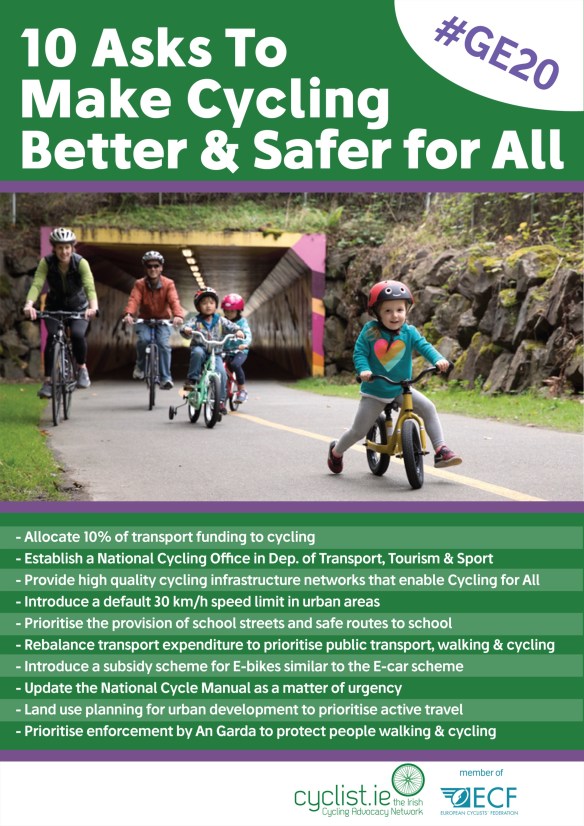
We need our next Government to allocate a minimum 10 per cent of transport funding to cycling immediately as promised under the National Climate Action Plan. Currently, cycling is allocated a tiny two per cent of our transport spend.

We do not need to reinvent the wheel. Bike safety is highest in countries and cities where bike use is high and people cycling have interconnected networks of segregated routes such as in the Netherlands, Denmark, and Bristol and Manchester in the UK.

It’s as easy as ABC: Allocate 10 per cent of transport funding to cycling; Build safer infrastructure, and everyone will cycle more.

Build safe segregated networks

Manifestos that mention school cycle buses should make us weep with rage. There should be no need for parents and adults to marshal kids to school on bikes, forming human shields between small soft bodies and big, motorised, metal boxes. Cycle buses must not become the norm.

What we need are safe routes to schools and throughout populated areas: networks of segregated cycle paths along roads; safe junction design with priority signalling for people on bikes; and quiet routes through permeable neighbourhoods. Let’s get designing and building!

Increasing cycling numbers in Ireland will cut congestion, improve public health, and reduce pollution. To get more people cycling, we need to make it an easier and safer choice. Let’s have real cycle networks, safe school routes, and coordinated planning, policy and policing that protects us.

Design fit-for-purpose planning, policy and policing system

The 3 Ps of Planning, Policy and Policing seem a little dry at first glance – but these are the actions that make the good things happen.

Planning – Building safer cycling infrastructure should be guided by our National Cycle Manual. This design guidance needs urgent updating to upgrade our standards and bring us into line with best international practice.

Policy – We need joined-up thinking for everyday cycling across a myriad of Departments – Transport, Health, Environment, Housing, Education, and Justice. We need a resourced National Cycling Office, preferably within the Department of Transport to coordinate policy and ensure action.

Policing – We have road traffic legislation that considers people who cycle and walk, but enforcement needs greater priority. People who cycle are frustrated and frightened by illegal parking in cycle lanes and dangerous overtaking.
Minister’s statement at COP 25 was a missed opportunity to show Ireland is ready to take leadership

Stop Climate Chaos Coalition – Press Statement
Immediate release 11th December 2019

The Stop Climate Chaos coalition has today (December 11th) said that the Minister’s national statement at COP 25 this morning, was a missed opportunity to show that Ireland is ready to take leadership to avert climate breakdown. The Minister participated in the high level segment, where Heads of State and Government make national statements on increasing their targets.

Earlier this week, Stop Climate Chaos wrote to the Minister in advance urging the Government to align Ireland with other EU member states calling for an increase of the EU’s 2030 target to at least 55%, and for Ireland to urge the European Commission to advance a proposal to increase the EU NDC target (in line with the science and the EU’s fair share of the global effort) in the first 100 days in office.

Catherine Devitt, Head of Policy with the Stop Climate Chaos coalition commented,

“2020 marks the beginning of a decade in which global emissions must reduce by 55% before 2030 if the 1.5oC limit in the Paris Agreement is to remain at all feasible. We need bold political leadership now more so than ever, and this needs to be matched with bold commitments that will drive deep and sustained emissions reductions over the next decade. Therefore, it’s deeply disappointing to hear nothing new from Minister Bruton’s contribution at COP25.”

“Ramping up emissions cuts before 2030 is in line with the commitments made by Ireland at COP 21 in 2015, and a higher target will increase the chances of reaching global net zero emissions well before 2050. The longer we delay, the costlier and sharper the social and economic adjustment will be. It is disappointing that the Minister did not use the opportunity at COP 25 in front of the global community, to explicitly express Ireland’s support for a higher EU 2030 of at least 55%, and to put pressure on the Commission to urgently increase 2030 ambition in line with the science and the EU’s fair share of the global effort.”

“We very much welcome the Minister’s commitment to enshrine net zero by 2050 into law. 2020 will be a crucial year for the climate, as will be the next decade. If this Government is now serious about stepping up to the challenge, we need to see the new draft Climate Law before Cabinet before Christmas and the new law being passed without delay in 2020.”

In reaction to the Minister’s national statement in Madrid, Christian Aid’s Policy and Advocacy adviser, Jennifer Higgins, said,

“We need the enthusiasm in Minister Bruton’s speech to translate into concrete and ambitious climate action. We’ve learnt nothing new in terms of Ireland’s planned response to the climate crisis, and the existing climate action plan still places Ireland as a low performer on climate action in the EU.”

“Ireland needs to be doing far more than doubling our contribution to the Green Climate Fund if we are to fairly contribute to efforts to prevent catastrophic climate breakdown. Ireland’s overall annual climate finance contributions will need to increase six-fold if we are to meaningfully support developing countries, who on the frontline of the climate emergency, to cut their emissions and adapt to the worsening impacts of climate change.”

Later this month, Ireland is required to submit to the EU its national energy and climate plan for the coming decade. Stop Climate Chaos has called on the Government to use this opportunity to close Ireland’s glaring emissions gap, to drive sustained and deep emissions reductions, and pave the way for Ireland to move from laggard to leader at European level.

Ends

Government (excluding DTTaS) allocates €3.5 Million out of €186 Million for Everyday (Utility) Cycling

In response to parliamentary questions, Minister Shane Ross is very keen to point out that in addition to funding from the Department of Transport, Tourism and Sport (DTTAS), the government also funds cycling through other departments including the Department of Community and Rural Regeneration and the Department of Housing, Planning and Local Government. We decided to investigate the contribution to cycling by these departments.

Michael Ring is Minister for the Department of Community and Rural Affairs. In May 2018, he announced the allocation of €4.5 million. This was followed in September by an additional allocation of €8 million. This funding was under the Community Enhancement Programme (CEP) which supports disadvantaged communities throughout the country by providing capital grants to community groups so none of this funding was for cycling or cycle related projects.

In January 2019, the Minister and Fáilte Ireland jointly announced funding of €10.8 million for 78 outdoor recreation infrastructure projects. Of the 78, 19 were identified as wholly or partially cycle related at an estimated cost of €1,680,786.

In February 2019, the Minister made a major announcement with an allocation of €62 million for Rural Regeneration and Development projects across the country at a cost ranging from €20,000 to €10.2 Million. There were three cycle related projects. The first which was a 100% cycling related project, was for the development of a cycle network in Mayo/Galway at a cost of €75,000. The second in County Meath was allocated €845,250 for a navigation/greenway project. The cycling component was assumed to be 25% cycling or €211,312. The third was a flagship project of national importance– the development of mountain biking trails at a cost of €10.2 million. Mountain biking is a sport which is growing in popularity but it is a niche sport. Even among current cyclists it is very much a minority sport and has nothing to do with utility or everyday cycling. Although funding was provided by the Department of Community, it could equally have been provided by the section of government dealing with sport or tourism or transport. Omitting the mountain biking scheme, the total component allocated for everyday cycling from the other two amounts to €286,31. In total, Minister Ring allocated approximately €2 million out of €86 million.

In November 2018, as part of Project Ireland 2040, Taoiseach Leo Varadkar and Eoghan Murphy, Minister for Housing, Planning and Local Government announced an allocation of €100 million for 88 projects under the Urban Regeneration and Development Fund (URDF). The schemes were classified under various headings including community development, culture, specific capital projects, energy development, integrated urban development, library development, public realm regeneration, road/strategic infrastructure and strategic acquisitions.

There may be a number of projects which involve a small component of cycling eg projects involving public realm improvements but in isolation these are unlikely to make any significant impact to the level of cycling either nationally or locally. Cycling is only explicitly mentioned in the following five:

Screenshot 2019-10-24 at 11.33.48

The total value of the five is estimated at €5.7 million but the likely cycling component is only of the order of €1-2 million out of an allocation of €100 million.

We warmly welcome the additional contribution to everyday cycling by Ministers Ring and Murphy. However, this is a long way from Cyclist.ie’s campaign for 10% of the DTTAS Land Transport capital budget or €149 Million based on the Budget 2019 allocation. In Budget 2020, this rose to €194 Million. As everyday cycling is essentially about transport, the heavy lifting for providing funding rightly belongs in the Department of Transport, Tourism and Sport.  If the Department fails to provide adequate funding for cycling, the primary responsibility rests with Shane Ross, the Minister in Charge.

10 Days to the Biggest Climate Protest in History – SCC PRESS RELEASE

Stop Climate Chaos Coalition

For immediate release : Tuesday 10 September 2019

Student organisers and climate campaigners supporting the School Strikes for Climate have announced their plans for Ireland’s participation in the Global Climate Strike on Friday 20th September. Students have so far organised School Strike Rallies for 10 locations around Ireland from Tralee to Dundalk, as well as Dublin, Cork, Limerick and Galway. Adults have signed up to host 60 local Support Actions in their communities and workplaces for people who can’t make the rallies. These numbers are growing every day and a team of volunteers is on hand to support people who put their hand up to organise a local event.

Commenting Áine O’Gorman, Activism Support Coordinator with the Stop Climate Chaos Coalition, said:

On September 20th we hope to empty schools and workplaces and fill the streets with people demanding our Government take climate action more seriously. Our house is on fire – let’s act like it.

We’ve have a great response to our call for people to organise local actions in support of the school strikes and our volunteers are ready to help anyone who wants to get involved in their community or workplace.”

The Global Climate Strike was called by Swedish teen, Greta Thurnberg, and the global youth movement she has sparked. But this time she has asked adults to join in, saying “We need everyone, to change everything”. The Global Strike comes three days before heads of government from around the world, including Taoiseach Leo Varadkar, are due in New York for a UN Climate Action Summit. Greta, who has been invited to speak at the summit, sailed to New York in August in a zero emissions boat, with the slogan “Unite behind the science” emblazoned on the sails. The overarching message to world leaders from the strikers and their supporters is “It’s an emergency, act like it”.

Oisín Coghlan, Coordinator of the Stop Climate Chaos Coalition, said:

“The Dáil declared a Climate and Biodiversity Emergency in May but as yet the Government is not acting like it. Just days later they issued new licences to Exxon and the Chinese to search for more oil and gas in Irish waters. And months later they still haven’t sat down with the trade unions to discuss the plight of the workers in the midlands who are facing a disorderly exit from the peat industry because for 20 years Irish politicians have refused to plan for a Just Transition away for fossil fuels.”

The first international School Strike for Climate in March saw 1.6 million young people and their families take to the street around the world, including 15,000 in Ireland.

ENDS

For more information or interviews contact:
Áine O’Gorman, Activism Support Coordinator, Stop Climate Chaos Coalition, or
Oisín Coghlan, National Coordinator, Stop Climate Chaos Coalition, on

1) All the student-led #ClimateStrike Rallies, and the local support actions organised by adults in communities and workplaces are on this map:
https://www.stopclimatechaos.ie/campaigns/support-the-climate-strike-movement/

2) So far the following student-organised marches and rallies are confirmed:
Dublin: Gathering 12:00 at Customs House, marching at 12:30 to Merrion Sq., rallying 13:00 – 14:00 at Merrion Sq. in front of Govt. buildings
Cork City: Gathering on Grand Parade St. from 12:00, marching at 12:20.
Kerry (Tralee): Meet at County Buildings, Ratass, at 9am
Clare (Ennis): Meet at The Height, O’Connell Square at 9am
Drogheda: Demonstrating from 13:00 outside St. Peters’s Church, West St.
Galway: Demonstrating from 13:00 – 16:00 in Eyre Square
Navan: Demonstrating from 13:00 – 15:00 at the Market Square
Limerick: Marching from Arthur’s Quay Park at 13:00, finishing at City Hall.
Dundalk: Demonstrating from 12:30 – 15:00 in the Market Square
Kenmare: Demonstrating from 9:00 – 13:00 outside the Courthouse

The student organising groups are:
Fridays for Future: https://www.fridaysforfuture.ie/september-20th
Schools Climate Action Network: https://www.schoolsclimateaction.ie/

3) Details of the Global Climate Strike are here: https://globalclimatestrike.net/

4) Details of the UN Climate Action Summit are here: https://www.un.org/en/climatechange/


SCC 5 Tests for All-of-Government Plan for Climate Action

Stop Climate Chaos

With the EPA confirming that Ireland will fail to meet its obligations to reduce carbon dioxide emissions by 2030, the Cabinet will meet shortly to consider the contents of the new All-of-Government climate plan which is intended to set out the roadmap to a carbon free future. The Stop Climate Chaos Coalition (SCC) has developed 5 tests for this new plan:

1. Does the plan acknowledge the scale of the challenge?
Does the plan accept that Ireland needs to get to net-zero emissions by 2050 and that our 2030 targets must be strengthened in line with the Paris Agreement and the IPCCC science? Will Ireland finally join with other countries calling for the EU’s ambition to match its rhetorical commitment to the Paris Agreement?

2. Does the plan commit to putting the Oireachtas recommendations on governance into law by the end of the year?
Will the Government bring forward legislation before the summer recess to amend the Climate Action Act in line Chapter One of the Joint Oireachtas Committee report to be enacted before Christmas? That includes putting our new 2050 target into law, 5-year carbon budgets voted on by the Dái l, a strengthened Climate Action Council (and a standing committee of the Dáil to act like the Public Accounts Committee for carbon emissions.

3. Does the plan cut emissions in every sector?
Does the plan include new measures to cut emissions in every sector of the economy? And not just “consider” or “explore”. John FitzGerald, chair of the Climate Advisory Council famously called the Government’s last climate action plan in 2017 “100 good ideas but no new decisions”. The decisions in the plan have to be definite enough to allow the EPA to revise its emissions projections.

4. Does the plan “do the math”?
Does the plan quantify the emissions reductions for every measure? And does it add them all up and benchmark them against our existing 2030 target and our 2050 goal. Does it express them as a carbon budget?

5. Does the plan make clear how the Government will devise the next set of actions?
The Oireachtas Committee makes clear that even its full suite of recommendations does not achieve our fair share of climate action. Does the Government plan acknowledge that too and, crucially, lay out a process and a timeline for developing and adopting the next round of actions?

We look forward to see what decisions the government takes.


#Allocate4Cycling Working Group

Following the launch of its Budget Submission 2019 in September 2018 and the Lobby Day in Buswells Hotel, Cyclist.ie set up a working group to progress the #Allocate4Cycling Campaign which involved individuals from a number of campaign groups including Maynooth Cycling Campaign.

There were five objectives to our work:

  • Create a logo for #Allocate4Cycling
  • Clarify government expenditure on cycling
  • Make a submission to the Joint Oireachtas Committee on Transport with an objective of being invited to present before them
  • Engage with political parties, and
  • Publicise our efforts through the issue of press releases.

We designed a logo for #Allocate4Cycling to try and create a recognisable brand. #A4C LogoOriginally it was similar to a speed limit sign – with black text, white background  and surrounded with a red circle. After mature reflection, however, it was thought  that such signs indicate prohibition rather than approval so the colour was changed to white text, blue background and white circle. The intention was that the  logo would appear on websites and correspondence with external parties but the outcome has been patchy at best.

Estimation of government expenditure  was linked to engagement with political parties. We contacted all the parties which had indicated their support for #Allocate4Cycling as well as some independents and asked them to put down parliamentary questions on finance to the Minister for Transport, Tourism and Sport. Some of the department responses were so obtuse that they shone no light on the issue at all but gradually the picture began to get clearer although we still require one final answer to fully resolve the question or as least as much as is possible.

We wanted to raise an issue with the Joint Oireachtas Committee on Transport (JOCT) which might get have the same impact as Joint Oireachtas Committee on Climate Action (JOCCA). We contacted Catherine Murphy TD who is an Oireachtas committee member for advice on how to raise such an issue. We had already made a submission on Budget 2019 and decided to submit a related one to the secretary of the JOCT. This may seem strange as the JOCCA has already endorsed the recommendation that 10% of transport capital funding should be allocated to cycling. However, it was felt important that the issue should be kept in the news to ensure that the recommendation is carried through to the All of Government Plan for Climate Action. This is especially important as the main government party representatives, Fine Gael, voted against the 10% allocation but were outvoted on a motion submitted by Eamon Ryan and supported by the members from other parties and independents.

One of the greatest difficulties for Cyclist.ie is having an impact in the media. Cyclist.ie is made up of a number of geographically spread  groups which are trying to make an impact in their own locality  as well as nationally. We have learnt lessons from our support for Stop Climate Change and the campaign for Active Travel. However, it would be fair to state that we have still to make an impact on this area  but hope to do better in the future. All in all though, we feel that progress is being made but that the next twelve months will be critical due to elections  (local, European and probably national),  the All of Government Report on Climate Action and Budget 2020.

CYCLIST.IE PRESS RELEASE – Report by Joint Oireachtas Committee on Climate Action

Cyclist.ie, the Irish Cycling Advocacy Network, warmly welcomes the Report on Addressing Climate Change in Ireland by the Joint Oireachtas Committee on Climate Action. As acknowledged by the government, Ireland is behind other European countries in attaining its binding, EU agreed, 2020 and 2030 targets with regards to energy efficiency and reduction of GHG emissions.

Colm Ryder, Chair of Cyclist.ie, said “This report is an important step on the path to decarbonising transport in Ireland. In particular, the cross-party recommendation for an allocation to cycling of 10% of transport investment is a momentous decision and when properly expended will ensure that the government delivers far ranging change not only in  carbon emissions but also in personal travel, health, congestion and air/noise pollution”.

The Committee is to be highly commended for its prioritising of active travel by placing it front and centre in the transport section of the report. Transport policies often pay lip-service to active travel but rarely give it the serious consideration it deserves. We acknowledge the proposed government investment in active travel in cities and welcome its extension to larger towns across the country. We regret that the Committee did not adopt the Citizens Assembly recommendation of reversing the proportion of funding towards roads relative to public transport. Simple rules will be required to proportion the allocation of investment to different modes of transport for, unless there is transparency and clarity about the funding, there is a risk of investment being misdirected.

The Committee acknowledges the impact of car travel on congestion and that the ‘do nothing” scenario will only lead to increasing gridlock in our towns and cities. While it is accepted that the  Committee has not considered school travel in depth, it is regrettable that efforts to deter school trips by car such as the closing of streets near schools to private car traffic have not been referenced.

We share the Committee’s concern about the length of time it takes to deliver major projects and welcome its support for multi-modal travel. We applaud its recommendation for restrictions on access of private cars to large urban centres but we are concerned about local authorities preference for ‘balance between road users’ which is often a  synonym for maintaining the status quo.

While electric vehicles have a role in decarbonising the transport sector, we regret that there is no mention of the huge potential of E-bikes. In countries where the level of cycling is high, the sale of such bikes far outweighs the number of electric cars and at far less cost to the individual and to government. It is hoped that in the future the Committee will also have the opportunity to consider the increasing use of cargo bikes for last mile deliveries across Europe, so we can replicate it here in Ireland.

We are happy to see the reference to trials of free public transport in a number of European cities, although it is disappointing that the report does not refer to the removal of hidden subsidies to car travel such as free parking at places of work, at shopping centres and in public areas.  These areas need to be addressed.

In summary, the report is an important step on the path to a carbon free future and Cyclist.ie warmly welcomes its publication.  Its ultimate success however will depend on how it informs the adoption of appropriate targets and on the monitoring and reporting of progress in Minister Richard Bruton’s  eagerly awaited All-of-Government Plan on Climate.

Government (excluding DTTaS) allocates €3.5 Million for Everyday Cycling

 In response to parliamentary questions, Minister Shane Ross is very keen to point out that in addition to funding from the Department of Transport, Tourism and Sport (DTTaS), the government also funds cycling through other departments including the Department of Community and Rural Regeneration and the Department of Housing, Planning and Local Government. We decided to investigate the contribution to cycling by these departments.

Michael Ring is Minister for the Department of Community and Rural Affairs. In May 2018, he announced the allocation of €4.5 million. This was followed in September by an additional allocation of €8 million. These rounds of funding were under the Community Enhancement Programme (CEP) which supports disadvantaged communities throughout the country by providing capital grants to community groups so none of this funding was for cycling or cycle related projects.

In January 2019, the Minister and Fáilte Ireland jointly announced funding of €10.8 million for 78 outdoor recreation infrastructure projects. Of the 78, 19 were identified as wholly or partially cycle related at an estimated cost of €1,680,786.

In February 2019, the Minister made a major announcement with an allocation of €62 million for Rural Regeneration and Development projects across the country at a cost per project ranging from €20,000 for to €10.2 Million. These included three cycle related projects. The first was the development of a cycle network in Mayo/Galway at a cost of €75,000. The second  was for a navigation/greenway project in County Meath at a cost of €845,250. While the cycling component of this scheme is open to debate, it is assumed for the purposes of this article that 25% or €211,312 is for cycling. The third was a flagship project of national importance – the development of mountain biking trails at a cost of €10.2 million. Mountain biking is a sport which is growing in popularity but it is a niche activity. Even among current cyclists it is very much a minority sport and has little, if anything, to do with utility or everyday cycling. Although funding was provided by the Department of Community, it could equally have been provided by that section of government dealing with sport or tourism or even transport. Omitting the mountain biking scheme, the total component allocated for everyday cycling from the other two amounts to €286,312 so in total, Minister Ring allocated approximately €2 million to cycling out of €86 million.

In November 2018, as part of Project Ireland 2040, Taoiseach Leo Varadkar and Eoghan Murphy, Minister for Housing, Planning and Local Government, announced an allocation of €100 million for 88 projects under the Urban Regeneration and Development Fund (URDF). The schemes were classified under various headings including community development, culture, specific capital projects, energy development, integrated urban development, library development, public realm regeneration, road/strategic infrastructure and strategic acquisitions.

There may be a number of projects which involved a small component of cycling eg projects involving public realm improvements but in isolation these are unlikely to make any significant impact to the level of cycling either locally or nationally. Cycling is only explicitly mentioned in the five:

Scheme County

Cost

Cherrywood Public Parks, Greenways & Attenuation Dublin

€870,000

Sustainable Swords (Category B) Dublin

(estimated)  €257,500

Cycling & Walking Galway

€2,900,000

Smarter Travel Killarney
(Link & Public Realm)
Kerry

€1,000,000

Castlebar Greenway Link Mayo

€938,000

Total

€5,708,000

The total value of the five is estimated at €5.7 million but the cycling component is likely to be  of the order of €1-2 million at most out of an allocation of €100 million.

We warmly welcome this additional contribution of approximately €3.5 million to everyday cycling by Ministers Ring and Murphy. However, this is a long way from Cyclist.ie’s campaign for 10% of the DTTaS Land Transport capital budget or €149 Million based on the 2019 Department of Finance allocation. As everyday cycling is essentially about transport, the heavy lifting for funding cycling rightly belongs in the Department of Transport, Tourism and Sport. If that department fails to provide adequate funding, the primary responsibility rests with Shane Ross, the Minister in Charge.

The 1979 Delft Cycle Plan

Quote

Delft was the third city in The Netherlands to experiment with modern cycling infrastructure, aided by the national government. After the experiments in Tilburg and The Hague in the 1970s, where they built one very good (but also very expensive) cycle route, that had mixed results but didn’t lead to more cycling overall, Delft took a different and innovative approach. Delft wanted to improve the city’s existing cycle network, which had a lot of missing links. The reason for this area-wide experiment was the increasing modal share of private motor traffic. The city clogged up and couldn’t cope with all those cars, it certainly wouldn’t be able to accommodate even more cars in the future. Cycle expert André Pettinga, who worked for the city of Delft at the time, summarises the need for the Delft Cycle Plan in just a few words: “The local government wished to increase the modal share of cycling!”. This cycle plan was a direct answer to the mainly car-driven Traffic Circulation Plans that had been made for many cities in the Netherlands, including Delft, in the 1960s. The execution of those plans was stopped oneafter the other, because of opposition of the public and changed ideas regarding urban planning……………….

via The 1979 Delft Cycle Plan