Is the Railpark housing estate the worst place to live in Maynooth? (Spoiler: It isn’t.) Then why, at a number of public meetings during the summer, did some Maynooth residents imply a feature that is working well in Railpark would mean a host of problems if applied to other areas?
The meetings were called to discuss the impact of proposals in the Maynooth and Environs Local Area Plan 2025-29. The Local Area Plan (LAP) covers a broad range of issues related to the future development of Maynooth. It includes proposals that are designed to contribute to Ireland meeting its commitment to reduce carbon emissions by 50% by 2030. However, many of the discussions focused on pedestrian and cycling permeability – the retrofitting of active travel access through existing adjacent developments, mainly housing estates.
One such proposal linked the Kilcock Road and Crewhill — a new high-density development to the north-west of the town via Maynooth University and the unconnected residential estates of Moyglare Abbey and Moyglare Village.
It was claimed that retrofitting an active travel access would lead to increased anti-social behaviour and increased littering. One attendee quoted an unnamed member of the Garda Síochána who had warned that opening up estates would lead to increased crime. It was claimed that a direct link between Moyglare Abbey and the university would lead to Moyglare Abbey turning into a car park for students. But no such link was even proposed in the LAP. Concerns were also expressed that the openings would be so wide that cars would also be able to use them and that drivers would not see cyclists at a junction due to inadequate sightlines. (For clarity – cars will not be able to use the access points.)
This proposal was designed to provide an alternative to Moyglare Road where, at peak times, there is heavy congestion on crowded footpaths, and many secondary school students cycle on the road instead of an adjacent shared path. At school closing time, traffic queues stretch to nearly a kilometre from the Kilcock Road junction to beyond the GAA clubhouse. It was pointed out that improving permeability would be good for health by reducing air and noise pollution. The high level of traffic congestion would also be reduced, but the mood of the majority who attended the meeting was to oppose the permeability links regardless of any benefits that they might bring.
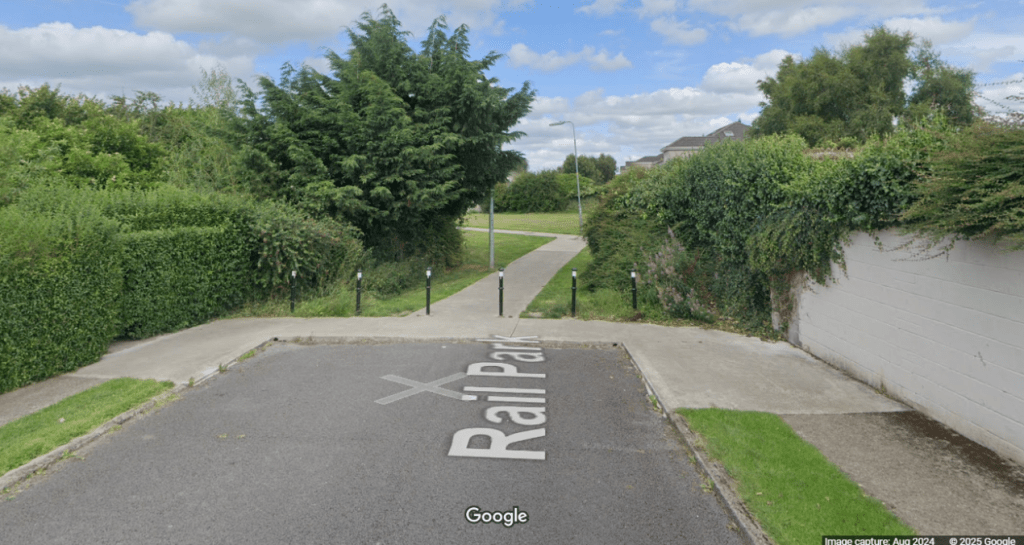
The irony is that Maynooth residents don’t have to go too far to see good examples of active travel permeability. Most of the estates off the Straffan Road are permeable. On the west side, Kingsbry, Beaufield and Greenfield estates are linked. Parson Hall and Ashleigh are also linked. On the east side, Railpark estate is particularly good as it is linked to both Rockfield and Parklands, as well as having a pedestrian link to the Straffan Road.
If the fears expressed by Moyglare residents are valid, Railpark must be the worst place to live in Maynooth. In fact, it is estates like Moyglare Abbey and Moyglare Hall that are badly designed in regard to mobility. So, the LAP presents a rare opportunity to mitigate the poor outcomes of past planning decisions.
Public consultations are an important part of local democracy. However, democracy is not just about the number of submissions for and against a scheme. The proposal to provide greater permeability and increase active travel has implications for climate change and road safety as well as health in Maynooth. This concerns all the people of Maynooth and not just those who reside close to the proposed openings. The provision of permeability links is a very modest proposal to reduce our carbon emissions.
The backdrop to this includes Ireland still recovering from one of its most severe storms that was linked to two deaths, other European countries suffering extreme climate events involving multiple fatalities, and 2024 was confirmed as the warmest year on record globally. It’s also at a time when the consensus between Europe and the USA on climate is under threat like never before.
Given that the addition of a “relatively” small number of people cycling and walking provokes such opposition from people who are opposed to change and happy with the current status quo, then what will happen when people are asked to make major changes to their lifestyle?
In a recent appeal against a refusal for a proposed wind farm in Laois, the High Court stated that “rapid, far-reaching and unprecedented changes to all aspects of society and the economy” and “an immediate end to business as usual” by consenting authorities is required to cut greenhouse gas emissions and ensure planetary survival.
Maynooth University is an important institution in the town. It is one of the Irish universities that is noted for research on climate change and lecturers there collaborate with their international colleagues. It is disappointing that the university authorities did not consider the LAP important enough to make a submission. It is particularly disappointing as the university is also the biggest single generator of traffic in the town.
Ireland was fortunate to rely on expert medical advice during the Covid epidemic rather than on non-experts. Expert advice on the LAP from the university authorities could have reassured a lot of people who are fearful of or opposed to change.
Local councillors are responsible for approving Local Area Plans, and while they have a responsibility to represent the views of the public, they also have a responsibility to show leadership. Central government ministers and their departments primarily fund local government. Central government also sets down national policies so their views cannot be ignored by local government.
Prior to Christmas 2024, in their submission of amendments to the Draft LAP, the Office of the Planning Regulator, which reviews the performance of planning authorities, recommended that all the permeability links deleted by councillors be reinstated. However, on February 17th, at the meeting of the municipal district on the LAP, councillors voted to proceed with deleting 12 of the 34 walking links and 1 of the 3 cycle links that had been proposed to be abandoned.
With only five years until the next local government elections and one year after that to the 2030 target of a 50% reduction in carbon emissions, the decisions of current councils nationwide will decide where Ireland will stand by the key target date. Kildare is just the latest council to demonstrate the disconnect between government policy and the actions of local councillors. Many groups and individuals will be watching to see how this saga plays out.
This article was edited post publishing to correct an error in the numbers of links for abandonment.
The submission below was forwarded to Kildare County Council in early December.
SUMMARY
Maynooth Cycling Campaign supports the retention of all of the removed permeability and cycling measures on the grounds that their deletion is contrary to government policy on climate, health and road safety.
We support the retention of all of the permeability and cycling measures. There are plenty of existing examples of permeability in Maynooth. While some are not so good in terms of width, most permeability links are good to very good and are positive features for the residential estates in question.
Although not explicitly appearing in the LAP, the LAP references the targets for future modes of travel in the Maynooth & Environs Area Based Transport Assessment. Unfortunately these do not make mathematical sense given that the totals sum up in excess of 100%. Best national and international practice is that they amount to 100% and if one mode of travel increases in percentage, another mode must decrease by an equivalent amount. Targets at a micro level (at town level) rather than at national level must be included in the LAP in order to allow government to monitor and report progress on an annual basis.
The proposed deletion of the permeability measures will make it more difficult to achieve any target of increased active travel.
.
Maynooth Cycling Campaign suggests that Kildare County Council could have done much more to prepare local people for the prospect of increased permeability as it failed to make the case for their inclusion in advance of the publication of the Local Area Plan.
Although child safety was cited as a reason by residents and parents opposed to some of the permeability measures, international experience shows that dedicated cycling and walking linkages promote child safety by keeping them away from busy roads and intersections.
OPPOSITION TO CYCLING INFRASTRUCTURE
Maynooth has a track record of opposition to proposed cycle infrastructure, especially where it involves reallocation of space from cars. This was the case
On the Straffan Road when officials proposed to remove the turn right turning lane into residential estates.
On Carton Avenue when officials proposed to turn the footpath into a shared path.
On Parsons Street when it was proposed to trial the restriction of motorised traffic to flow in one direction.
Albert Einstein is reputed to have said “Insanity is doing the same thing over and over again and expecting different results”. Kildare County Council should have learnt from these episodes that residents, especially drivers, would not meekly accept its plans for active travel without any opposition.
Kildare County Council should also have learnt from the report Active travel infrastructure design and implementation: Insights from behavioral science by the ESRI in conjunction with Fingal County Council. The report looked at the results of 180 international active travel schemes. There was lots of opposition to the schemes initially with people expecting negative effects on traffic and local businesses. The experience internationally, however, is that when implemented, active travel schemes were positively received. Most business owners associate car drivers with bigger spending. However, while active travellers spend less money per visit to local businesses, they visit businesses more often and so end up spending more.
How to allay fears? Everyone is subject to inherent bias. People make a judgment on something based on their beliefs or previous experience. Few people though have experience of the wider benefits of increased cycling but most feel that they will be disadvantaged by it. The researchers also found a second bias – the primary effect bias. Primary effect bias is where If a person’s initial reaction to a proposal is negative, it is then very difficult to get them to change their mind. Most people do not like change and fear the worst of change in their circumstances. When change is implemented, people find that it is not as bad as feared.
To overcome bias resulting in opposition to their proposals, Kildare County Council must do more to make the positive case for change. In particular, there has never been any attempt to summarise the transport strategy Maynooth & Environs Area Based Transport Assessment into a document which is circulated to every home in Maynooth and which explains in plain terms what is planned for the community, why it is necessary and what are the impacts both good and bad.
This submission concerns four areas – Targets for Travel Modes and three areas where the deletion of permeability and cycling measures are not in accordance with government strategies and policies, namely in the areas of Climate Action, Health and Road Safety.
TARGETS FOR TRAVEL MODES
The LAP does not include any targets for different modes of travel. Instead it references the targets set out in the Maynooth & Environs Area Based Transport Assessment (and the County Development Plan). See copy of Table 2-1 from the Assessment.
Table 2-1 Journeys to Work Share Targets to County Kildare in draft CDP
The Assessment includes existing modal splits for transport and as well as future targets. If a mode of transport increases, another mode or modes must reduce by an equivalent amount in order for all modes to sum up to 100%. Targets should be challenging and achievable but the future targets make no sense as they amount to more than 100%. See Table 2-1 above from the Assessment. This is not in line with best practice either nationally or internationally. Targets at a micro level (at town level) must be included in the LAP in order to allow government to monitor and report progress on an annual basis. Regardless of the future targets, the deletion of permeability measures will make achieving them even more difficult.
CLIMATE ACTION
Climate is one of the major threats to the future of Kildare, Ireland and the rest of the world. The Dáil formally recognised this threat when it declared a climate emergency in 2019. Kildare County Council also recognised the climate emergency in a vote by its elected members. The government, representing the people of Ireland, is legally committed to a 50% reduction in carbon emissions from the transport sector by 2030. The Climate Plan details a wide range of measures which includes a significant increase in the level of active travel and a consequent reduction in use of private cars.
In the 1970s, the Netherlands was the first country to explicitly attempt to decrease car use and to increase the level of cycling. The first two attempts to increase cycling had mixed results but didn’t lead to more cycling overall.
In 1979 Delft was the third city to try to increase cycling and the authorities there took a different and innovative area wide approach. The reason for this area-wide experiment was the increasing modal share of private motor traffic. The city already had an existing cycle network but Delft had noted that there were a lot of missing links. A consultant summarised the need for the Delft Cycle Plan as “The local government wished to increase the modal share of cycling!”. The two essential elements were they planned an area wide network and identified the missing links. This was the most successful plan to significantly increase the level of cycling and formed the model for other Dutch cities to follow for the next forty years.
Although considerably smaller than Delft, Maynooth has a rudimentary network with segregated or shared cycle infrastructure on the Straffan, Kilcock, Moyglare Roads and Mariavilla. Like Delft, residential estates in Maynooth do not generally require dedicated cycle facilities but if Kildare County Council is serious about significantly increasing the level of cycling in Maynooth, it must follow the best international practice in the Netherlands and address the lack of permeability.
The Climate Plans and associated documentation set out a comprehensive list of measures required to reduce carbon emissions. The Climate Plan 2024 Annex of Actions identified local authorities as having a key role in developing cycle infrastructure and achieving modal shift.
Climate Action Plan 2024
15.2.4 Shift 15.2.4.1
Active Travel Infrastructure and Accessibility Work Programme
The provision of safe and accessible walking and cycling infrastructure is key to encouraging modal shift away from private car use and towards walking and cycling. The role of local authorities in the development of active travel infrastructure cannot be overstated ….
While the use of private cars is not the only source of carbon emissions, it is a significant one. The widespread deletion of permeability measures by councillors is contrary to the government’s Climate Action Plans as it will have a negative impact on a proven strategy to increase the level of cycling.
In a recent interview on RTE, the Chair of the Climate Change Advisory Council Marie Donnelly said that the main reason for Ireland not meeting its climate targets is due to transport, where emissions are “stubbornly high”.
The Climate Advisory Council has reported that Ireland is unlikely to achieve the required 50% reduction in emissions by 2030. It has also highlighted that emissions have continued to increase in 2023 rather than decrease. It warns that the cost of failing to meet Ireland 2030 climate targets could exceed €8 billion. This is the equivalent of more than 60% of the recent Apple windfall. As several countries like Ireland are unlikely to meet their emission target, it is likely that more countries will be chasing carbon credits than will be offering them. As a result, the cost of carbon credits could rise significantly.
To maximise reduction of carbon emissions, local authorities must offer the community an alternative mode of travel to the private car. As the inclusion of permeability measures is critical to the achievement of government targets, the permeability measures should be retained.
Furthermore, Kildare County Council selected Maynooth as its model Decarbonisation Zone. As one of approximately 26 Decarbonation Zones, Maynooth is intended to be a role model for other areas within the County and indeed within the country. Blocking the development of cycling and walking networks by the deletion of permeability links will impact on decarbonising elsewhere in Kildare and in the rest of the country and would be contrary to the demonstration of best Irish practice.
HEALTH
How active are Irish people? The National Survey of Lifestyles Attitudes and Nutrition (SLÁN 2007) showed that only 41% of Irish adults took part in moderate or strenuous physical activity for at least 20 minutes three or more times a week.
The Health Behaviours in School Children (HBSC, 2006) survey revealed that over half of primary school age children did not achieve the recommended level of physical activity. By 15 years of age, almost nine out of 10 girls and seven out of 10 boys don’t achieve the recommended level.
The cost of health care provision in Ireland due to physical inactivity is not available but on the basis of international research, physical inactivity has been estimated to cost about €150-300 per citizen per year. In a worst case scenario this could imply a cost in Ireland of approximately €1.5 billion per year. (WHO, 2006 Physical Activity and Health in Europe Evidence for Action)
A fundamental part of improving community health is ensuring that people are enabled to be more active. Sports clubs and gyms encourage mobility but large sections of the population do not take part in formal or informal forms of exercise. The countries which are most successful at encouraging mobility, build it into everyday movement by enabling active travel.
HSE and Healthy Ireland
The Health Service Executive (HSE) manages public health services in Ireland. One service, Healthy Ireland brings together stakeholders including government departments, public sector organisations, businesses, communities and individuals to improve health and wellbeing and reduce the risks posed to future generations.
Healthy Ireland’s Get Ireland Active! – National Physical Activity Plan for Ireland
The National Physical Activity Plan for Ireland sets out a strategy to reduce inactivity in communities. It states:
Promoting the use of the natural and built environment and promoting active transport are the most practical and sustainable ways to increase physical activity as part of everyday routine. The built environment is an important determinant of physical activity behaviour. The way the built environment is designed, planned and built can also act as a barrier to being active and can reinforce sedentary behaviour and car dependence. (My emphasis)
Action Area 4 deals with the Environment. It includes 7 actions, of which three list local authorities as the lead partner and a further two list local authorities as partners.
National Sports Policy 2018 – 2027
The National Sports Policy 2018 – 2027 highlights the Leading Role for Local Authorities:
Local Authorities are key stakeholders in the context of the public spaces which are widely used for sport and physical activity. They manage the public parks; they are responsible for the local road network;
For the above reasons, we believe that Local Authorities are well positioned to be charged within the policy with a formal leadership role in facilitating the drive towards greater participation at a local level throughout the population.
The development and evaluation of interventions aimed at reducing sedentary behaviour in children and adults is a priority.
There is a growing body of evidence linking sedentary behaviour with chronic disease morbidity and mortality in adults and preliminary evidence to suggest sedentary behaviour may also be a health risk in children and young people.
Healthy Kildare Plan 2022-26
One of the priorities of the Healthy Kildare Plan 2022-26 is Healthy Spaces and Places. The High Level Goals includes
Improve sustainability and longevity of programmes by encouraging active travel ………
Theme: Healthy Places and Environments
Strategic Objective 6: To support the development of new spaces, places and environments that promote positive Health and Wellbeing across Kildare
Key Action 6.3 To inform and support the development of greenways, cycleways and walkways across the County and promote sustainable transport
Successive health policies and strategies all stress the important role of local authorities in increasing community health through enabling active travel.
While elected councillors have a role in representing the views of the public (which councillors have done in relation to the issue of permeability in the Maynooth LAP,) councillors also have a responsibility in implementing central government policies as well as its own policies on health. As a result, the proposed permeability measures should be retained in the LAP.
ROAD SAFETY STRATEGY
After several years when Ireland improved road safety, the number of road fatalities increased significantly and is unlikely to achieve the European target of a 50% reduction in road fatalities by 2030 relative to the base year of 2019. Much of the existing cycle infrastructure is low quality. Moyglare Road shared path is not fit for purpose at peak times. Cyclists need more and better options to reduce the risk of collisions. Child safety was cited as a reason by some residents and parents opposed to the permeability measures. International experience shows the opposite. One of the drivers of change in the Netherlands in the 1970s was the scale of road fatalities. The deaths of over 400 children per annum gave rise to a widespread campaign “Stop de Kindermoord” or “Stop the Child Murder. The provision of permeability links in Maynooth would offer people – young and old – an alternative to roads with either low quality cycling infrastructure or with no dedicated infrastructure. The absence of such links will endanger an increased number of vulnerable road users.
Waterways Ireland is in the process of revising its Byelaws. The previous ones were passed in 1988 more than 30 years ago so a revision has been long overdue. The proposed Byelaws are arranged in some 40 sections. Most of the changes affect the boating fraternity but buried deep in the document is a clause which is aimed at cyclists.
Under Section 35 Protection of biodiversity, water quality, heritage, environment and prohibited activities, Waterways Ireland includes subsection (10) Prohibited Activity on canal property. The subsection refers to bicycles and powered personal transporters in two clauses
(n) Exceed a speed of 15 kilometres per hour on any bicycle, tricycle or powered persontransporter while using any greenway.
Maynooth Cycling Campaign has no issue with the first subclause. However, we strongly oppose the proposal to introduce a speed limit for cyclists on any Greenway or Blueway under the control of Waterways Ireland.
The general design speed for greenways is 30 km/h (ref TII Rural Cycleway Design (2022).
A bicycle is not legally obliged to have a speedometer. Therefore there is no way for a cyclist to know if he or she is travelling above or below a specific speed.
The introduction of such a proposal would discourage cyclists from using a greenway or blueway, and cause them to divert them to trafficked roads. Introducing such a proposal at a time when road fatalities are increasing sharply is wholly irresponsible.
Extreme weather events are worsening as a result of climate change. The result of suppressing the number of cyclists using the greenways and blueways will be to make it harder to meet our international obligations to reduce carbon emissions by 50% by 2030.
Internationally, many adult utility cyclists in urban areas travel in excess of 15 km/h. Imposing a limit of 15km/h for cyclists in rural areas in the vicinity of few other users is therefore ridiculous.
There is no speed limit on equivalent cycle facilities internationally. The introduction of such a speed limit would be to discourage international (as well as local) touring cyclists from using greenways along canals and waterways. This would reduce the potential financial benefits to adjacent businesses.
Waterways Ireland claims that the revisions were introduced following research and consultation with key stakeholders. Certainly Maynooth Cycling Campaign was not consulted and neither was our parent body Cyclist.ie who, for many years, has campaigned for development of the Royal Canal as part of the trans-national EuroVelo Route 02 the Capitals Route which runs from Moscow to Galway.
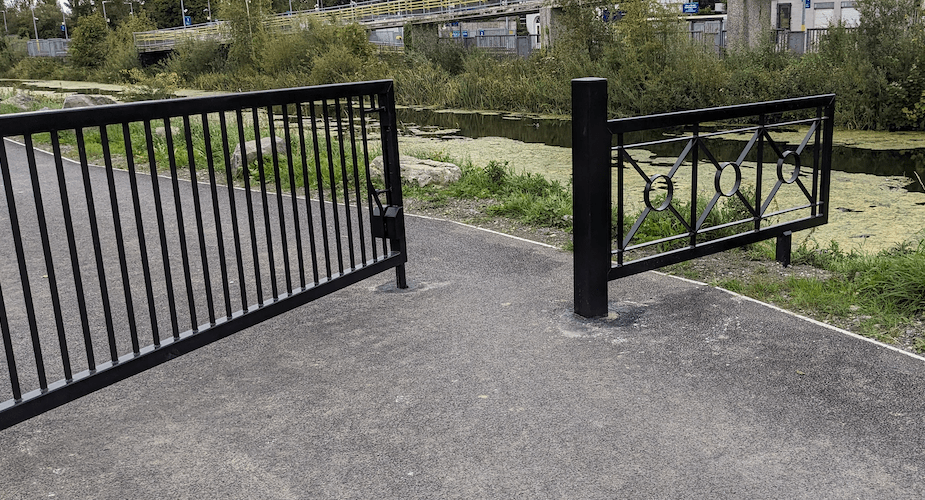
Waterways Ireland should be encouraging cyclists instead of discouraging them. Waterways Ireland is noted for an ambivalent attitude to cyclists. Cyclists are potentially a greater source of income than walkers or boaters on many waterways but Waterways Ireland want to provide low quality cycling infrastructure. This was demonstrated by their provision of kissing gates in the past. It is demonstrated by the large number of substandard gates provided between Leixlip and Kilcock. This has been repeated with the barriers on the Royal Canal at Louisa Bridge where the openings arer 1.3m and 1.0m. It is hardly rocket science. They just need to provide bollards at 1.5m spacing to enable all types of cycles but instead of learning from their mistakes, Waterways Ireland insist on repeating them.
The closing date for submissions on the ByeLaws was the 2nd October but Waterways Ireland has extended the date for submissions until 27th October so there is still time to make your views known. To be fair to them, Waterways Ireland has announced that they will be having discussions with Cyclist.ie.
The Department of Transport/National Roads Authority has allocated €55M to local authorities to promote increased walking and cycling.
It has to be said that Maynooth Cycling Campaign is underwhelmed by some of the approved projects and the amount of funding which Kildare has received as a result, compared to similar councils in Wicklow, Meath and Fingal.
When the UK Department of Transport offered funding to their local authorities, it pointed out that filtered permeability was the cheapest and easiest method of improving conditions for pedestrians and cyclists. They also informed the local authorities that work would have to be completed within three months. In Ireland, nearly six months after the outbreak and after traffic levels has increased to close to pre-Covid-19 levels, nothing in Kildare has been implemented so far.
The proposed schemes are as follows:
1. Parson Street – Covid Funding (temp works) €50,000 – Work entails trialling traffic management & shared space for cycling.
Maynooth Cycling Campaign strongly supports this measure and is opposed on health and safety grounds to the retention of two lanes of motorised traffic. In general, we support Part 8 public consultation and approval by elected councillors but this measure stems from the global pandemic. As the works are temporary and it is more than five months since the lockdown was announced, it does not appear that bringing this proposal to Part 8 is treating the issue as an emergency.
2.Rathcoffey/Beaufield/Newtown – Covid Funding (temp works) €50,000 – Work entails trialling traffic management & reallocation of road space to cycling (& walking) Maynooth Cycling Campaign strongly supports this measure.
4. Mill Street – Covid Funding (temp works) €15,000 – Work entails reallocation of road space from cyclists to pedestrians, and cyclists “taking the lane” Mill Street is a key transport corridor. The Rye Bridge is particularly narrow with inadequate footpaths and pedestrians stepping off the footpath onto the cycle path. It is proposed to improve conditions for pedestrians at the expense of cyclists. Maynooth Cycling Campaign recommends that pedestrians and cyclists continue to share space as the consequences of a pedestrian/cyclist collision is significantly less rather than the consequences of a cyclist/vehicle collision.
5. Celbridge Road – Covid Funding (temp works) €15,000 – Work entails an additional entrance to the Gaelscoil and indicative cycle lanes on Celbridge Road. Maynooth Cycling Campaign supports the opening of an additional entrance but does not support indicative cycle lanes on the Celbridge Road. The Celbridge Road is a regional road which is used by all forms of traffic including HGVs and is above the AADT threshold of 2,000 vehicles per day which Irish and international guidance recommends for sharing. Indicative cycle lanes on this type of road are only suitable for “brave” cyclists and are not AAA standard – for all ages and abilities. Paint does not safeguard vulnerable road users.
6. Main Street – Covid Funding (temp works ) €15,000 – Work entails worsening conditions for pedestrians and cyclists. Maynooth Cycling Campaign supports the reallocation of space for business but is opposed to worsening conditions for pedestrians and cyclists. On Main Street, there is provision for two-three lanes of live traffic and two parking lanes. Cycle facilities are poor quality and discontinuous. In contrast to what the Council claims, the cycle facilities are well used for both north south and east west movement. The Design Manual for Roads and Streets (DMURS) established a road user hierarchy with pedestrians at the top followed by cyclists and with private cars last. Despite this, the proposal is to increase space for adjacent cafes and restaurants by removing cyclists from dedicated (albeit poor quality and discontinuous) tracks and provide shared space between pedestrians and cyclists. Shared space is a low quality solution – bad for both pedestrians and cyclists. Maynooth Cycling Campaign supports the allocation of additional space for businesses but instead recommends that the cycle lanes should replace the the limited number of parking spaces . There is ample room where there is two lanes of traffic ie between Straffan Road and the Old Dunboyne Road. A detailed design is required for the section between Straffan Road and Mill Street because 1990s design prioritised three traffic lanes. Provision would also have to be made for business deliveries and disabled parking using the lanes or alternatives.
7. & 8. Maynooth Town Centre & Celbridge Road Design – permanent works (longer term) Maynooth Cycling Campaign welcomes these proposals but will reserve an opinion on them until we get an indication of what is proposed.
Maynooth Cycling Campaign strongly supports trials where feasible. They are widely used internationally to convince politicians and communities of the overall benefit of active travel schemes. The vast majority of them subsequently were made permanent and changed the minds of many of, though not all, former opponents.The trials should be given a fair chance, If they don’t work, they can be scrapped but if they are a success there will be multiple benefits to road safety, air quality, physical and mental health, and the climate crisis.
So in summary, of the six Covid-19 measures, Maynooth Cycling Campaign supports the three trials and half the Celbridge Road proposal. The two other proposed measures will worsen conditions for cyclists.
Delft was the third city in The Netherlands to experiment with modern cycling infrastructure, aided by the national government. After the experiments in Tilburg and The Hague in the 1970s, where they built one very good (but also very expensive) cycle route, that had mixed results but didn’t lead to more cycling overall, Delft took a different and innovative approach. Delft wanted to improve the city’s existing cycle network, which had a lot of missing links. The reason for this area-wide experiment was the increasing modal share of private motor traffic. The city clogged up and couldn’t cope with all those cars, it certainly wouldn’t be able to accommodate even more cars in the future. Cycle expert André Pettinga, who worked for the city of Delft at the time, summarises the need for the Delft Cycle Plan in just a few words: “The local government wished to increase the modal share of cycling!”. This cycle plan was a direct answer to the mainly car-driven Traffic Circulation Plans that had been made for many cities in the Netherlands, including Delft, in the 1960s. The execution of those plans was stopped oneafter the other, because of opposition of the public and changed ideas regarding urban planning……………….
The Carton Walk Preservation Society (CWPS) has recently commented on the new cycling and walking link from Limetree Hall to the adjacent Carton Walk.
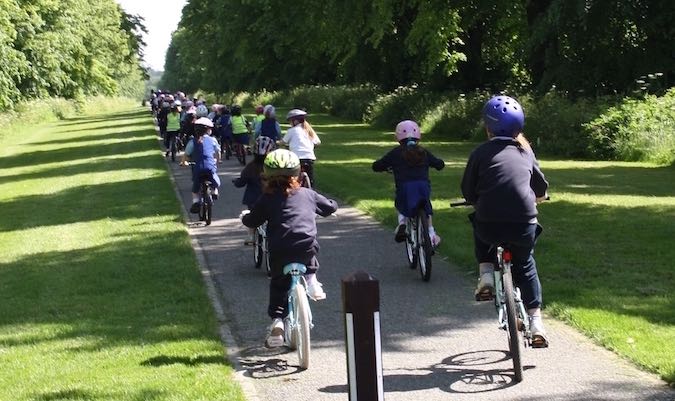
In particular, a spokesperson has been reported as stating that no-one would want a cycle link. Maynooth Cycling Campaign strongly support the provision of cycle facilities between the residential estates and Main Street as it would be a safe route for children attending the nearby school. The alternative route on the Dublin Road has no cycle facilities and would involve a road crossing. Judging from the above photograph, the pupils at Presentation Girls School would appear to agree with our view.
The CWPS also argue that there has been no consultation on the proposal. The proposed walking/cycling link was shown in the Maynooth Local Area Plan 2013–2019 which went to public consultation and was subsequently approved by county councillors. The work is not of a scale which warrants a separate public consultation so Kildare County County got it right this time. Opposition to improved walking and cycling is both mean spirited and detrimental to a more active community.
Maynooth Cycling Campaign submitted the following as part of the Part 8 Public Consultation process on the Royal Canal (Confey to Maynooth).
17 February 2016
Submission on Royal Canal Greenway (Confey to Maynooth)
Maynooth Cycling welcomes the proposal for the development of a Greenway along the Royal canal from Maynooth to the Dublin County border. Together with the Greenway west of Maynooth, currently under development, this will be a huge boost to active and sustainable transport in our area. Since it will allow people of all ages to cycle safely and conveniently between Maynooth and Leixlip, it has the potential to offer a real alternative to the car, leading to improved public health and reduced congestion and pollution.
The Greenway will be part of the Dublin to Galway national cycle route, which in turn is part of the EuroVelo 2 Galway to Moscow route. It will attract significant numbers of tourists to North Kildare towns, giving a welcome boost to the local economy.
We are nonetheless concerned that the proposed scheme is not of an adequate standard to fully capitalise on these potential benefits. In particular, the proposal to finish much of the route in dust, rather than black-top tarmacadam, will deter its use by commuters. Many residents of Maynooth and Leixlip commute to work, between the towns themselves and toward the city. A largely off road, sealed-surface, cycle track will encourage cycle use among these commuters. A dust surface can be appropriate for a pure leisure facility with limited range. However, for commuters and those travelling more than a few kilometres a dust surface which creates dirt, puddles and potholes is wholly unsuitable. Additionally, as noted by Sustrans in their documents, Cycle Path Surfacing Options, unbound surfaces are at least 50% more expensive than bound surfaces to lay and maintain.
The grass verge will limit the ingress of some dust into the canal, but it will not prevent dust being carried by the wind into the water. The environmental report does not provide consideration of dust movement into the water.
Recommendation 1: A bound surface should be provided along the length of the proposed greenway to facilitate the large number of commuters potentially using this route. At a minimum a bound surface should be provided between the towns of Maynooth & Leixlip.
The proposed width of the Greenway is 3 metres. We consider this to be inadequate for safety and comfort of both cyclists and pedestrians; 4 metres is more appropriate. The NRA Rural Cycling Design Standards document TD300/14 specifies 3 metres as the MINIMUM standard for a shared low-volume facility. Given its route through the most densely populated area of the country, high volumes should be expected.
Whilst the available corridor is narrow as some points along its length, additional land could be compulsory purchased to ensure adequate width. Where the removal of vegetation would be necessary to construct a 4 metre wide track, additional land acquired could be planted with native species and, when it matures sufficiently, existing vegetation removed to widen the track to 4 metres.
Recommendation 2: A 4 metre wide track should be provided along the length of the greenway.
The proposed scheme does not set out any objectives in terms of modal shift or number of users. In order to properly assess the scheme, its projected contribution to the government target of 10% of commuters using bikes should be considered. In this context a cost benefit of analysis of dust versus sealed surface and 3 metre versus 4 metre width should be carried out.
Recommendation 3: Further consideration should be given to the design of the scheme in terms of government objectives for commuter modal shift.
The default position of the proposed access controls at Straffan Road and Deey Bridge may create an obstacle to tourists and leisure cyclists with large panniers or child trailers. We appreciate that these are a considerable improvement on the barriers currently on the Grand Canal between Adamstown and Inchicore, but question the need for such restrictive barriers.
Recommendation 4: Bollards to be used instead of access gates at all access points.


 Maynooth Cycling Campaign