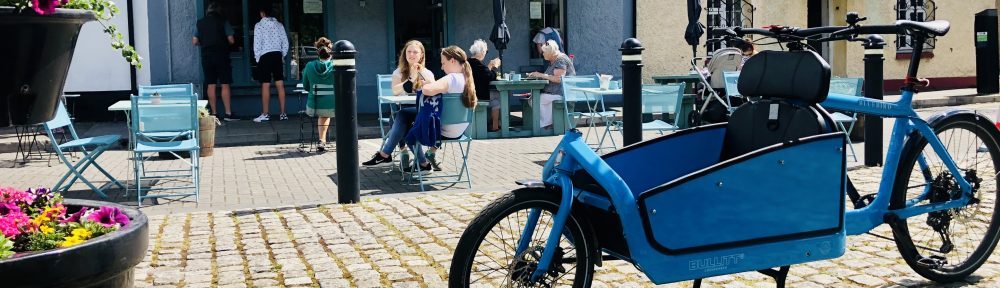
Are You a Cyclist or a Wheeler?

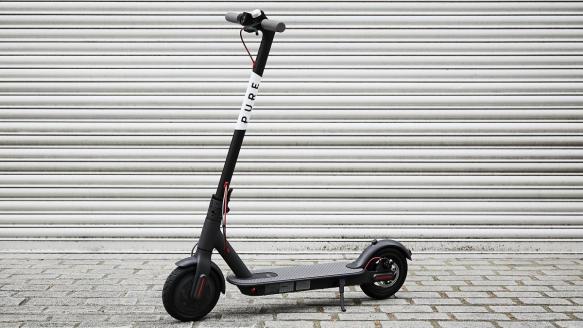
E-scooter

If you are reading this blog, the probability is that you understand that a cyclist is someone wearing their ordinary clothes in an urban situation but to most people a cyclist is someone in lycra riding at high speed a bicycle with dropped down handle bars.

In Ireland we have multiple names for rain. In Iceland they have multiple names for snow. In the Netherlands, they have two words for people who ride bikes. There is a “wielrenner” (wheel chaser/sport cyclist) and a “fietser” (everyday cyclist).

How can we differentiate between the two in an English speaking country if we use the same word for both? We could use bicyclist but that would not be applicable to tricycles or four-wheeled “bicycle vehicles” which have been around for some time.

In recent years, new and innovative forms of personal transport devices have emerged such as electric scooters (e-scooters), segways, trishaws, hoverboards, u-wheels, powered mini scooters (go-peds), and powered unicycles. Such devices may be classified as “Powered transporters” – “novel personal transport devices which are mechanically propelled (propelled by a motor) as well as or instead of being manually propelled”. And this is not to mention hybrid or cross-over devices. So what does you call the people who use such devices. Perhaps it is time to abandon the term “cyclist” to sport cyclists and instead adopt the term “wheeler” to cover people who use wheeled devices.

10 Days to the Biggest Climate Protest in History – SCC PRESS RELEASE

Stop Climate Chaos Coalition

For immediate release : Tuesday 10 September 2019

Student organisers and climate campaigners supporting the School Strikes for Climate have announced their plans for Ireland’s participation in the Global Climate Strike on Friday 20th September. Students have so far organised School Strike Rallies for 10 locations around Ireland from Tralee to Dundalk, as well as Dublin, Cork, Limerick and Galway. Adults have signed up to host 60 local Support Actions in their communities and workplaces for people who can’t make the rallies. These numbers are growing every day and a team of volunteers is on hand to support people who put their hand up to organise a local event.

Commenting Áine O’Gorman, Activism Support Coordinator with the Stop Climate Chaos Coalition, said:

On September 20th we hope to empty schools and workplaces and fill the streets with people demanding our Government take climate action more seriously. Our house is on fire – let’s act like it.

We’ve have a great response to our call for people to organise local actions in support of the school strikes and our volunteers are ready to help anyone who wants to get involved in their community or workplace.”

The Global Climate Strike was called by Swedish teen, Greta Thurnberg, and the global youth movement she has sparked. But this time she has asked adults to join in, saying “We need everyone, to change everything”. The Global Strike comes three days before heads of government from around the world, including Taoiseach Leo Varadkar, are due in New York for a UN Climate Action Summit. Greta, who has been invited to speak at the summit, sailed to New York in August in a zero emissions boat, with the slogan “Unite behind the science” emblazoned on the sails. The overarching message to world leaders from the strikers and their supporters is “It’s an emergency, act like it”.

Oisín Coghlan, Coordinator of the Stop Climate Chaos Coalition, said:

“The Dáil declared a Climate and Biodiversity Emergency in May but as yet the Government is not acting like it. Just days later they issued new licences to Exxon and the Chinese to search for more oil and gas in Irish waters. And months later they still haven’t sat down with the trade unions to discuss the plight of the workers in the midlands who are facing a disorderly exit from the peat industry because for 20 years Irish politicians have refused to plan for a Just Transition away for fossil fuels.”

The first international School Strike for Climate in March saw 1.6 million young people and their families take to the street around the world, including 15,000 in Ireland.

ENDS

For more information or interviews contact:
Áine O’Gorman, Activism Support Coordinator, Stop Climate Chaos Coalition, or
Oisín Coghlan, National Coordinator, Stop Climate Chaos Coalition, on

1) All the student-led #ClimateStrike Rallies, and the local support actions organised by adults in communities and workplaces are on this map:
https://www.stopclimatechaos.ie/campaigns/support-the-climate-strike-movement/

2) So far the following student-organised marches and rallies are confirmed:
Dublin: Gathering 12:00 at Customs House, marching at 12:30 to Merrion Sq., rallying 13:00 – 14:00 at Merrion Sq. in front of Govt. buildings
Cork City: Gathering on Grand Parade St. from 12:00, marching at 12:20.
Kerry (Tralee): Meet at County Buildings, Ratass, at 9am
Clare (Ennis): Meet at The Height, O’Connell Square at 9am
Drogheda: Demonstrating from 13:00 outside St. Peters’s Church, West St.
Galway: Demonstrating from 13:00 – 16:00 in Eyre Square
Navan: Demonstrating from 13:00 – 15:00 at the Market Square
Limerick: Marching from Arthur’s Quay Park at 13:00, finishing at City Hall.
Dundalk: Demonstrating from 12:30 – 15:00 in the Market Square
Kenmare: Demonstrating from 9:00 – 13:00 outside the Courthouse

The student organising groups are:
Fridays for Future: https://www.fridaysforfuture.ie/september-20th
Schools Climate Action Network: https://www.schoolsclimateaction.ie/

3) Details of the Global Climate Strike are here: https://globalclimatestrike.net/

4) Details of the UN Climate Action Summit are here: https://www.un.org/en/climatechange/
 

Cyclist.ie Demands ‘Revolution’ in Cycle Transport Funding! – PRESS RELEASE

Don’t tell me where your priorities are. Show me where you spend your money and I’ll tell you what they are  – Jim Frick, Notre Dame USA.

Cyclist.ie, the Irish Cycling Advocacy Network, calls on the Government to implement the recommendation of the all-party Joint Oireachtas Committee on Climate Action (JOCCA) Report and of its own Climate Action Plan by allocating 10% of the Land Transport budget to cycling with immediate effect from Budget 2020. Currently, despite the fact that cycling provides the highest rate of return on investment of all transport projects, as well as numerous co-benefits for health and the environment, it receives less than 2% of the land transport budget, notwithstanding recent increases. According to the Chairperson of Cyclist.ie, Colm Ryder, “10% of Transport funding is required, in order to expedite the development of a comprehensive cycle policy and long-stalled strategic cycling infrastructure projects not just in Kildare but in all of our urban and rural areas”.

Read Budget 2020 submission here: https://cyclist.ie/2019/08/cyclist-ie-pre-budget-submission-2020/ .

In addition to essential cycling infrastructure, ranging from commuter routes to greenways, Cyclist.ie is calling for the establishment of a National Cycling Office within the Department of Transport Tourism and Sport, to oversee overall development in Policy and Legislation, and for the appointment of dedicated cycling officers at senior level in all local authorities.

Cyclist.ie points out that one striking, short-sighted and regrettable omission from the Government’s Climate Action Plan is the absence of any incentives towards the purchase of electric bikes, or electric cargo bikes. This is in spite of projections from the Department of Transport Tourism and Sport that the cost of congestion in the Greater Dublin Area will amount to €2Billion per year by 2033. Instead, the very first action mentioned in the Transport Section of the Plan is to develop the EV charging network so as to support “at least” 800,000 EV’s by 2030. Modal shift is mentioned in the Plan only in the context of Public Transport. E-bikes (including e-cargo bikes) have great potential to encourage modal shift and change the transportation dynamic. E-bikes have the potential to replace a family car, enable longer commutes, enable older people to remain active for longer, facilitate cycling in hilly areas, increase levels of everyday cycling, and help to reduce congestion levels

For these reasons, from Budget 2020 onward the Government must develop and operate a purchase subsidy for e-bikes, in parallel with the subsidy for electric cars. An extra generous allowance should be given to those who show that they are replacing a car with an e-bike. It is critical that e-cargo bikes are included in this scheme as they are a cost effective and low emissions means of freight deliveries in cities, as well as potential family transporters.

Other asks in the Cyclist.ie budget submission include mandating the provision of high-volume safe and secure bike parking at all public transport hubs, all public buildings such as schools, hospitals, libraries etc, and all major event centres such as sport and concert venues as well as provision for the carriage of bikes on trains and buses. In addition, the organisation wants to see cycle training being made available free of charge in all primary and second level schools. It wishes to see greater flexibility in the Bike to Work scheme including its extension to those not in work such as students, the unemployed and retired people. Finally, Mr Ryder states that legislation and enforcement are crucial – “The long-promised safe passing (of cyclists) legislation is by far the most urgent need, but other laws, to bring us in line with our European neighbours, such as contra-flow cycling on one-way streets and turning left on red lights are required” he stated, “as well as enforcement action on parking in cycle lanes”.

ENDS

Who Decides on the Expenditure of Discretionary Grants – Councillors or Officials?

Councillors like to think that they make policy and approve budgets while the role of officials is to implement policy. In the autumn, officials present draft budgets for the coming year for approval and after arguing over increases or decreases, councillors eventually approve the budget and strike an associated rate for business.

However, councillors are primarily concerned with discussing revenue raised by the council. The budget includes notional figures for grants from government or government bodies such as TII or NTA. These tend to be for specific projects which councillors wish to see progress. The difference between the estimated allocation and the actual drawdown is regularised when that year’s expenditure is finalised some 18 months later.

In the past, councillors have had little interest in this stream of funding from government as it was intended for specific schemes. However, in more recent years the DTTaS has allocated an element of Discretionary Funding which amounts to over €80 million nationally in 2019. Not all counties receive a Discretionary Grant. The Dublin Local Authorities do not receive anything. Kildare County Council’s portion amounts to €2.5 million – not a fortune by today’s standards but still a sizeable amount. Councillors frequently receive the response that no funding is available for a particular project. The question is who decides on its use – the elected councillors or officials? And, equally important, what proportion should be allocated to walking and cycling?

How cycle friendly is Dublin?

If Ireland is really interested in increasing the level of cycling rather than just ticking the cycling box, it needs to pay attention to the views of international experts.

Bicycle Dutch's avatarBICYCLE DUTCH

I couldn’t remember when I last felt afraid on my bicycle. Not just anxious, but genuinely fearing for my life. I do now, after I cycled in Dublin last week. The 4-kilometre-long ride from my hotel near the Phoenix Park Gate to the Conference Centre of Dublin was just one long straight line on the quays of the river Liffey. The route couldn’t be easier. According to plans from 2011 there was supposed to be a cycle route here, but there wasn’t. Instead, there were multiple lanes for motor traffic. The drivers of most vehicles showed little respect for cycling. I can’t tell you what was worse; the quays during rush hour, with the many large vehicles that you had to find (and fight) your way through, or the quays outside rush hour, with motor traffic passing just centimetres from you at incredibly high speeds. The leap·frogging with the many…

View original post 870 more words

Big data surprises

Interesting article including information on benefits of cycling in Utrecht.

stripymoggie's avatarCargobike Dad

It has been quite the week for data.

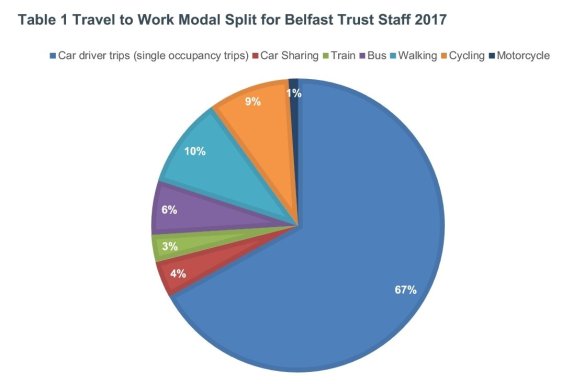
The Belfast Health and Social Care Trust have launched their annual Staff Travel Survey. Last year’s results are available in the Trust’s Travel Plan. It reveals that 9% of staff cycle to work:

The official figures for Belfast indicate cycling is somewhere between 3 and 5%, with cycling across Northern Ireland at 1% stubbornly refusing to move out of the statistical noise (i.e., the margin of error in the stats is greater than the reported number) in the past decade.

The 2018 staff travel survey shows the number of cycling commuters are at least double the city’s average.

This has big consequences for Belfast. The Trust is responsible for 1/3 of Belfast traffic. And how Trust staff travel has a real effect on congestion, air pollution and carbon emissions.

The targets for 2020 are mind-boggling:

The Trust are aiming for a 16%…

View original post 576 more words

SCC 5 Tests for All-of-Government Plan for Climate Action

Stop Climate Chaos

With the EPA confirming that Ireland will fail to meet its obligations to reduce carbon dioxide emissions by 2030, the Cabinet will meet shortly to consider the contents of the new All-of-Government climate plan which is intended to set out the roadmap to a carbon free future. The Stop Climate Chaos Coalition (SCC) has developed 5 tests for this new plan:

1. Does the plan acknowledge the scale of the challenge?
Does the plan accept that Ireland needs to get to net-zero emissions by 2050 and that our 2030 targets must be strengthened in line with the Paris Agreement and the IPCCC science? Will Ireland finally join with other countries calling for the EU’s ambition to match its rhetorical commitment to the Paris Agreement?

2. Does the plan commit to putting the Oireachtas recommendations on governance into law by the end of the year?
Will the Government bring forward legislation before the summer recess to amend the Climate Action Act in line Chapter One of the Joint Oireachtas Committee report to be enacted before Christmas? That includes putting our new 2050 target into law, 5-year carbon budgets voted on by the Dái l, a strengthened Climate Action Council (and a standing committee of the Dáil to act like the Public Accounts Committee for carbon emissions.

3. Does the plan cut emissions in every sector?
Does the plan include new measures to cut emissions in every sector of the economy? And not just “consider” or “explore”. John FitzGerald, chair of the Climate Advisory Council famously called the Government’s last climate action plan in 2017 “100 good ideas but no new decisions”. The decisions in the plan have to be definite enough to allow the EPA to revise its emissions projections.

4. Does the plan “do the math”?
Does the plan quantify the emissions reductions for every measure? And does it add them all up and benchmark them against our existing 2030 target and our 2050 goal. Does it express them as a carbon budget?

5. Does the plan make clear how the Government will devise the next set of actions?
The Oireachtas Committee makes clear that even its full suite of recommendations does not achieve our fair share of climate action. Does the Government plan acknowledge that too and, crucially, lay out a process and a timeline for developing and adopting the next round of actions?

We look forward to see what decisions the government takes.


Cycling for All – Kildare Supporters

Maynooth Cycling Campaign, on behalf of Cyclist.ie (the Irish Cycling Advocacy Network), contacted candidates running for election to Kildare County Council and sought their commitment to high quality cycle facilities through support for Cycling for All.  Maynooth candidates were asked a further local question – to support high quality cycling facilities to two primary schools on the Celbridge Road serving some 700 pupils.

Well the election is now imminent – so what is the position on cycling of candidates? One canvasser said in response to a query “Isn’t everyone in favour of cycling?” Well actually no.  All or practically all are in favour of cycling but support ranges from strong to very soft.

The candidates who pledged support for high quality cycle facilities by endorsing Cycling for All are listed in Table 1 below. We wish them all well in the election and hope that you, the voter, will remember them in the polling booth.

Electoral DistrictNamePartySupport for High Quality Cycling on Celbridge Rd Maynooth
MaynoothPeter Hamilton Green PartyYes
MaynoothCllr. Tim Durkan Fine GaelYes
MaynoothRioana Mulligan Fine Gael 
AthySamantha Kenny Soc Demsn/a
CelbridgePhilip Slattery Fine Gaeln/a
CelbridgeCllr. Brendan Young  Independentn/a
ClaneCllr. Padraig McEvoy Independentn/a
ClaneEoin Hallissey Green Partyn/a
KildareDeclan Crowe   Independentn/a
LeixlipCllr. A. Larkin  Independentn/a
NaasCllr. Sorcha O’Neill Independentn/a
NaasBill Clear Soc Demsn/a
NaasCllr. Carmel Kelly Fianna Fáiln/a

In the report entitled International Cycling Infrastructure Best Practice Study on behalf of Transport for London, consultants identified a number of characteristics of locations where cycling was either strong or where there was strong commitment to increasing the level of cycling. The first characteristic was

There is strong, clear political and technical pro-cycling leadership which is supported through all parts of the lead organisation.

Strong clear political leadership is generally lacking in Ireland but support for Cycling for All shows that that is now changing. More than 120 candidates  have signed up which includes representatives from Fine Gael, Fianna Fáil, Sinn Fein, Labour, Green Party, Social Democrats and People Before Profit as well as Independents.  

What Do They Love More – Their Cars or Their Kids?

Screenshot 2019-05-18 at 14.30.25

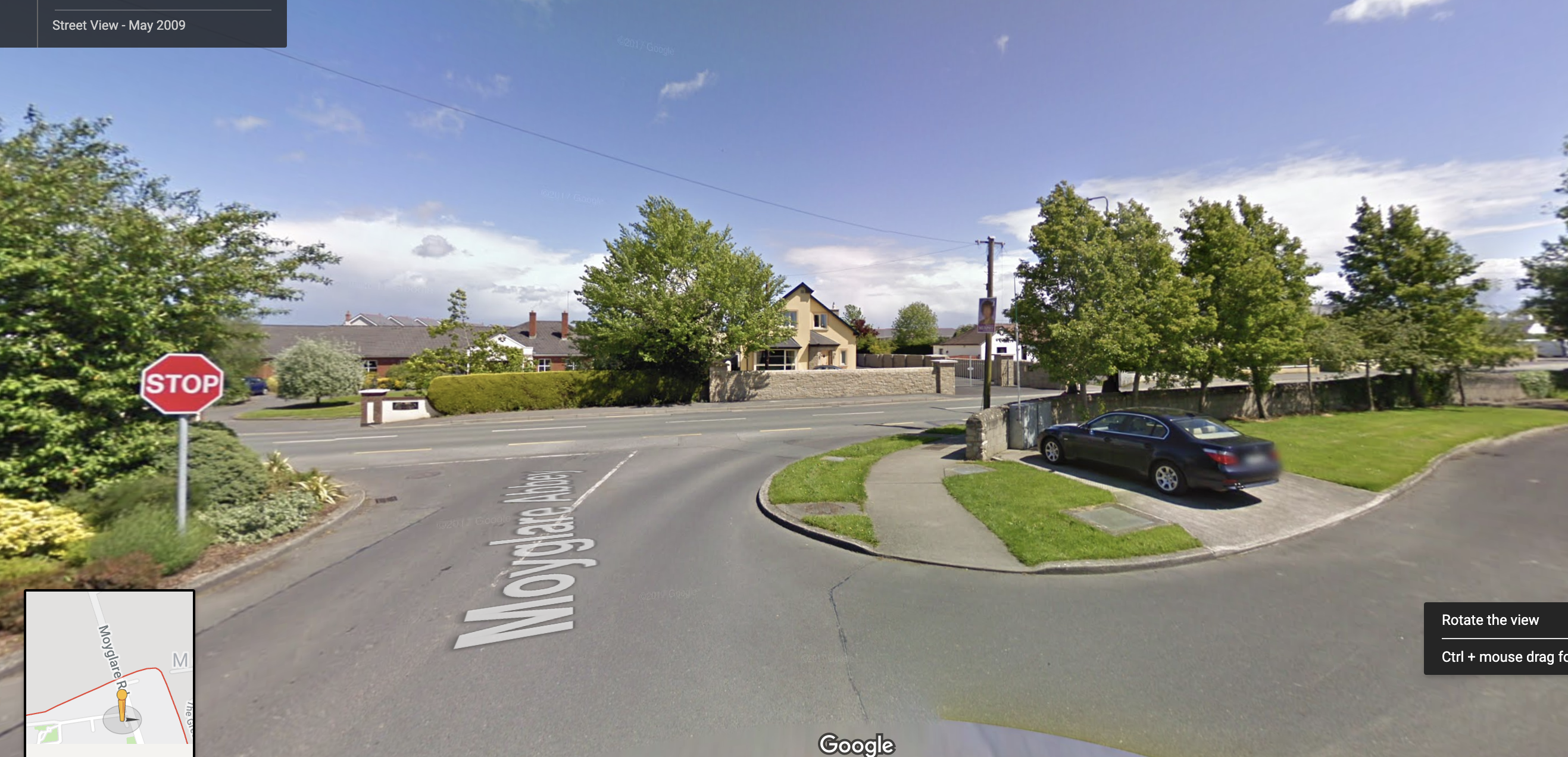
A number of Moyglare Abbey residents have complained about the proposed narrowing of the entrance to the estate from the Moyglare Road as part of the provision of cycle facilities to the new school campus.

Arising from issues raised, Kildare County Council undertook to carry out a review of the proposed junction and in a letter the Senior Executive Officer stated that

With reference to the entrance to Moyglare Abbey, the proposed works to the entrance are to ensure compliance with DMURS.

This statement is incorrect. The internal roads of Moyglare Abbey were designed at a time when engineers considered that wide roads were beneficial for road safety reasons. It is now realised that on the contrary wider roads encourage faster speeds which makes it more dangerous particularly for vulnerable road users such as pedestrians and cyclists.

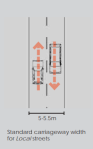
The Design Manual for Urban Roads and Streets (DMURS) sets out current thinking on the design of urban roads and streets. The emphasis is on the design of “streets” in urban areas as the word “streets” suggests multi users as opposed to “roads” which suggests priority for cars and motorised traffic. Leaving aside the term streets, roads are categorised as either arterial roads, link roads or local roads. Internal estate roads like in Moyglare Abbey are local roads – they cater for local only as opposed to through traffic. Section 4.4.1 of DMURS includes Figure 4.55 which gives widths for different categories of roads. The following, an extract from Page 102, defines the widths for local roads ranging from 5 to 5.5m:


If the entrance was in accordance with DMURS, it would be within this range. Instead it is 7m wide which is narrower than it was but which shows how badly designed, by current standards, many of our existing roads and junctions are. If councillors are interested in road safety, they should ask three questions:

  1. What Is the width of the junction and where is it set out in DMURS as being applicable for a local road?
  2. What are the the kerb radii and where is it set out in DMURS as being applicable for a local road?
  3. Does the junction design prioritise cars or pedestrians and cyclists as set out in the DMURS hierarchy of road users?

The Moyglare Abbey access road is different from many other estates in that it also serves a farm. As the entrance must also work for the farm, councillors should ask a fourth question :

    4.  What is the width and frequency of “farm” traffic.

This may lead to a wider entrance than specified by DMURS but an increase should be reasonable. It should not, as in the past, be designed for the  widest vehicle. 

Screenshot 2019-05-18 at 14.41.10

Photograph showing Entrance to Farm off Moyglare Abbey

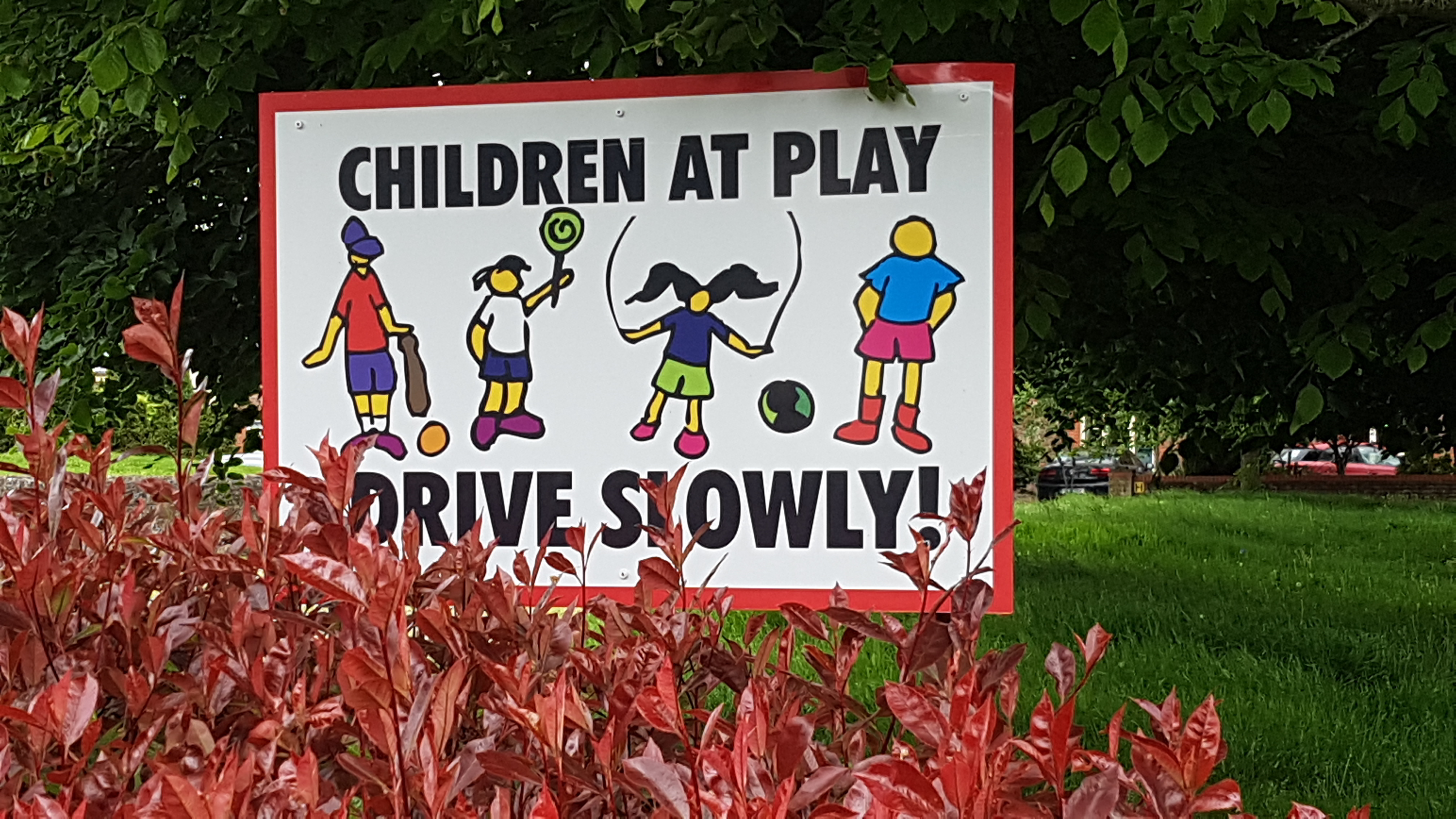
Those who oppose the narrowing of estate junctions increase the risk to children and other vulnerable road users. The Moyglare Residents Association erected the sign below to alert drivers of the presence of children but in deciding on speed most drivers take their cue from the road form rather than from road signage. At the end of the day, people have to decide what do they love more  – their cars or their kids? 

moyglare

Postscript – The road/laneway to the farm is only 2.45m so the entrance to a residential estate is nearly three times the width of a road for farm machinery. Crazy!!!

Celbridge Road Needs High Quality Cycle Facilities

Election time is an opportunity by cycle campaigners to reassess progress and to set out new goals for the future. From earlier this year, we identified one glaring omission in Kildare County Council’s proposals for Maynooth – the failure to provide for cycling facilities to the two primary schools on the Celbridge Road. Planning for these schools commenced nearly twenty years ago with little or no consideration on how children would cycle to school and last year, Kildare County Council’s Area Engineer was quoted as stating that there was no room for cycle facilities.  As it turned out, draft plans have recently been drawn up to provide cycle facilities on the Celbridge Road and we are grateful to Cllr. Tim Durkan for informing us. However, the use of the terms “provide” and “cycle facilities” is somewhat arbitrary. The proposed cycle track does not connect with the Straffan Road cycle track and doesn’t extend as far as either of the two schools. It is also discontinuous at Laurence’s Avenue and its effective width is 1.5m which puts it in the category of low quality. The County Council seems to think that cyclists have need to travel in one direction only as the cycle track is unidirectional. Overall, it is an appalling design and once again the council is “ticking the box” for cycling but doing nothing to enable people who want to cycle. Maynooth Cycling Campaign proposes a 2m footpath and 2m cycle track with 1m buffer either side of a 6m road, requiring an overall width of 16m. The existing cross-section of the Celbridge Road varies along its length but there is generally an available width of 14m. So where does the other 2m come from?

Existing Cross-section adjacent to Rockfield

At Rockfield Estate, the 2m could be made up from grass verge on the Laurence’s Avenue side.  Between Rockfield and the Maynooth Educate Together School, it will be necessary to acquire a strip of land at the front of two properties either by agreement or through the use of a Compulsory Purchase Order. Compulsory purchase orders are a normal procedure for providing new roads and it is proposed to used the procedure as part of the Bus Connect project to acquire additional space.

Proposed Cross-section (Typical)

It is accepted that close to the junction with the Straffan Road a pinch point does exist which will require an imaginative solution. The location of two bungalows close to the road complicates the use of CPOs and while there is also a lack of space at Maxol, only a short length is affected. Consequently, a reduction in standards over a short length or, alternatively,  a reduction to a single traffic lane with flow in one direction (after the construction of the relief road between the Celbridge and Straffan Roads) may be acceptable. A detailed survey of the area will allow all options to be considered. Discussions will be required with adjacent residents as part of the design process. However, this must be balanced against the needs of the wider community and government policies on climate and health. High quality cycling facilities on the Celbridge Road is supported by Maynooth Cycling Campaign. It also has the support of the Parent Teacher Association of Maynooth Educate Together and the Parent Association of Gaelscoil Uí Fhiaich. For some twenty years, Kildare County Council has been providing low quality cycle infrastructure which has had negligible impact on levels of cycling. If it continues to provide such quality, there will be negligible change in the next twenty years. Maynooth Cycling Campaign proposes to lobby candidates for the Maynooth Municipal District to support high quality cycle facilities on the Celbridge Road and to publicise the results in advance of the election.