via Where is the best place for congestion?
Where is the best place for congestion? – Thoughtful article on the pointlessness of trying to build your way out of road congestion. Very relevant to proposals to add another lane onto the M4.
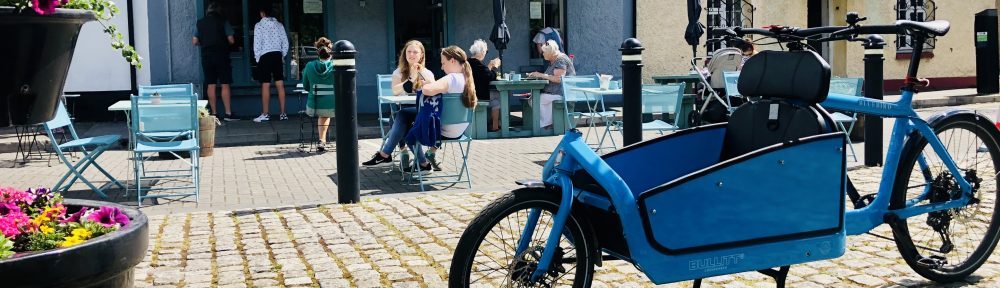
via Where is the best place for congestion?
Where is the best place for congestion? – Thoughtful article on the pointlessness of trying to build your way out of road congestion. Very relevant to proposals to add another lane onto the M4.
The Irish Pedestrian Network and Cyclist.ie call on the national government to provide safe, usable space across the country for people to shop, exercise and commute by walking and cycling during the Covid-19 crisis as a matter of urgency.
While current lock-down restrictions are in place until May 5th, the Minister for Health Simon Harris has stated that social distancing measures may stay in place to some degree until a coronavirus vaccine has been found. A substantial percentage of Irish people shop on foot or by cycling, and physical exercise is vitally important to both physical and mental health.
The Irish Pedestrian Network and Cyclist.ie propose that while motor traffic is reduced, space on streets must be reallocated to walking, running, cycling and playing to ensure safe social distancing within communities – a reallocation that is already taking place internationally.
Speaking for the Irish Pedestrian Network Ailish Drake says, “The New Zealand government has empowered local communities to create more social distancing space by providing 90% funding for new footpaths and widen existing ones, and to create pop-up bike lanes. These measures can be put in place in a matter of hours or a few days using paint, blocks or planters.”
Damien Ó Tuama spokesperson for Cyclist.ie, the Irish Cycling Advocacy Network, says,
“Over sixty towns and cities worldwide, in recognition of this new reality, have quickly installed low-cost temporary measures by using cones to widen footpaths and repurposing full vehicle lanes to cycle lanes. Dublin has now joined Berlin, Washington DC and London in reallocating road space to ensure safer social distancing is possible. We want other councils to do the same.”
The Irish Pedestrian Network and Cyclist.ie welcome efforts by many local Councillors and TDs in seeking additional space for social distancing across Irish cities and in particular the progress made in Dublin where Dublin City Council will begin implementing emergency distancing measures from Monday 20th April.
The IPN and Cyclist.ie now call on the government to implement a nationwide program as follows:
1. Make social distancing easier for those walking or cycling to shops or essential work
2. Automated pedestrian crossings so people do not have to manually press signal buttons.
3. Introduction of a default speed limit of 30km/h on all urban and suburban streets
4. A proportionate reallocation of road space to pedestrians and cyclists, to make walking and cycling safer for those who are exercising within their 2km zone, especially those with prams or wheelchairs
5. Local authorities to prioritise temporary widening of footpaths, pop-up cycle lanes, quietways in cities and/or closing road lanes and specific streets to motor traffic (for example: by the temporary application of DMURS standards to existing streets)
6. New space to be allocated fairly and with consideration of universal needs across city centre, suburbs, towns and villages to avoid people ‘flocking’ to centralised areas
7. Dedicated teams in each local authority to enable local residents and interested groups to plan and design temporary footpaths and cycle lanes in their locality
8. Rapid implementation of said routes with a design strategy to clearly indicate new routes to users and motorists.
Orla Burke, spokesperson for Pedestrian Cork explains, “Families in Cork, denied the opportunity to drive to their favourite walking spots, are coming face-to-face with the poor provision for walking in their immediate neighbourhoods. Quick wins are available to our councils but this requires thoughtful leadership. This could be a time for simple yet effective improvements to facilitate walking. We call on our local authorities to rise to the challenge of Covid-19 make our streets safe for all.”
Anne Cronin of Cycle Bus Limerick added, “For children that live in the city or suburbs, jumping on their bike with a parent, is their only way to connect with a space outside of their home. Many children are forced to cycle on the road as opposed to the footpath and therefore are at risk without segregation. The increase in the numbers of children cycling in our city is remarkable at the moment and children should be protected and supported to remain doing so.”
Ailish Drake added that “these temporary actions in response to the Covid-19 emergency, would be strategic in creating a positive culture change to make our towns and cities more liveable and contributing to a much needed boost in footfall required to aid the economic recovery when we move beyond the current crisis. This is in line with current government policy for both urban and rural regeneration development funds (URDF & RRDF).”
END
The Irish Pedestrian Network is a national advocacy group working to deliver a public realm that is inclusive and ambitious for all. The Network has rapidly grown since its foundation in 2019, and now has affiliated groups in Dublin, Limerick and Cork. Twitter @IrishPedestrian
Maynooth Cycling Campaign is a member of Cyclist.ie, the Irish Cycling Advocacy Network.
Professor John Crown has called for lowered speed limits during this COVID-19 emergency via social media (Twitter, Mar 20). On behalf of people who walk and cycle every day, we back him 100%. As he said, soon our Emergency Departments will likely be busy enough.
Frontline healthcare professionals have to self-isolate outside of work, both to protect themselves and us. Many are choosing alternatives to public transport to get to and from work. Cycling provides social distancing, daily exercise, and mental health benefits; all of which our doctors, nurses, carers, porters, and cleaners need.
Empty streets mean people are staying home. But we are deeply concerned by countrywide reports of people driving faster and ignoring speed limits. They are putting people walking and cycling at risk of being patients in our EDs.
The research is stark: collisions at 50km/h are five times more likely to be fatal than at 30km/h.
As Prof Crown says, we need lower speed limits, now.
Timely blog on cycle priority on roundabouts – the pros and cons. Important discussion on how the Dutch prioritise cycling over private cars in practice whereas in Ireland it is in theory.
Roundabouts are much safer than regular intersections. There is not much debate about that fact in the Netherlands. But when it comes to the priority rules on roundabouts the opinions differ sometimes. Why does cycling need to get the right of way over motor traffic on roundabouts? This guideline from the Dutch Ministry of Transport, “causes many unnecessary victims among people cycling”, a small minority of opponents claims. Is that true? Or do Dutch road safety experts, cycling advocates and most of the authorities maybe look at a bigger piture?
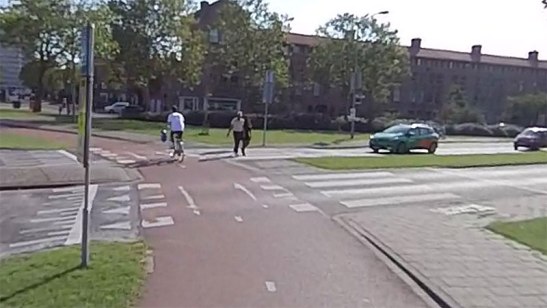 A pedestrian and a cyclist on a roundabout in ’s-Hertogenbosch, both have priority over the drivers who wait patiently for their turn.
Every now and then the discussion flares up about the priority of cycling on roundabouts. In the Netherlands the guidelines are clear: in the built-up area cycling must have priority over motor traffic and outside the built-up area…
View original post 1,676 more words
We are urging all cyclists to get out and vote on Saturday for the
political parties that have promised to make a difference for everyday
cyclists. Check out our comparative ratings of the political party
manifestos above, and think about how you cast your vote! These
ratings are based simply on what the various parties have outlined in
their manifestos in relation to proposed investment and policies to
grow cycling in Ireland. **YOU BIKE – YOU VOTE!**


(This article was previously published in GreenNews.ie in a series under the heading of “What the experts want from GE 2020 “. In this case the expert is Cyclist.ie, the Irish Cycling Advocacy Network, which is represented by Martina Callanan of the Galway Cycling Campaign.)
Over the past three weeks, as in all election cycles, we have become accustomed to the knock at the door from canvassers or candidates themselves are they vie for our number one at the ballot box.
We have asked leading climate and biodiversity experts to tell us the key policy asks that they have raised with candidates when they come a-knocking.
Next up is Martina Callanan who represents Galway Cycling Campaign on the executive council of Cyclist.ie, the Irish Cycling Advocacy Network, whose vision is for cycling to become a normal part of transport and everyday life in Ireland.
The network sees cycling as a vital part of building healthier and less polluted communities, and has developed 10 election asks that it Martina has boiled down to three kernel points below.
Make cycling a normal everyday activity
Cycling is a critical part of the transport equation in combating Climate Change. We need everyday cycling to be better and safer, more convenient, and easier. Hopping on your bike should be a more attractive option for the so-called first-mile and last-mile journeys.
No more slashing of funding or paltry rises: major investment is needed to shift people away from car dependency, especially for short journeys under 5km. This means greater investment in cycling infrastructure and promotion.
We need our next Government to allocate a minimum 10 per cent of transport funding to cycling immediately as promised under the National Climate Action Plan. Currently, cycling is allocated a tiny two per cent of our transport spend.
We do not need to reinvent the wheel. Bike safety is highest in countries and cities where bike use is high and people cycling have interconnected networks of segregated routes such as in the Netherlands, Denmark, and Bristol and Manchester in the UK.
It’s as easy as ABC: Allocate 10 per cent of transport funding to cycling; Build safer infrastructure, and everyone will cycle more.
Build safe segregated networks
Manifestos that mention school cycle buses should make us weep with rage. There should be no need for parents and adults to marshal kids to school on bikes, forming human shields between small soft bodies and big, motorised, metal boxes. Cycle buses must not become the norm.
What we need are safe routes to schools and throughout populated areas: networks of segregated cycle paths along roads; safe junction design with priority signalling for people on bikes; and quiet routes through permeable neighbourhoods. Let’s get designing and building!
Increasing cycling numbers in Ireland will cut congestion, improve public health, and reduce pollution. To get more people cycling, we need to make it an easier and safer choice. Let’s have real cycle networks, safe school routes, and coordinated planning, policy and policing that protects us.
Design fit-for-purpose planning, policy and policing system
The 3 Ps of Planning, Policy and Policing seem a little dry at first glance – but these are the actions that make the good things happen.
Planning – Building safer cycling infrastructure should be guided by our National Cycle Manual. This design guidance needs urgent updating to upgrade our standards and bring us into line with best international practice.
Policy – We need joined-up thinking for everyday cycling across a myriad of Departments – Transport, Health, Environment, Housing, Education, and Justice. We need a resourced National Cycling Office, preferably within the Department of Transport to coordinate policy and ensure action.
Policing – We have road traffic legislation that considers people who cycle and walk, but enforcement needs greater priority. People who cycle are frustrated and frightened by illegal parking in cycle lanes and dangerous overtaking.
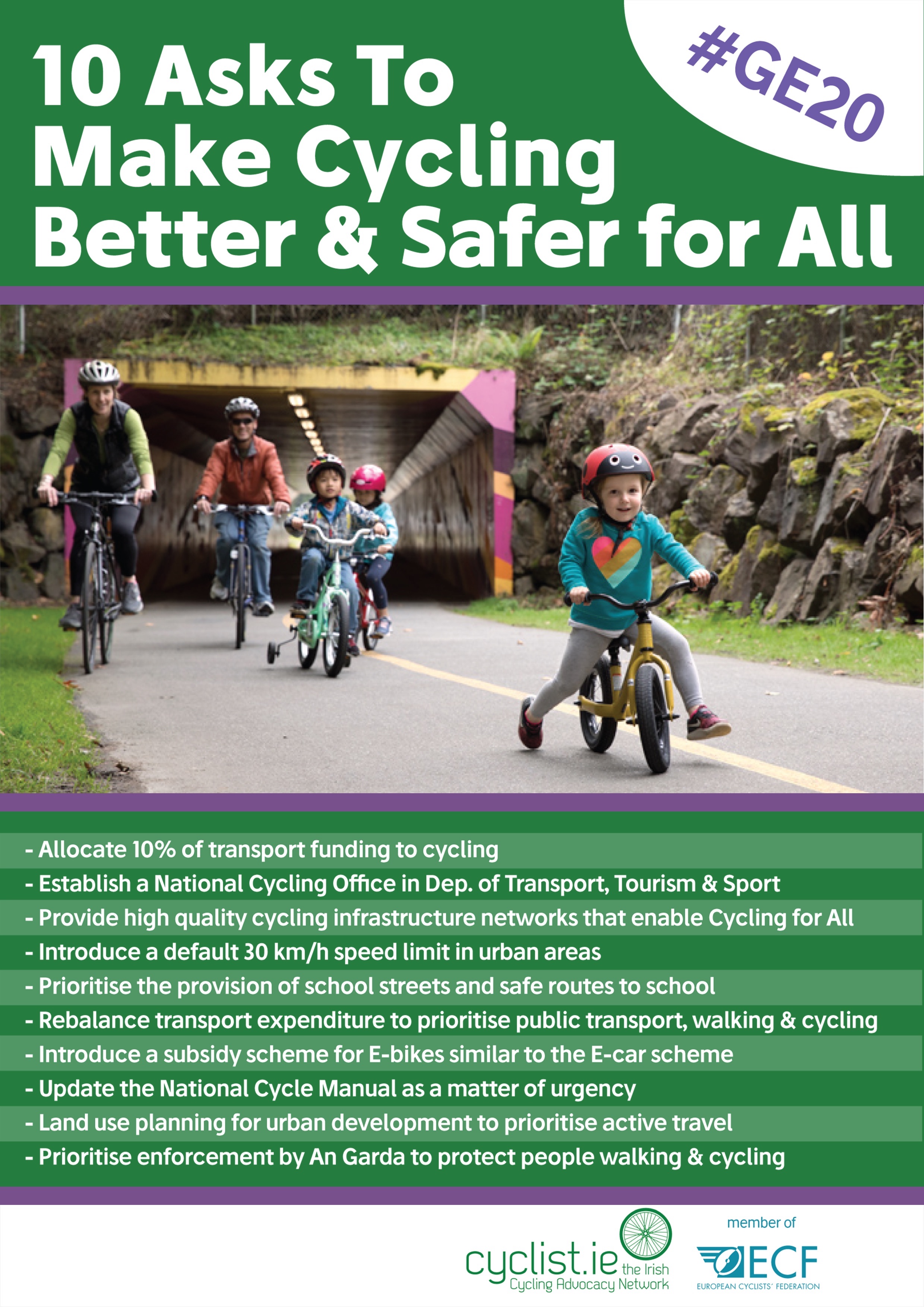
Ten asks from Cyclist.ie – consisting of more than 20 cycling campaign and greenway groups across the country.

I happened to be in Cambridge this week and I also happened to see some relatively new streets. You would think that in the UK city with the highest rate of cycling that I’d have seen some world class cycling infrastructure? Sadly not.OK, what I did see in the Eddington development, in the northwest of…
On Thursday 23rd January 2020, Dropbox will formally launch its initiative to support everyday cycling in Ireland at an event in its European Headquarters in Hatch Street in Dublin. Dropbox has agreed to support the work of the Dublin Cycling Campaign and to help it develop as a stronger cycling advocacy force.
Dropbox is the first company in Ireland to formally support the work of Dublin Cycling Campaign as Business Members. This follows its pioneering support for other progressive causes over the years such as the Marriage Equality and Pride campaigns.
Amongst the speakers at the special event on 23rd of January in the company’s Dublin headquarters will be Paulo Rodriguez, Director of Solutions EMEA, Klaus Bondam, CEO of the Danish Cyclists’ Federation, Dr. Sabina Brennan, Neuroscientist and Active Travel Advocate from Trinity College Dublin and Dr. Damien Ó Tuama, National Cycling Coordinator with Cyclist.ie – the Irish Cycling Advocacy Network. Invitees will include senior executives from many of the country’s largest tech and finance firms, together with figures from the transport world.
Dropbox’s employee led initiative responds to the urgent need to develop Dublin and other Irish cities as bicycle friendly and Active Travel cities. Compared to other places where large tech companies are based – such as Copenhagen, Berlin, Stockholm and Amsterdam – Dublin and other Irish cities need to recognise the necessity to become properly bike and family friendly. This means ensuring greater investment in high quality segregated cycling infrastructure, making the most hostile junctions cycle friendly and lessening car domination of our streets, to encourage all ages, genders and ethnicities to be ‘active travellers’.
Speaking before the event, Dr. Damien Ó Tuama from Cyclist.ie, stated: “We are really delighted with Dropbox’s support for cycling advocacy. A recent internal employee survey found 85% of Dropbox employees, bike, walk or take public transport. Our advocacy work is continually pushing cycling up the political agenda. Our recent detailed budget submissions and presentations to the Joint Oireachtas Committee on Transport, Tourism and Sport succeeded in further raising awareness around the need to bring cycling into the core of transport thinking and practice. We now want this translated into higher levels of national investment, and quality schemes on the ground so our communities are cycle friendly for everyone aged 8 to 80. The support of Dropbox – and other progressive thinking companies – will enable us to transition into a much stronger advocacy force and accelerate this necessary transition.”
Speaking on behalf of Dropbox, Paulo Rodriguez, Director of Solutions EMEA added the following: “We understand the importance of making cities and towns bicycle friendly, and are delighted to partner with Dublin Cycling Campaign. They are advocating to make cycling a safe aspect of everyday life. We have been very impressed with their unceasing work to effect change at national, local and community levels.”
ENDS
15th December 2019
Prof. John Sweeney’s final report on the UNFCCC COP-25 Meeting in Madrid, December 2019.
See also his three previous reports : No Real Progress in Week 1, Waiting for Leadership and the EU’s Green New Deal, Deadlock at COP – Can the Chilean President Deliver Progress on Key Issues?
And so after two weeks of negotiations, COP25 finally came to a fractious end on Sunday, some 40 hours past the scheduled close. As the remaining bleary-eyed delegates gathered for the final plenary, the stands were being dismantled, the protesters had departed and the motto of the meeting “Time for Action” had a hollow ring to it. Make no mistake, this was a failure of epic proportions. Whereas in Paris in 2015 the countries of the world had come together to do business, in 2019 some of them came to obstruct progress and to place narrow national and financial interests ahead of the urgent needs of the global community. The science that told them there was less than a decade of present carbon budget left to burn to have a reasonable chance of avoiding the climate tipping points associated with a global warming of 1.5oC did not sway them. Neither did the vigorous participation of the global youth represented, nor the urgings of the Secretary General, Antonio Guterres, who expressed himself disappointed by the outcome. In his view, the international community had lost an important opportunity to show increased ambition on mitigation, adaptation and finance to tackle the climate crisis.
The main objective of COP25 was to finalise the remaining rules under which the Paris Agreement would be administered. Most of the non-contentious aspects had been agreed at earlier meetings. The chief concern at Madrid was how the global trading of carbon would be implemented, and how countries would be rewarded for safeguarding their carbon sinks, especially forests in areas such as the Amazon. There was also the issue of whether unused credits carried over from previous agreements would be recognised as part of any new trading regime. In these areas it was the big emitting countries of the USA, Australia, and Brazil who sought to thwart the wishes of the smaller and more climate vulnerable countries. It was hoped that any agreed arrangements would not facilitate large increases in global emissions from these big countries that could be offset against their credits. This would have the effect of causing further acceleration of global warming, with all the distress this would entail for the most vulnerable developing nations and small island states. For some of the large emitting countries, however, it was all about exploiting loopholes that might even enable them to double count their forest credits. The stalemate that resulted pitched the US, China, Australia and Brazil against a coalition of smaller states and the EU. No resolution was obtained after two weeks of bitter wrangling. The issue was left unresolved, to be returned to in COP26, and so another year has been lost while global emissions continue to climb.
It is clear that many countries are not keeping to the pledges to contain emissions that they made five years ago in Paris. Under the International Treaty that they signed then, a further round of stricter pledges are due to be made by the end of next year. Some of the biggest emitters questioned whether they would comply with this requirement. Perhaps the only positive outcome of the meeting was a decision that new pledges will be delivered by this time next year. But the enthusiasm for this came mainly from 80 countries, mostly small developing countries accounting for around 10% of global emissions.
The US will, of course, have exited from the Paris agreement altogether by this time next year and will not have to make any commitments at all. But this did not stop it from being obstructive, in particular when discussions concerning how to financially support poor countries seeking to cope with extremes associated with climate change. Loss and Damage discussions have historically been uncomfortable topics for the US in particular given its historically high contribution to the present problem. Rising sea level, severe droughts and floods and unprecedented storms are affecting many poorer tropical countries who have no significant greenhouse gas emissions, but bear the brunt of climate change impacts. The UN Framework Convention on Climate Change recognises this in its principle of Common But Differentiated Responsibilities. It was hoped this would be addressed in Madrid by an appropriate funds transfer arrangement; but once again the big developed countries baulked at the prospect.
Among the big power blocs, the EU (minus Poland) emerged with some credit as it unveiled its plan for carbon neutrality by 2050. But the EU only accounts now for 10% of global emissions and needs active partners such as China, India, and the USA if the curve of increasing global emissions is to be turned downwards. Ireland also needs to actively support EU ambition in a way that has not characterised its actions in former years. The recently unveiled Climate Action Plan is wholly deficient in contributing appropriately to emission reductions which the UN Secretary General estimated as requiring on a global basis 7.6% reductions every year for the next decade. We cannot criticise other nations for playing the national self interest card if we ourselves seek to do the same.
There is no doubt but that the failure of COP25 is symptomatic of a world failing to advance the multilateralism ideals many of us grew up with. International cooperation in economics, politics and in solving environmental problems, such as ozone depletion, have now given way to narrow national and populist ideologies. What is most worrying about current developments in tackling climate change is however the disconnect between the power brokers and society at large. The advice of the scientists and the pleas of the young were ignored in Madrid. Indeed some 200 young people were summarily ejected from the conference after a protest, and the eloquent arguments presented by the young Irish activists at several side events fell on deaf ears. Attempts by some world leaders and some media commentators to direct personal vitriol against young activists even surfaced. In the words of Greta Thunberg:
“As you may have noticed, the haters are as active as ever — going after me, my looks, my clothes, my behavior and my differences…..It seems they will cross every possible line to avert the focus, since they are so desperate not to talk about the climate and ecological crisis. Being different is not an illness and the current, best available science is not opinions — it’s facts.”
The denial of facts, and the unwillingness to address the urgency of climate change as expressed so clearly by different segments of society, and the supremacy of national self-interest over the needs of ‘Our Common Home’ will unfortunately be the abiding memories of COP25.

 Maynooth Cycling Campaign