
Greyways – An Irish Solution to an Irish Problem

A Greyway?

It is with some concern that that we read about “Greyways” in the details of the government’s July Stimulus package. We googled “Greyways” and found no reference to Greyways pertaining to cycle infrastructure. There is also no reference to Greyways in the National Cycle Manual, the Design Manual for Urban Road and Streets or Rural Cycleway Design. So it appears to be yet another Irish solution to an Irish problem. Lack of quality cycle infrastructure is not an Irish problem – it is a world wide problem in many if not most countries.

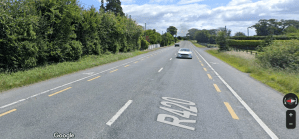
Converting hard shoulders to cycle infrastructure is not a recent idea. Back in 2012-13, the Department of Transport funded a number of such schemes. An example was the R420 between Tullamore and Clara in Offaly.

As far as I am aware, one of the requirements for the scheme was that local councils had to include counters to measure the effectiveness of the scheme but there appears to never have been any publication of the results. Nevertheless, although there was no official announcement of its failure, the initiative was soon abandoned and the Department made clear that they were not going to fund such infrastructure in the future.

The July Stimulus package claims:

             “This would provide better and safer cycle facilities, between towns and villages,         facilitate modal shift and also help to reduce vehicle speeds because of reduced    carriageway widths. “

The addition of cycle logos has been proven not to protect vulnerable road users. While such hard shoulders are used by road cyclists, most people perceive them not to be safer especially where the speed limit is 80 or 100 km/hr?  They also do nothing to facilitate modal shift. They may help to reduce vehicle speeds of the majority of drivers but what is the evidence that they reduce the vehicle speed of the fastest drivers? We may be premature in jumping to conclusions about the quality of proposed infrastructure but we will wait and see.

CHAIRPERSON’S ANNUAL REPORT – SUMMARY (Mar 2020)

Kildare County Council
• Submission on LIHAF Maynooth Ring Road (Jun 2019)
• Submission on Climate Adaptation (Jul 2019)

Public Participation Network
• Elected as PPN Community representative on Transportation SPC
• Meeting on PPN Linkage Groups (Feb 2020)

Attendance at Conferences/Meetings
• Velo-City in Dublin (Jun 2019)
• Cyclist.ie Council Meeting (Oct 2019)
• Cyclist.ie Council Meeting (Mar 2020)
• A Just Transition in Maynooth University (February 2020)

Ongoing Commitments
• Maynooth Community Council – Attendance at most monthly meetings
• Maynooth Newsletter –monthly article submitted
• Monitor bike/scooter parking at Maynooth Schools

Miscellaneous
• Application to Department of Community Development for purchase of Trishaw (Nov 2019)
• Accepted an invitation to join the Board of Dublin Cycling Campaign CLG (Jan 2020)
• Liaison with local nursing homes re Trishaw (Feb 2020)


WEB PRESENCE (Oct 2018 – Mar 2019)


CYCLIST.IE, IRISH CYCLING ADVOCACY NETWORK
• Vice-Chair of Cyclist.ie
• Lead Author on Submission to Joint Oireachtas Committee on Transport which resulted in appearance of cycling groups in front of Committee (2019)
• Meetings with Cycling Ireland (Sept & Feb 2020)
• Meeting with Department Transport, Tourism and Sport re Greenways (Feb 2020)
• Member of Working Group on Transport Funding
• Lead Author on Cyclist.ie’s Submission on Congestion for the DTTAS Public Consultation on Sustainable Mobility (Feb 2020)


Gerry Dornan,
Chair Maynooth Cycling Campaign

Model for Cycling in Rural Ireland now needs Cash Injection

Clon Bikes

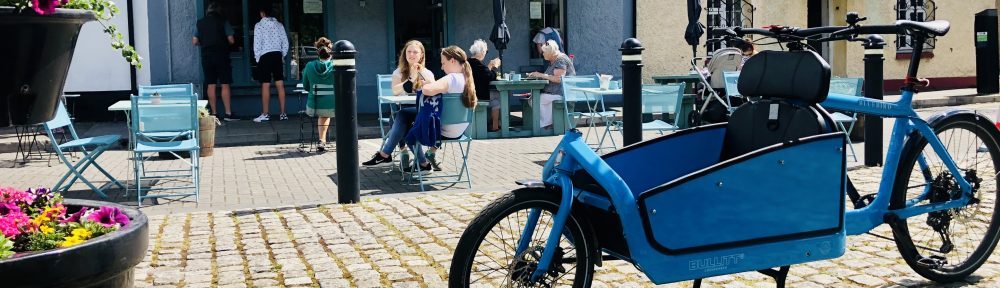
Today, Clonakilty is best known for its black pudding and its characteristic Irish architecture. It possesses no greenways or cycle lanes but despite this, the people of Clonakilty have come together as a community to promote cycling in a way that would put to shame government supported SmarterTravel towns such as Westport or Dungarvan. It holds an annual Bike Festival (just over) which went global this year. It has its own community bike workshop ‘The Bike Circus’ which also runs an active apprenticeship program. The town has a chapter of Cycling without Age/Wind in Your Hair and has its own Trio E-bike which they use to bring out elderly and sick from hospital or nursing homes. The most remarkable aspect of the cycling culture of the town, however, is that they have their own bike share with almost no financial assistance from Cork County Council or the Department of Transport, Tourism and Sport.

Tom O’Donovan of O’Donovan’s Hotel was one of the founders who established the Clonakilty Bike Share 6 years ago with some 60 bikes. He recalls that Cork County Council refused to give them public space for bike hubs so a number of hotels offered a section of their car parking area. With contributions from the hotels and private local sponsors and a small financial contribution from government bodies, they purchased bicycles, paid for parking racks and developed a website through which people could book and pay for renting. Most of the work was carried out by community volunteers so any money raised from renting was reinvested in the scheme. While the bike scheme originated in Clonakilty, it soon spread out to hotels in a number of locations across West Cork as far as Courtmacsherry and Rosscarbery. The scheme allowed users to stay overnight in different places and ensured that more money was retained in the local community than from individual day trippers.

Clonakilty also procured funding to erect directional signage designating a number of nearby cycling routes along quiet roads. Although funding has been available from late 2018 the County Council Area Engineer refuses to erect the signage as he is concerned about the legal consequences to Cork County Council of encouraging cycling on quiet roads. (Apparently, he has no concerns about the consequences to the Council of cyclists travelling on heavily trafficked national or regional roads). The Area Engineer and his Senior Engineer, want an independent safety assessor to tell them that it is safe before they agree to erect the signage. If they have such doubts about the safety of the roads, it is potentially negligent for them not to alert the public in general and cyclists in particular as to the nature of hazard and the risks of exposure.

The Clonakilty bike share was already facing increased maintenance costs due to an ageing fleet of bikes. Now, the rising cost of insurance is the straw that breaks the camel’s back and Clonakilty has been forced to shelve its bike share. Clonakilty is a model for a small community based cycling town. At a time when

(1)  A new Programme for Government prioritising cycling has been agreed
(2)  Over €1 million has been invested in bike share schemes in Cork, Limerick and Galway
(3)  Due to Covid-19, the health authorities urge people to walk or cycle where possible,
4)  The NTA are offering funding to encourage active travel and
5)  Cork City proposes to expand its bike share,

it is ironic that the Clonakilty bike share would be allowed to fail. While West Cork politicians have been vocal in their support, Clonakilty has received almost no state funding. Clonakilty’s most famous cyclist is of course Michael Collins who was born nearby. Looking down from heaven (or up from the other place if that is your politics), what must he think of Cork County Council and current councillors.

Programme for Government 2020

PfG 2020

This is Maynooth Cycling Campaign’s response to the section of the Programme for Government which impacts on cycling. It is divided into five parts.

1.   Financial Commitment
The Government will commit to an allocation of 10% of the total transport capital budget for cycling projects and an allocation of 10% of the total capital budget for pedestrian infrastructure. The Government’s commitment to cycling and pedestrian projects will be set at 20% of the 2020 capital budget (€360 million) per year for the lifetime of the Government.

The total spend on walking and cycling infrastructure includes committed funding from the Department of Transport, Tourism and Sport for active travel, greenways and an agreed pedestrian and cycling allocation from the Bus Connects programme.
Additional funding to meet the annual ceiling will be provided through the Recovery Fund, with a focus on jobs-intensive infrastructure. 


The first sentence is straight forward, clear and unambiguous except for the reference to the total transport capital budget rather than the Land Transport capital budget. The former includes investment in other areas such as marine, civil aviation and tourism – it would seem unfair to impact on them but it is thought that this was just a minor error in the text. The second sentence sets the financial commitment at €360 Million per year for the lifetime of the next government ie 20% of the 2020 budget allocation. Cyclist.ie was looking for a straight percentage which would increase if overall capital expenditure went up and would go down if overall capital expenditure was reduced. The one area of possible concern is what percentage of Bus Connect will apply to cycling. Bus Connect has the potential to swallow up a lot of the funding intended for cycling depending on motives.

2.    We will:

        • Expand and enhance the expertise on active travel needed to dramatically improve infrastructure and participation both in the NTA and local authorities, including by establishing Regional Cycle Design Offices, co-located in the seven Regional Design Offices for roads, to support local authorities.
        • Dramatically increase the number of children walking and cycling to primary and secondary school by mandating the Department of Transport to work with schools across Ireland, local authorities, the Green- Schools programme and local initiatives, including Cycle Bus and School Streets.
        • Widen the eligibility of the Bike to Work scheme. We will provide an increased proportionate allowance for e-bikes and cargo bikes.
        • Ramp up the Cycle Right programme to ensure that all children are offered cycling training in primary school.
        • Conduct a review of road traffic policy and legislation to prioritise the safety of walking and cycling.
        • Conduct a review of road traffic policy and legislation to prioritise the safety of walking and cycling.

While the additional measures listed do not specify any particular commitment or targets, they are all measures that cyclist campaigners would welcome. Linking the implementation of cycle network plans to a suitably qualified Cycling Officer with clear powers and roles is a major advance. In the 2009 National Cycling Policy Framework, the only task of the Cycling Officer was to set up a Cycle Forum in a local authority. The reference indicates movement towards Cyclist.ie policy, namely that the appropriate level for a Cycling Officer is Director of Services. The emphasis on travel to school and school streets is also warmly welcomed. Travel to school is important as it ingrains good behaviour at a young age. The promotion of Cycle Buses is a little surprising as Cycle Buses are a short term reaction to the absence of quality infrastructure and it is hoped that Cycle Buses will have a short life. Cyclist.ie has long campaigned for increased support for the purchase of E-bikes and cargo bikes, comparable to the support for the purchase of E-cars. A review of road traffic policy and legislation to prioritise the safety of walking and cycling suggests that the issue of enforcement may finally be addressed.

3.   Greenways
We will lead the development of an integrated national greenways strategy. This has the potential to transform modal shift and improve air quality and public health.
This commitment to cycling will enable us to achieve the huge ambition of developing an integrated national network of greenways to be used by commuters, leisure cyclists and tourists. We will continue the coordinated approach between central government, local authorities, and agencies to deliver on this ambition.


The reference to a national greenways strategy is welcome as in recent years the DTTAS had moved away from references to a “national” network. The Programme states that a national greenway strategy has the potential to transform modal shift and improve air quality and public health. In theory, this is correct but in practice, conditions imposed by local authorities and by bodies such as Waterways Ireland on widths, surfacing, lack of lighting and access have the effect of suppressing demand by both utility and recreational cyclists. Furthermore, to transform modal split, provision for cycling will be required between proposed greenways and adjacent towns and villages. In the past, proposed greenways have excluded such links.

4.   Transport Infrastructure
In relation to new transport infrastructure, the Government is committed to a 2:1 ratio of expenditure between new public transport infrastructure and new roads over its lifetime. This ratio will be maintained in each Budget by the Government. In the event of an underspend on roads, this will not impact on public transport spending.
Essential road and public transport maintenance and upkeep budgets will be fully protected to ensure continued public safety and connectivity.
We will develop and implement the existing strategies for our cities, such as the Greater Dublin Area Transport Strategy, the Galway Transport Strategy, the draft Cork Metropolitan Area Transport Strategy, as well as strategies being developed for Waterford and Limerick, and other projects progressing through planning.
We are committed to maintaining the existing road network to a high standard and funding safety improvements.
We will continue to invest in new roads infrastructure to ensure that all parts of Ireland are connected to each other.


The commitment to rebalance transport investment to 2:1 between public transport and roads is warmly welcomed. It is unclear what the sentence “In the event of an underspend on roads, this will not impact on public transport spending” means as there is unlikely to be any underspend on roads. If it merely means that underspend on roads will not be transferred to public transport and active travel, that is reasonable as long as underspend on public transport and active travel will not be transferred to roads, once investment on active travel has been ramped up to the levels agreed.

It is right and proper that essential road and public transport maintenance and upkeep budgets will be protected. However, as the cost of essential maintenance is questionable, it will require close examination to ensure that essential road maintenance budgets are not suddenly inflated. Old habits die hard and one of the big challenges for the new Ministers will be to ensure that their Department is singing off the one hymn sheet!
The undertaking to develop the existing transport strategies in Cork, Galway and Limerick will be warmly welcomed by our colleagues in the regional cities as the current transport strategies are based on negligible increases in levels of cycling. This clause has the potential to enable the cities to develop systems fit for the 21st century with walking and cycling at the heart of their transport strategies.

5.   Carry out a comprehensive review of PPNs and LECPs, to ensure that they are fit for purpose for climate action and community development

This final clause is generally overlooked by cycling advocates as it is not centrally concerned with cycling per se but it also has great potential to focus on local authorities which are “half-hearted” in their enthusiasm for public participation.

Conclusion

The Programme for Government has been described as like a visit from Santa. we would hope that it will work out that way. However, we recall a union leader who promised his members that a government pay award would be like “getting money from a cash dispenser” but things did not quite turn out as thought. While the Programme holds out great potential for Ireland being a leader rather than a laggard in cycling and walking, we stopped believing in Santa a long time ago. We wish the new Transport Ministers, senior and junior well and look forward to working closely with them in the future.
Cyclist.ie wishes Eamon Ryan TD, the new Minister for Climate Action, Communication Networks and Transport, the very best in his new role.

Eamon Ryan

Minister Ryan’s appointment comes on the back of the inclusion of some very progressive sustainable transport commitments in the agreed Programme for Government (PfG), especially in regard to cycling and walking. On funding, the new government has committed to:

… an allocation of 10% of the total transport capital budget for cycling projects and an allocation of 10% of the total capital budget for pedestrian infrastructure. The Government’s commitment to cycling and pedestrian projects will be set at 20% of the 2020 capital budget (€360 million) per year for the lifetime of the Government. (p13)

This is potentially game-changing when one considers that the spend on cycling in 2018 was just €12.64 million (or less than 2% of the transport budget) – see Cyclist.ie Pre-Budget Submission 2020. It opens up the feasibility of funding high quality cycling infrastructure in all of our cities and towns, and providing greenway infrastructure connecting into the heart of our built-up areas, and schools, sports grounds, shops and other destinations.

The new emphasis on cycling and walking in the PfG comes at a time when the Department of Transport, Tourism and Sport (DTTAS) – as it was called up until a few days ago – is preparing a new Sustainable Mobility Policy (SMP). Cyclist.ie responded to the public consultation on the SMP early in 2020 – see Submissions on New Sustainable Mobility Policy – and we are awaiting the Department’s analysis of the submissions received. It is timely for a new Minister with a low carbon vision of mobility to take office when a new plan is being drafted.

The other point to highlight is the need for the new Minister to create the structures to enable several government departments, a handful of state agencies, and all 31 local authorities (LAs) to be aligned in their policies around walking and cycling promotion. One of the failings in the implementation of the ambitious 2009 National Cycle Policy Framework (NCPF) was the inaction on ensuring good coordination and cooperation between all bodies.

It is essential that Minister Ryan makes sure there is strong alignment between the key departments of Health (Minister Stephen Donnelly), Housing, Local Government and Heritage (Minister Darragh O’Brien), Education (Minister Norma Foley), Social Protection, Community and Rural Development and the Islands (Minister Heather Humphreys), and Children, Disability, Equality and Integration (Minister Roderic O’Gorman) so that a new culture of active travel can emerge, and become part of everyday life in Ireland. Additionally, local authorities are crucial actors because they will be responsible for so much of the change, but their expertise on cycling development varies from strong to weak.

The changes are already underway with COVID-19 prompting local authorities to reallocate space for people on foot and bikes – see for example Dublin City Covid Mobility Programme. This process is being facilitated by funding from the National Transport Authority and by an update to DMURS (the Design Manual for Urban Roads and Streets) entitled Interim Advice Note COVID-19 Pandemic Response.

The opportunity to be seized by the Minister now is to harness the public appetite for change and lead the way in transforming our cities and towns into the healthy, convivial and economically vibrant places they need to be.

We wish the Minister the very best of luck.

(This article previously appeared on the Cyclist.ie website.)