Reflections on the Citizens’ Assembly by Leinster Wheeler


I had the pleasure of attending as an observer the Citizen’s Assembly dealing with Climate Change in Malahide on 4th and 5th November. Here are my thoughts of the weekend.

Day 1

The first speaker on transportation was Anne Graham, CEO of the National Transport Authority. She began by pointing out that Ireland’s greenhouse gas emissions per person are among the highest of any country in the world and outlined the characteristics of our transport network and the travel mode share. The problem with a speaker from the NTA is that it is dependent on the Department of Transport, Tourism and Sport  for funding so is not in a position to criticise its parent body. As a result, the talk was largely a restatement of current policies rather than mapping out a brave new path to the future or highlighting current deficiencies.

The second speaker was Dr. Brian Caulfield, Associate Professor at TCD. He outlined two options aimed at achieving a low carbon transport network – changing how we fuel our transport and reducing our reliance on private vehicles. A future low carbon transport model would see

  • Much greater use of public transport
  • Electrification of our car stock
  • Sustained growth in walking and cycling for lower distance trips
  • In rural areas the use of demand responsive transport

He pointed out that even if we achieve the targets of 25% electric vehicles by 2025 and 50% by 2030 (which is very ambitious) our carbon emissions would still grow by 22% rather than decrease. He pointed out that cars spend 95% of their time parked and when use for short journeys their emission profile is inefficient with cold starts. He went on to describe the change in car ownership models with the advent of Mobility as a Service (MaaS) and ‘Netflix for Cars’ ie you only pay for a car when you use one.

The third speaker was Connie Hedegaard the former Danish Minister for Climate and Energy and former EU Commissioner for Climate Action. Unfortunately, at the last moment, she was unable to come to Ireland for personal reasons but sent a message which is available on YouTube. The first part of her talk was about climate change in general while the second half focused on the role of bicycles in Copenhagen.

During a discussion which followed, one of the assembly members suggested that government ministers should have to use public transport for a month. This was warmly welcomed but the Chair stated that unfortunately that message could not be conveyed to government. There was also a suggestion (which I thought had some merit) that subsidies for electric vehicles should be greater for people living in rural areas than in Dublin.

Later sessions dealt with energy and agriculture.


Day 2

The second day began with an address by John Fitzgerald, Chair of the Climate Change Advisory Council. He gave a speech which was well received by the audience in which he discussed the scale of the problem and the degree of change that would be required to meet Ireland’s challenge on climate change.

The secretariat and a panel of experts had drawn up a draft Ballot paper which was divided into four sections including one on Transport. Based on feedback from the members, they proposed three questions related to transport on sustainable travel, electric vehicles and public transport.

In the initial draft, there was no text entered for the question on sustainable travel. Text in red proposed a ‘great’ increase in cycling, park and ride and ‘much greater priority’ for them over private cars. The problem was that ‘greatly increased’ or ‘much greater priority’ was not defined.

The second question was in relation to the electric vehicle promotion and referred to year on year increases in taxes on petrol and diesel.

The third question was in relation to expansion of public transport spending over road infrastructure at a ratio of no less than 2:1. This was quite a radical view but the original wording was watered down by the change of ‘road infrastructure’ to ‘new road infrastructure’. The addition of ‘new’ was very significant as most road expenditure is on existing roads rather than ‘new’ roads per se. The wording also referred to public transport with particular attention on rural areas. However, the economic reality is that public transport will always be concentrated on urban areas due to the higher population density.

Overall, I doubt that the motions will cause the mandarins in the Department of Transport, Tourism and Sport to lose any sleep.

Observations on the Process

It felt good to be see democracy in action (even as an observer) where people had come together to come to discuss and reach agreement on topical subjects. The Chair had commented that there was a greater number of observers for this meeting of the Citizens’ Assembly than previous sessions.  One observer present was a representative from the Council of Europe while another had come from Belgium. This brought home to me the international interest in the proceedings of our Citizens’ Assembly. Justice Mary Laffoy was an excellent Chair, but with the benefit of hindsight I had a number of reservations about the process. While the wordings and amendments to wordings were all proposed and accepted by the Assembly, my concern was about the information which was presented to the Assembly.  As someone who believes in the benefits to society of mass cycling, it was disappointing that the two of the three nominated speakers only referred to cycling in passing. The third speaker did devote half of her talk to cycling but it was in terms of the level of cycling in Copenhagen. Rather than ‘experts’, someone locally could point out barriers to cycling in Ireland, to the lack of children cycling to school, to WHO recommendations on levels of spending on walking and cycling and to the financial cost of Ireland failing to achieve climate change targets. I accept that cycling plays only a small part in the prevention of climate change and that not everyone would be exercised by it but I strongly feel that the motion on greatly increased cycle lanes was too bland, too general and too open to interpretation to carry much weight. For a mode of transport which in other countries can carry more than 20% of people, I regret to say that the outcome was disappointing.

Secondly, the experts and their areas of expertise was also open a cause of concern. A member of the Assembly raised the issue of a congestion charge which politicians in London introduced and which Stockholm citizens voted to introduce. One of the panel of experts replied that a congestion charge could not be introduced until public transport and park and ride facilities in Dublin are improved. I very much doubt that people in London or Stockholm were asked for their opinion on public transport before politicians introduced the congestion charge in those cities. While congestion, air pollution and health concerns are among the main drivers for change, it was troubling that  ‘business as usual’ was considered acceptable until however long it might take to bring public transport and park/ride facilities in Ireland up to an ‘acceptable’ level.

Finally, there were thirteen votes on different aspects of climate change. Most of the votes were overwhelmingly carried with more than 90% of citizens in favour which indicated to me that the motions were designed to reflect overwhelming majority opinion rather than gauge where people stood on a contentious issue.

NTA Makes Dog’s Dinner of Cycle Quality

The NTA have made a dog’s dinner of cycle facility quality. Yes they are concerned about quality and yes they refer to it in the National Cycle Manual but does anyone outside the NTA really understand it?

When people are booking a hotel, they have an understanding of the ‘Star’ system of ranking. They may not understand the difference between a 2 star and 3 star hotel but they understand that a 3 star hotel is more luxurious or offers better facilities than a 2 star one and would expect to pay more for it (all other things being equal).

So what is the story with the quality of cycle facilities? There are five levels of service – A+, A, B, C and D. Any cycle facility which does not fall into the first four is level D. Width is one of five determinants of quality the other being number of conflicts, percentage of HGVs on the route, pavement condition and journey time delay. (There has been some modification to pavement condition as a result of the development of the Greater Dublin Cycle Network but the amendments have not been incorporated into the written or digital Manual.) Width is by far the most important determinant, so what does the Manual say about width and level of service? The Manual assesses width in terms of the number of adjacent cyclists as shown below.

So is the width of Level C the same as Level D? And is the width of Level A the same as Level B? What is the width of a Level A facility? In Section 1.5.2, there are references to widths of five cycling regimes but the Manual does not state if the cycling regimes correspond to the Level of Service, and furthermore the exact meaning of different regimes is unclear and open to interpretation. For example what does basic two way mean?

Section 1.5.1 of the Manual on Determining Width includes the following
The designed width of a cycle facility is comprised of the effective width, i.e. the
space that is “usable” by cyclists, as well as the clearances that will be required in
different circumstances.

Effective width as opposed to designed or constructed width is a very important concept as it takes conditions on either side into account. This is important as local authorities often provide a 2m wide cycle track with kerbs adjacent to the footpath on one side and adjacent to a traffic lane on the other, which only has an effective width of 1m.

To make matters worse, the Manual defines the minimum width of a shared footway as 3m, but whether this is effective width or designed/constructed width is not clarified and it does not define whether this is one way cycling shared with two way pedestrians or two way cycling shared with two way pedestrians. The MAnual does not take the level of use into account. As 3m is the minimum standard in accordance with the National Cycling Manual, it is assumed that the level of service for cycling is the fifth and lowest category ie D. Then, just when you think that the NTA couldn’t complicate things further, they succeed.

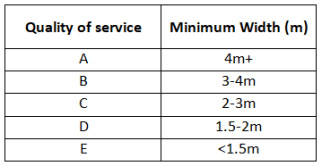
In 2015, they published a Permeability Best Practice Guide which also has five levels of service but in this case they are A,B,C, D and E. Section 3 of the Guide defines widths for the different Quality of Service (see below) but doesn’t define whether these are effective or constructed widths.

Permeability Quality of Service

The Best Practice Guide states that local authorities in urban areas should aim to provide a Level A quality of service for any pedestrian or cycle links between residential areas and destinations such as schools and shops. Not unreasonably, the document goes on to point out that Level A will often be unachievable due to constraints but at least sets out a high target.

So where does that leave the common situation that arises where one section of a route has segregated cycle facilities and the next section has a 3m wide shared footway? Using the permeability criteria, the shared section is ranked category B and C (second and third) but using the National Cycle Manual criteria, it is D (fifth). What would you think of an organisation which ranks a hotel as one star, three star and four star at the same time? The idea of a star ranking is good. It gives cycle campaigners, politicians and the general public a crude but convenient assessment of quality. However, the time to properly define its use is long overdue.

Budget 2018 – Share Ross’s Three Card Trick

Last year, the government allocated approximately €12 million to cycling which was made up of some €10.4 million from the budget and a supplement during the year of a further €1.6 million for greenways. Cycling groups including Cyclist.ie support the allocation of 10% of transport expenditure to cycling or, at the very least, a roadmap to ramp up investment in cycling to that level. We will judge the budget on this basis rather than on the totality of the allocation per se.

Budget 2018 has now been published and the government has approved additional current and capital expenditure by the DTT&S. The multi annual expenditure ceilings for the department are reproduced below from the Part III Estimates for Public Services 2018:

2018 Budget Table

The Department of Transport, Tourism & Sport uses the term ‘Land Transport’ to describe two main areas – Roads and Public Transport whereas Public Transport is an umbrella term which is used to encompass expenditure on buses, rail, walking and cycling. Thus the Budget 2018 allocation for cycling should be €165 million.

What was allocated to cycling? Well who knows? In the manner beloved of the DTT&S, they lump cycling and walking together and have promised €110 Million over four years. This works out at €27.5 Million per year on average. So how much will the Minister give to cycling? Well he could give €27 Million to cycling and €0.5 Million to walking. Then again, he could €0.5 Million to cycling and €27 Million to walking. Or he could nothing in the first three year and backload cycling in year 4. Like any three card trick, the viewer has to try to guess where the Queen (ie money) is.

Cycling does get some further mention of minor funding but it is the headline figure of €110 million which stands out. In contrast, Sweden with a modal share for cycling of 9% (2009) and with twice the population of Ireland has just announced an allocation of €35 million JUST for the promotion of E-Bikes.

The Minister did agree to provide €30 Million for greenways. It should be pointed out that this was under the heading of tourism rather than transport. While this involves more people cycling, it will do little to increase the 3% of people who currently cycle and is rightly categorised under recreation rather than transport as it does not address the problems of congestion, community health, sustainability and climate change which every day cycling does.

The Minister protests that he is unable to quantify how much his Department spends on cycling and his latest pronouncement in the Dáil is that he doesn’t understand modal change. It is hoped that he is a fast learner because in January when budget details have been confirmed to TII, NTA, local authorities and such like, Cyclist.ie proposes to find out through parliamentary questions just how paltry the allocation for cycling is and will forward the news to him.

On one level, it is astonishing that a mode of transport of transport which can carry over 25% of the population is so overlooked. At another level, however, it is hardly unsurprising as it is totally in keeping with the view set out in the totally autocentric document Strategic Investment Framework for Land Transport. There may be individuals in the Department with an alternative vision for the future but they only produce nice sounding policy documents. The decisions on finance remain firmly in the hands of those who favour road building.

Countdown Clock to 10% Cycling

As we are fast approaching the government target date of 2020 for the achievement of 10% commuting trips and also 10% of total trips by bike, Maynooth Cycling Campaign decided to add a Countdown Clock to its website to mark the occasion. When we investigated how to do this, we found that there was a computer app (application) available. Based on the this assumption that progress will continue at the rate of the past five years, we estimate that the government target will be achieved in 2048. However, a problem arose, when we tried to set the countdown clock to 2048. The programme would only allow a countdown date of up to twenty years ie 2037. It would not allow a countdown far enough in the future. We managed to get around this however and our Countdown Clock shows that the 2020 target will not be achieved  for another 30 years. Don’t hold your breath!

In Response to an Article in the Leinster Leader by Paul O’Meara

It is not about bikes and parking. The issues are congestion, inactivity in the community, obesity , air and noise pollution and sustainability. This is not to mention the road fatalities and serious accidents in Kildare and 1200 premature deaths nationally according to the EPA. Bicycles and cycle facilities are just tools which will address (not solve) all these problems whereas more cars will just worsen them. Smart cities and towns realise that cars need a disproportionate amount of space for moving and parking and are investing in space efficient modes of transport ie in walking and cycling. Believe it or not, people actually cycle in the snow and rain and some people with disabilities use bicycles as a mobility aid. In relation to current usage of cycle lanes, if roads were low quality, disappear without warning and only cover about 1% of the journeys people want to make, car travel would be at the same level as cycling currently is.

National Road Network Indicators 2016

The National Road Network Indicators for 2016 which was recently published by Transport Infrastructure Ireland (TII) makes for interesting reading.  The report is split into five parts – Network, Economic, Road Condition, Safety and Accessibility/ Environment.

Nat_Rd_Indicators_2016

 The first part deals with the extent of national roads, traffic levels, and level of service which essentially means whether a road is congested or not. Chart C1 shows the level of service during the morning peak and demonstrates that over the whole country the level of congestion is surprisingly low with congestion apparent only in the vicinity of the cities – Dublin, Cork, Limerick and Galway.  With a surprising degree of honesty, the report admits that

                Following the substantial investment in National Roads over the last decade, most route sections are operating to the highest standard of service. However, for certain roads such as the M50, further interventions such as demand management are required to ensure that higher levels of service are achieved.

So it concedes that most of the network is operating to a high standard and accepts that congestion will worsen on the M50 unless more measures such as demand management are introduced.  As the principle type of demand management is road pricing or a congestion charge, this will not be to the liking of government which is opposed to such measures. The most interesting sections are Charts E and F which show Trip Duration and Trip Distance for National and Regional Roads and which are based on national computer models. The main findings are

  • 28% of trips last less than 10 minutes
  • 11% of trips are for a distance of less than 5km
  • 38% of trips are for less than 10km
  • 24% of trips are less than 7.5km
  • In 2016 traffic growth was 4.6% across the network
  • In 2016 growth in the Dublin region was 6.9%.

The 24% of trips less than 7.5km show the potential for substituting trips by car for trips by bicycle. It demonstrates clearly that congestion will not be solved by building more roads but by providing for more efficient modes of transport in terms of space and speed.

The second part Economy deals with estimates of future levels of population, car ownership and vehicles kilometres. By 2050 the ESRI forecast that the population will increase to between 5 and 5.6 million while TII expects total car ownership to increase from 2.5 million in 2013 to 3.5-4.0 million. The number of vehicle kilometres travelled is also forecast to increase from just over 40 billion in 2013 to between 52.0 and 58.5 billion in 2050 depending on future growth rate. Obviously, TII don’t agree with the concept of Peak Car or Peak Car Use. It also appears not to agree with Smarter Travel targets for reduction in commuting by private car although Smarter Travel uses a short time frame to 2020 while TII forecasts take a longer time frame to 2050. Although traffic growth was 4.6% nationally (and 7.4 in the Mid East region ie the commuter belt), it assumes that traffic will grow at an average rate of about 1% between 2016 and 2050 but this still implies an overall increase of nearly 40%. Just where this traffic will go is unclear but it is likely to lead to an increase in demands for yet more investment in roads for motorised traffic. This is already apparent in calls by groups like the Small Firms Association for a new motorway, the Leinster Outer Orbital Ring, to be developed to supplement the M50 at the same time as TII complains about inadequate funding to maintain existing roads.

The final section looks at Accessibility/Environment and includes the statement “the key benefit of a quality road system is improved accessibility to jobs”. This statement can be interpreted in two ways. The benign view is that a quality road system will reduce congestion and reinforce economic development thereby leading to increased employment. The alternative view is that the development of a better quality road system will lead to an increase in congestion and longer commuter times due to induced demand ie more people choosing to travel further to jobs because of an improved road system. Now looking at Dublin and the other Irish cities, I wonder which view predominates?

How much does Ireland spend on cycling?

Local and central governments are fond of ‘promoting cycling’. They have been promoting it for some twenty years with grants here and there, photo opportunities at the opening of cycle facilities, giving out hi vizjackets, exhortations to get on your bike, advertisements in the media and so on. In most of this time, cycling nationally has declined. Brendan Behan once suggested that in order to revive the Irish language, books which were banned for their sexual content in English should be printed in Irish. Perhaps local and central government should trying promoting car use – the outcome could hardly be worse!

There is a lack of knowledge of how much Ireland actually allocates to cycling.  It is difficult to be precise as cycling infrastructure can be provided  by funding from central or local government but can also be provided by private developers in the same way as other infrastructure such as road or sewers. Furthermore, some types of cycling infrastructure such as shared footpaths or greenways are provided to be shared with pedestrians so how do you determine the separate contribution for cyclists from pedestrians?

In most countries the critical figure is the amount of funding provided by central government. In 2014 in response to a question in the Dáil from Deputy Catherine Murphy, the Minister for Transport reported that a total of  €11.1 Million was allocated by his Department and gave a breakdown of the allocation to individual local authorities. However, this was only the direct budget allocation from the Department.  The National Transport Authority also provided funding of €8.2 Million to local authorities In the Greater Dublin Region and in May the government announced a Stimulus Programme which included funding of €10 million for greenway developments. Finally, in November, a supplementary budget was passed which included funding of €1.6 million also for greenways. Overall it is estimated that funding of €21.2 million was directly and indirectly provided for cycling by central government. With a population of 4.66 million, this equates to an expenditure of €4.55 per person for 2014.

How do we compare internationally? Well pretty badly. The Netherlands spends approximately €30 per person per annum. In the UK, politicians at Westminster estimate that expenditure of £10 per head per annum is required. Norway, with a similar population as Ireland has just announced an investment of almost €1 Billion in cycling infrastructure although it helps if you have extensive oil resources.  What is clear that unless spending is increased substantailly, the level of cycling in Ireland (outside of the capital) will remain under  3%.

Cycle Right – No Substitute for Infrastructure

Maynooth Cycling Campaign welcomes the launch of Cycle Right and congratulate Cycling Ireland and Celbridge’s Barbara Connolly on their leading role in its development. We now hope that the Department of Transport, Tourism and Sport will follow up with the second essential element to achieve mass cycling to school – increased funding for the provision of high quality infrastructure. Being able to cycle is not the same as willing to cycle and unless the road environment is made safe for all ages the Minister’s hope for support from parents and for more children to choose cycling will remain that – a hope.

In his press release, the Minister also expresses a hope  that the initiative will ‘show his commitment to improving road safety and reducing the number of fatalities’. Considering that the bulk of fatalities involved drivers and pedestrians, it is hard to see how cycle training will improve road safety generally.  His use of ‘we’  as in  we must … remember to take particular care around vulnerable road users such as pedestrians and cyclists… reveal with which group of road users his empathies lie. While details of the rollout of Cycle Right have not been revealed, the key figure will be the outcome of cycle training – that is the increase in the number of children cycling to school. This will show the Minister’s true level of ambition and commitment to cycling.

Most countries provide cycle training to children as a means of encouraging cycling. In the Netherlands, having learnt how to cycle from their parents at a young age, children undergo a cycle test at the age of eleven so the test is in reality a confirmation of their ability rather than the acquisition of a new skill. In the UK, most parents do not cycle and it is likely that many feel that they do not have the skills to teach their children. While children there are being trained in large numbers, this does not lead to them cycling. Conditions on UK streets simply remain too unpleasant and too dangerous for more than a very small proportion of parents to allow their children to cycle. Unless additional funding for infrastructure is provided, the mistakes in the UK will be repeated in Ireland.

Irish Independent & Victim Blaming

We are only three weeks into January 2017 and already there has been 11 fatalities on our roads. Seven are pedestrians, two are drivers and two are passengers. The reactions of government and government organisations are remarkable. Although drink driving has been identified as one of the causes of the increase in fatalities, Shane Ross, the Minister for Transport, Tourism and Sport has outlined how he wants to ‘name and shame’ the offenders. Well name them anyway. It is debatable how many will feel any shame.

Of the seven dead, one happened in an urban area, two had just come off a bus, two were walking along a national road – one in daylight, one in the dark, one died on the M50 while the last was walking along a regional road on the fringe of the city. The first four out of the seven were killed in a situation where motorists should have seen or anticipated vulnerable road users. In an article on road safety in the Irish Independent, the journalist Luke Byrne referred three times to the Road Safety Authority urging pedestrians to make themselves more visible.  In contrast, there was only one reference urging drivers to slow down. It is not known if this emphasis was as a result of the Road Safety Authority briefing or journalistic licence. Either way, the primary responsibility does not lie with vulnerable road users – they are the wrong target.