Minister’s statement at COP 25 was a missed opportunity to show Ireland is ready to take leadership

Stop Climate Chaos Coalition – Press Statement
Immediate release 11th December 2019

The Stop Climate Chaos coalition has today (December 11th) said that the Minister’s national statement at COP 25 this morning, was a missed opportunity to show that Ireland is ready to take leadership to avert climate breakdown. The Minister participated in the high level segment, where Heads of State and Government make national statements on increasing their targets.

Earlier this week, Stop Climate Chaos wrote to the Minister in advance urging the Government to align Ireland with other EU member states calling for an increase of the EU’s 2030 target to at least 55%, and for Ireland to urge the European Commission to advance a proposal to increase the EU NDC target (in line with the science and the EU’s fair share of the global effort) in the first 100 days in office.

Catherine Devitt, Head of Policy with the Stop Climate Chaos coalition commented,

“2020 marks the beginning of a decade in which global emissions must reduce by 55% before 2030 if the 1.5oC limit in the Paris Agreement is to remain at all feasible. We need bold political leadership now more so than ever, and this needs to be matched with bold commitments that will drive deep and sustained emissions reductions over the next decade. Therefore, it’s deeply disappointing to hear nothing new from Minister Bruton’s contribution at COP25.”

“Ramping up emissions cuts before 2030 is in line with the commitments made by Ireland at COP 21 in 2015, and a higher target will increase the chances of reaching global net zero emissions well before 2050. The longer we delay, the costlier and sharper the social and economic adjustment will be. It is disappointing that the Minister did not use the opportunity at COP 25 in front of the global community, to explicitly express Ireland’s support for a higher EU 2030 of at least 55%, and to put pressure on the Commission to urgently increase 2030 ambition in line with the science and the EU’s fair share of the global effort.”

“We very much welcome the Minister’s commitment to enshrine net zero by 2050 into law. 2020 will be a crucial year for the climate, as will be the next decade. If this Government is now serious about stepping up to the challenge, we need to see the new draft Climate Law before Cabinet before Christmas and the new law being passed without delay in 2020.”

In reaction to the Minister’s national statement in Madrid, Christian Aid’s Policy and Advocacy adviser, Jennifer Higgins, said,

“We need the enthusiasm in Minister Bruton’s speech to translate into concrete and ambitious climate action. We’ve learnt nothing new in terms of Ireland’s planned response to the climate crisis, and the existing climate action plan still places Ireland as a low performer on climate action in the EU.”

“Ireland needs to be doing far more than doubling our contribution to the Green Climate Fund if we are to fairly contribute to efforts to prevent catastrophic climate breakdown. Ireland’s overall annual climate finance contributions will need to increase six-fold if we are to meaningfully support developing countries, who on the frontline of the climate emergency, to cut their emissions and adapt to the worsening impacts of climate change.”

Later this month, Ireland is required to submit to the EU its national energy and climate plan for the coming decade. Stop Climate Chaos has called on the Government to use this opportunity to close Ireland’s glaring emissions gap, to drive sustained and deep emissions reductions, and pave the way for Ireland to move from laggard to leader at European level.

Ends

Government (excluding DTTaS) allocates €3.5 Million out of €186 Million for Everyday (Utility) Cycling

In response to parliamentary questions, Minister Shane Ross is very keen to point out that in addition to funding from the Department of Transport, Tourism and Sport (DTTAS), the government also funds cycling through other departments including the Department of Community and Rural Regeneration and the Department of Housing, Planning and Local Government. We decided to investigate the contribution to cycling by these departments.

Michael Ring is Minister for the Department of Community and Rural Affairs. In May 2018, he announced the allocation of €4.5 million. This was followed in September by an additional allocation of €8 million. This funding was under the Community Enhancement Programme (CEP) which supports disadvantaged communities throughout the country by providing capital grants to community groups so none of this funding was for cycling or cycle related projects.

In January 2019, the Minister and Fáilte Ireland jointly announced funding of €10.8 million for 78 outdoor recreation infrastructure projects. Of the 78, 19 were identified as wholly or partially cycle related at an estimated cost of €1,680,786.

In February 2019, the Minister made a major announcement with an allocation of €62 million for Rural Regeneration and Development projects across the country at a cost ranging from €20,000 to €10.2 Million. There were three cycle related projects. The first which was a 100% cycling related project, was for the development of a cycle network in Mayo/Galway at a cost of €75,000. The second in County Meath was allocated €845,250 for a navigation/greenway project. The cycling component was assumed to be 25% cycling or €211,312. The third was a flagship project of national importance– the development of mountain biking trails at a cost of €10.2 million. Mountain biking is a sport which is growing in popularity but it is a niche sport. Even among current cyclists it is very much a minority sport and has nothing to do with utility or everyday cycling. Although funding was provided by the Department of Community, it could equally have been provided by the section of government dealing with sport or tourism or transport. Omitting the mountain biking scheme, the total component allocated for everyday cycling from the other two amounts to €286,31. In total, Minister Ring allocated approximately €2 million out of €86 million.

In November 2018, as part of Project Ireland 2040, Taoiseach Leo Varadkar and Eoghan Murphy, Minister for Housing, Planning and Local Government announced an allocation of €100 million for 88 projects under the Urban Regeneration and Development Fund (URDF). The schemes were classified under various headings including community development, culture, specific capital projects, energy development, integrated urban development, library development, public realm regeneration, road/strategic infrastructure and strategic acquisitions.

There may be a number of projects which involve a small component of cycling eg projects involving public realm improvements but in isolation these are unlikely to make any significant impact to the level of cycling either nationally or locally. Cycling is only explicitly mentioned in the following five:

Screenshot 2019-10-24 at 11.33.48

The total value of the five is estimated at €5.7 million but the likely cycling component is only of the order of €1-2 million out of an allocation of €100 million.

We warmly welcome the additional contribution to everyday cycling by Ministers Ring and Murphy. However, this is a long way from Cyclist.ie’s campaign for 10% of the DTTAS Land Transport capital budget or €149 Million based on the Budget 2019 allocation. In Budget 2020, this rose to €194 Million. As everyday cycling is essentially about transport, the heavy lifting for providing funding rightly belongs in the Department of Transport, Tourism and Sport.  If the Department fails to provide adequate funding for cycling, the primary responsibility rests with Shane Ross, the Minister in Charge.

Railpark and Rat Running


20191006_170313Since the removal of the slip lane  at the Staffan Road / Celbridge Road junction, the residents of Railpark have been concerned about the significant increase in motorised traffic which passes through the estate on a daily basis. Most of this traffic is only using the route for convenience – they are not stopping to visit. T hey are merely passing through and using the route as a “rat-run”. Traffic levels are reported  to be as in excess of 4000 vehicles (?) per day which is greater than the threshold for a “major” road, as defined in the EU Environmental Noise Directive.

Rat-running is not a new phenomenon and the way to eliminate it is cheap and readily available. It consist of stopping motorised traffic from passing through by blocking one or other entrance or by blocking passage in the middle. This is termed “filtered permeability” whereby pedestrians and cyclists are permitted to pass but motorised traffic is not and is widely used in other European countries.

Kildare County Council suggested that it would introduce filtered permeability at Railpark but a number of the residents objected to the proposal on the grounds that it would inconvenience driving. Other residents, who were concerned about the risk to children playing in the estate, supported the proposal. The position of councillors is unclear at this time – they appear to want to introduce filtered permeability but do not want to antagonise vociferous residents.

The Design Manual for Urban Roads and Streets (DMURS) establishes a road user hierarchy with pedestrians and cyclists at the top and private car users further down so filtered permeability is in accordance with the principles of DMURS. The position of Maynooth Cycling Campaign is clear – we consider that the safety of vulnerable rod users takes precedence over rat-running.

In the UK, the debate is framed about Healthy Streets where car use is discouraged as opposed to streets which cater for large volumes of traffic. Healthy Streets developed out of concerns about issues such as road safety, child obesity, air and noise pollution and lack of sustainable development – problems which all affect Maynooth. In particular, there is increasing concern nationally about the effects of air pollution from traffic and the EPA has estimated  that nearly 1200 premature deaths per annum are caused as a result.

The selfishness and sense of entitlement of some people who drive – that they would place their convenience of driving over the safety of their neighbour’s children – is mind-boggling but we have already seen such attitudes in parts of Dublin. In the 19th century, when local authorities decided that clean water and sewage systems were required to avoid preventable deaths, they did not have to consult with the public. One would have hoped that if they had, they would have ignored narrow self interest and thought of the interests of the wider community. Local politicians should do likewise today.

Are You a Cyclist or a Wheeler?

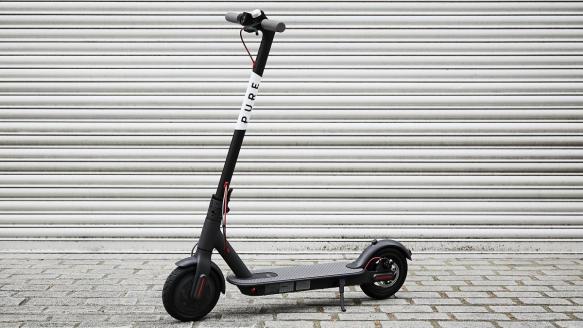
E-scooter

If you are reading this blog, the probability is that you understand that a cyclist is someone wearing their ordinary clothes in an urban situation but to most people a cyclist is someone in lycra riding at high speed a bicycle with dropped down handle bars.

In Ireland we have multiple names for rain. In Iceland they have multiple names for snow. In the Netherlands, they have two words for people who ride bikes. There is a “wielrenner” (wheel chaser/sport cyclist) and a “fietser” (everyday cyclist).

How can we differentiate between the two in an English speaking country if we use the same word for both? We could use bicyclist but that would not be applicable to tricycles or four-wheeled “bicycle vehicles” which have been around for some time.

In recent years, new and innovative forms of personal transport devices have emerged such as electric scooters (e-scooters), segways, trishaws, hoverboards, u-wheels, powered mini scooters (go-peds), and powered unicycles. Such devices may be classified as “Powered transporters” – “novel personal transport devices which are mechanically propelled (propelled by a motor) as well as or instead of being manually propelled”. And this is not to mention hybrid or cross-over devices. So what does you call the people who use such devices. Perhaps it is time to abandon the term “cyclist” to sport cyclists and instead adopt the term “wheeler” to cover people who use wheeled devices.

10 Days to the Biggest Climate Protest in History – SCC PRESS RELEASE

Stop Climate Chaos Coalition

For immediate release : Tuesday 10 September 2019

Student organisers and climate campaigners supporting the School Strikes for Climate have announced their plans for Ireland’s participation in the Global Climate Strike on Friday 20th September. Students have so far organised School Strike Rallies for 10 locations around Ireland from Tralee to Dundalk, as well as Dublin, Cork, Limerick and Galway. Adults have signed up to host 60 local Support Actions in their communities and workplaces for people who can’t make the rallies. These numbers are growing every day and a team of volunteers is on hand to support people who put their hand up to organise a local event.

Commenting Áine O’Gorman, Activism Support Coordinator with the Stop Climate Chaos Coalition, said:

On September 20th we hope to empty schools and workplaces and fill the streets with people demanding our Government take climate action more seriously. Our house is on fire – let’s act like it.

We’ve have a great response to our call for people to organise local actions in support of the school strikes and our volunteers are ready to help anyone who wants to get involved in their community or workplace.”

The Global Climate Strike was called by Swedish teen, Greta Thurnberg, and the global youth movement she has sparked. But this time she has asked adults to join in, saying “We need everyone, to change everything”. The Global Strike comes three days before heads of government from around the world, including Taoiseach Leo Varadkar, are due in New York for a UN Climate Action Summit. Greta, who has been invited to speak at the summit, sailed to New York in August in a zero emissions boat, with the slogan “Unite behind the science” emblazoned on the sails. The overarching message to world leaders from the strikers and their supporters is “It’s an emergency, act like it”.

Oisín Coghlan, Coordinator of the Stop Climate Chaos Coalition, said:

“The Dáil declared a Climate and Biodiversity Emergency in May but as yet the Government is not acting like it. Just days later they issued new licences to Exxon and the Chinese to search for more oil and gas in Irish waters. And months later they still haven’t sat down with the trade unions to discuss the plight of the workers in the midlands who are facing a disorderly exit from the peat industry because for 20 years Irish politicians have refused to plan for a Just Transition away for fossil fuels.”

The first international School Strike for Climate in March saw 1.6 million young people and their families take to the street around the world, including 15,000 in Ireland.

ENDS

For more information or interviews contact:
Áine O’Gorman, Activism Support Coordinator, Stop Climate Chaos Coalition, or
Oisín Coghlan, National Coordinator, Stop Climate Chaos Coalition, on

1) All the student-led #ClimateStrike Rallies, and the local support actions organised by adults in communities and workplaces are on this map:
https://www.stopclimatechaos.ie/campaigns/support-the-climate-strike-movement/

2) So far the following student-organised marches and rallies are confirmed:
Dublin: Gathering 12:00 at Customs House, marching at 12:30 to Merrion Sq., rallying 13:00 – 14:00 at Merrion Sq. in front of Govt. buildings
Cork City: Gathering on Grand Parade St. from 12:00, marching at 12:20.
Kerry (Tralee): Meet at County Buildings, Ratass, at 9am
Clare (Ennis): Meet at The Height, O’Connell Square at 9am
Drogheda: Demonstrating from 13:00 outside St. Peters’s Church, West St.
Galway: Demonstrating from 13:00 – 16:00 in Eyre Square
Navan: Demonstrating from 13:00 – 15:00 at the Market Square
Limerick: Marching from Arthur’s Quay Park at 13:00, finishing at City Hall.
Dundalk: Demonstrating from 12:30 – 15:00 in the Market Square
Kenmare: Demonstrating from 9:00 – 13:00 outside the Courthouse

The student organising groups are:
Fridays for Future: https://www.fridaysforfuture.ie/september-20th
Schools Climate Action Network: https://www.schoolsclimateaction.ie/

3) Details of the Global Climate Strike are here: https://globalclimatestrike.net/

4) Details of the UN Climate Action Summit are here: https://www.un.org/en/climatechange/


Cyclist.ie Demands ‘Revolution’ in Cycle Transport Funding! – PRESS RELEASE

Don’t tell me where your priorities are. Show me where you spend your money and I’ll tell you what they are  – Jim Frick, Notre Dame USA.

Cyclist.ie, the Irish Cycling Advocacy Network, calls on the Government to implement the recommendation of the all-party Joint Oireachtas Committee on Climate Action (JOCCA) Report and of its own Climate Action Plan by allocating 10% of the Land Transport budget to cycling with immediate effect from Budget 2020. Currently, despite the fact that cycling provides the highest rate of return on investment of all transport projects, as well as numerous co-benefits for health and the environment, it receives less than 2% of the land transport budget, notwithstanding recent increases. According to the Chairperson of Cyclist.ie, Colm Ryder, “10% of Transport funding is required, in order to expedite the development of a comprehensive cycle policy and long-stalled strategic cycling infrastructure projects not just in Kildare but in all of our urban and rural areas”.

Read Budget 2020 submission here: https://cyclist.ie/2019/08/cyclist-ie-pre-budget-submission-2020/ .

In addition to essential cycling infrastructure, ranging from commuter routes to greenways, Cyclist.ie is calling for the establishment of a National Cycling Office within the Department of Transport Tourism and Sport, to oversee overall development in Policy and Legislation, and for the appointment of dedicated cycling officers at senior level in all local authorities.

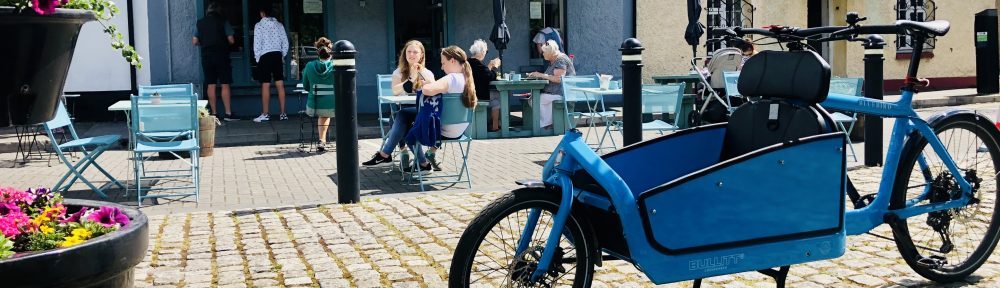
Cyclist.ie points out that one striking, short-sighted and regrettable omission from the Government’s Climate Action Plan is the absence of any incentives towards the purchase of electric bikes, or electric cargo bikes. This is in spite of projections from the Department of Transport Tourism and Sport that the cost of congestion in the Greater Dublin Area will amount to €2Billion per year by 2033. Instead, the very first action mentioned in the Transport Section of the Plan is to develop the EV charging network so as to support “at least” 800,000 EV’s by 2030. Modal shift is mentioned in the Plan only in the context of Public Transport. E-bikes (including e-cargo bikes) have great potential to encourage modal shift and change the transportation dynamic. E-bikes have the potential to replace a family car, enable longer commutes, enable older people to remain active for longer, facilitate cycling in hilly areas, increase levels of everyday cycling, and help to reduce congestion levels

For these reasons, from Budget 2020 onward the Government must develop and operate a purchase subsidy for e-bikes, in parallel with the subsidy for electric cars. An extra generous allowance should be given to those who show that they are replacing a car with an e-bike. It is critical that e-cargo bikes are included in this scheme as they are a cost effective and low emissions means of freight deliveries in cities, as well as potential family transporters.

Other asks in the Cyclist.ie budget submission include mandating the provision of high-volume safe and secure bike parking at all public transport hubs, all public buildings such as schools, hospitals, libraries etc, and all major event centres such as sport and concert venues as well as provision for the carriage of bikes on trains and buses. In addition, the organisation wants to see cycle training being made available free of charge in all primary and second level schools. It wishes to see greater flexibility in the Bike to Work scheme including its extension to those not in work such as students, the unemployed and retired people. Finally, Mr Ryder states that legislation and enforcement are crucial – “The long-promised safe passing (of cyclists) legislation is by far the most urgent need, but other laws, to bring us in line with our European neighbours, such as contra-flow cycling on one-way streets and turning left on red lights are required” he stated, “as well as enforcement action on parking in cycle lanes”.

ENDS

Who Decides on the Expenditure of Discretionary Grants – Councillors or Officials?

Councillors like to think that they make policy and approve budgets while the role of officials is to implement policy. In the autumn, officials present draft budgets for the coming year for approval and after arguing over increases or decreases, councillors eventually approve the budget and strike an associated rate for business.

However, councillors are primarily concerned with discussing revenue raised by the council. The budget includes notional figures for grants from government or government bodies such as TII or NTA. These tend to be for specific projects which councillors wish to see progress. The difference between the estimated allocation and the actual drawdown is regularised when that year’s expenditure is finalised some 18 months later.

In the past, councillors have had little interest in this stream of funding from government as it was intended for specific schemes. However, in more recent years the DTTaS has allocated an element of Discretionary Funding which amounts to over €80 million nationally in 2019. Not all counties receive a Discretionary Grant. The Dublin Local Authorities do not receive anything. Kildare County Council’s portion amounts to €2.5 million – not a fortune by today’s standards but still a sizeable amount. Councillors frequently receive the response that no funding is available for a particular project. The question is who decides on its use – the elected councillors or officials? And, equally important, what proportion should be allocated to walking and cycling?

How cycle friendly is Dublin?

If Ireland is really interested in increasing the level of cycling rather than just ticking the cycling box, it needs to pay attention to the views of international experts.

Bicycle Dutch's avatarBICYCLE DUTCH

I couldn’t remember when I last felt afraid on my bicycle. Not just anxious, but genuinely fearing for my life. I do now, after I cycled in Dublin last week. The 4-kilometre-long ride from my hotel near the Phoenix Park Gate to the Conference Centre of Dublin was just one long straight line on the quays of the river Liffey. The route couldn’t be easier. According to plans from 2011 there was supposed to be a cycle route here, but there wasn’t. Instead, there were multiple lanes for motor traffic. The drivers of most vehicles showed little respect for cycling. I can’t tell you what was worse; the quays during rush hour, with the many large vehicles that you had to find (and fight) your way through, or the quays outside rush hour, with motor traffic passing just centimetres from you at incredibly high speeds. The leap·frogging with the many…

View original post 870 more words

Big data surprises

Interesting article including information on benefits of cycling in Utrecht.

stripymoggie's avatarCargobike Dad

It has been quite the week for data.

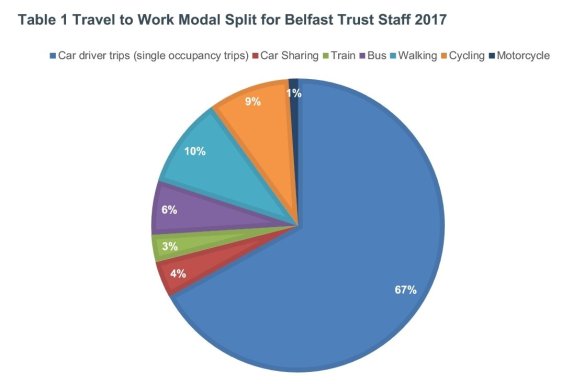
The Belfast Health and Social Care Trust have launched their annual Staff Travel Survey. Last year’s results are available in the Trust’s Travel Plan. It reveals that 9% of staff cycle to work:

The official figures for Belfast indicate cycling is somewhere between 3 and 5%, with cycling across Northern Ireland at 1% stubbornly refusing to move out of the statistical noise (i.e., the margin of error in the stats is greater than the reported number) in the past decade.

The 2018 staff travel survey shows the number of cycling commuters are at least double the city’s average.

This has big consequences for Belfast. The Trust is responsible for 1/3 of Belfast traffic. And how Trust staff travel has a real effect on congestion, air pollution and carbon emissions.

The targets for 2020 are mind-boggling:

The Trust are aiming for a 16%…

View original post 576 more words