Here is our programme for Bikeweek 2016. We hope that you can join us.

Here is our programme for Bikeweek 2016. We hope that you can join us.

Maynooth Cycling Campaign and Cyclist.ie has joined Stop Climate Chaos – a coalition of civil society organisations campaigning to ensure Ireland plays its part in preventing runaway climate change. Current members include development, environmental, youth and faith based organisations. A full list of members is available here.
Stop Climate Chaos calls for action under four headings:
According to Andy Storey reported in the Dublin Inquirer, Ireland is falling behind in its commitments to combat climate change. We are supposed to have cut greenhouse-gas emissions by 20 percent by 2020 (relative to 2005) but the Environmental Protection Agency reckons we will come in with a cut of just 6 percent to 11 percent. It may be even worse than that – last year the rest of the EU cut emissions but Ireland increased them by 5.3 percent. All this is pointing to Ireland facing E.U. fines of the order of €600 Million per year.
(This article first appeared in the May 2016 edition of the Maynooth Newsletter)
Councillors Approve New Cycle Corridor in Naas
Maynooth Cycling Campaign congratulates the councillors of the Naas Municipal District on cross-party approval of the Dublin Road Cycle Corridor Scheme which involves removing right hand turns and a number of car parking spaces in the town centre. The approval includes significant improvements proposed by our colleagues in the Naas Neighbourhood Greenways. This is the first time that Kildare County Council has accepted any improvement suggested by a cycling group, and despite the availability of significantly less space, Naas councillors have approved a scheme which will provide a higher quality cycling facility than the Maynooth North South Corridor Scheme. Perhaps the Maynooth councillors might look at and learn from their Naas colleagues.
Kildare Cycle Forum
In a related development, Maynooth Cycling Campaign has joined with Naas Neighbourhood Greenways in calling on the political groups in Kildare County Council to convene a meeting of the Kildare Cycle Forum. Government policy on cycling is to adopt a collaborative approach giving cycling representatives input into the development and implementation of cycling policy. Maynooth Cycling Campaign accepted an invitation to join the Forum and is looking forward to playing a full part in its work.
Galway Cycle 2016
Congratulations also to the Galway Cycle 2016 for raising over €100,000 for their nominated charity which this year is Down Syndrome Ireland.
Bikeweek 2016
This spring has largely been windy and cold. May is now upon us so we are hoping for more spring like weather. We have also begun to plan for Bikeweek 2016 which runs from 11th to 19th June. Next month’s Newsletter will have full detail of events.
Celbridge Road
Maynooth Cycling Campaign is opposed to the proposed NTA expenditure of €100,000 on a missing section of footpath on Celbridge Road, as it will copperfasten a situation where over 1000 children have no facilities to cycle to school. We call on councillors to ensure that this work does not proceed without a clear plan on how cyclists will be catered for and the timescale involved. Otherwise money will be wasted on a short term measure which will have to be undone in the future.
Railpark
Like a number of locations in Maynooth, Railpark suffers from rat-running with drivers using Railpark to avoid delays at the Celbridge Road junction. If the problem was one of speeding, the solution would be traffic calming. However, it is a traffic management problem and the solution is filtered permeability with no through route for motor vehicles. This would involve motorists having to enter either from the Straffan Road or the Celbridge Road side, but pedestrians and cyclists would continue to use it as at present. It is also a road safety issue as allowing traffic to rat-run in a residential area is contrary to good road safety practice and needlessly increases the risk to adults and children who live there.
Maynooth Cycling is a non-party political cycling advocacy group. Its aims are to promote cycling as a healthy leisure pursuit and as a safe, enjoyable and efficient mode of transport for everyone in the Maynooth area.
Maynooth Cycling Campaign submitted the following as part of the Part 8 Public Consultation process on the Royal Canal (Confey to Maynooth).
17 February 2016
Submission on Royal Canal Greenway (Confey to Maynooth)
Maynooth Cycling welcomes the proposal for the development of a Greenway along the Royal canal from Maynooth to the Dublin County border. Together with the Greenway west of Maynooth, currently under development, this will be a huge boost to active and sustainable transport in our area. Since it will allow people of all ages to cycle safely and conveniently between Maynooth and Leixlip, it has the potential to offer a real alternative to the car, leading to improved public health and reduced congestion and pollution.
The Greenway will be part of the Dublin to Galway national cycle route, which in turn is part of the EuroVelo 2 Galway to Moscow route. It will attract significant numbers of tourists to North Kildare towns, giving a welcome boost to the local economy.
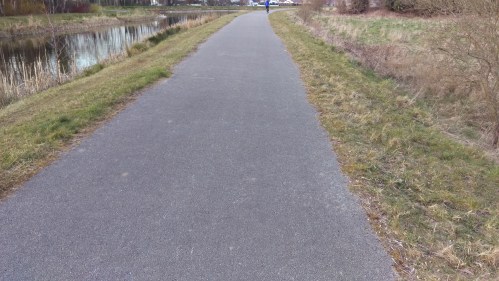
We are nonetheless concerned that the proposed scheme is not of an adequate standard to fully capitalise on these potential benefits. In particular, the proposal to finish much of the route in dust, rather than black-top tarmacadam, will deter its use by commuters. Many residents of Maynooth and Leixlip commute to work, between the towns themselves and toward the city. A largely off road, sealed-surface, cycle track will encourage cycle use among these commuters. A dust surface can be appropriate for a pure leisure facility with limited range. However, for commuters and those travelling more than a few kilometres a dust surface which creates dirt, puddles and potholes is wholly unsuitable. Additionally, as noted by Sustrans in their documents, Cycle Path Surfacing Options, unbound surfaces are at least 50% more expensive than bound surfaces to lay and maintain.
The grass verge will limit the ingress of some dust into the canal, but it will not prevent dust being carried by the wind into the water. The environmental report does not provide consideration of dust movement into the water.
Recommendation 1: A bound surface should be provided along the length of the proposed greenway to facilitate the large number of commuters potentially using this route. At a minimum a bound surface should be provided between the towns of Maynooth & Leixlip.
The proposed width of the Greenway is 3 metres. We consider this to be inadequate for safety and comfort of both cyclists and pedestrians; 4 metres is more appropriate. The NRA Rural Cycling Design Standards document TD300/14 specifies 3 metres as the MINIMUM standard for a shared low-volume facility. Given its route through the most densely populated area of the country, high volumes should be expected.
Whilst the available corridor is narrow as some points along its length, additional land could be compulsory purchased to ensure adequate width. Where the removal of vegetation would be necessary to construct a 4 metre wide track, additional land acquired could be planted with native species and, when it matures sufficiently, existing vegetation removed to widen the track to 4 metres.
Recommendation 2: A 4 metre wide track should be provided along the length of the greenway.
The proposed scheme does not set out any objectives in terms of modal shift or number of users. In order to properly assess the scheme, its projected contribution to the government target of 10% of commuters using bikes should be considered. In this context a cost benefit of analysis of dust versus sealed surface and 3 metre versus 4 metre width should be carried out.
Recommendation 3: Further consideration should be given to the design of the scheme in terms of government objectives for commuter modal shift.
The default position of the proposed access controls at Straffan Road and Deey Bridge may create an obstacle to tourists and leisure cyclists with large panniers or child trailers. We appreciate that these are a considerable improvement on the barriers currently on the Grand Canal between Adamstown and Inchicore, but question the need for such restrictive barriers.
Recommendation 4: Bollards to be used instead of access gates at all access points.
Yours faithfully,
_________________
Secretary
(This article appeared in the February 2016 copy of the Maynooth Newsletter)
In the November issue of the Newsletter, there were three items which referred either directly or indirectly to cycling.
The first was the Tidy Towns Adjudication Report for Maynooth. The judges reported that ‘It is great to be in a town with so many clear, good quality cycle lanes and to see so many people using them.’ Maynooth Cycling takes issue with the statement in relation to ‘good quality cycle lanes’ and with ‘so many people using them’.
At that time of the judging, the surface of the cycle track on the Straffan Road was extremely poor and even Kildare County Council accepts that upgrading was overdue. In the 2011 Census, the level of level of bike use was 2.2% for commuting purposes.
We appreciate the fact that the judges include active transport as one of their judging criteria. We are mindful also that the country is starting from a very low base in relation to cycle infrastructure and while we accept that judges bring a wide range of skills to the job of adjudication, we consider that they should be given some guidance on high quality infrastructure and levels of cycling. Maynooth Cycling contends that Town Reports should detail
The second issue was a concern expressed at the previous Community Council meeting over Moyglare Road traffic at the Kilcock Road junction being disadvantaged. If traffic from Moyglare Road is to be prioritised, it would imply that other traffic or pedestrians would have a lower priority which begs the question of who should loses out? Maynooth Cycling contends that Moyglare Road is not disadvantaged by traffic signals – it is disadvantaged by too much traffic, especially by people who could use alternative modes of transport for short trips.
The third issue referred was concern over the lack of cycle lane road markings at the RC Church. Maynooth Cycling contends that the lining should have been renewed several years ago – if for no other reason than its close proximity to St. Mary’s Boys School. The pupils complained to the Council about the markings in 2010 but their complaints have been ignored.
Finally, in the December issue of the Newsletter, the Community Council notes reported that ‘common sense prevailed’ in relation to the decision on the North South Corridor. As a group which is in favour of an active community, is against traffic congestion and does not welcome fines for failure to meet climate change targets, common sense did not prevail.
Maynooth Cycling is a non-party political cycling advocacy group. Its aims are to promote cycling as a healthy leisure pursuit and as a safe, enjoyable and efficient mode of transport for everyone in the Maynooth area.
Rationale behind Allocation of Road Space
Maynooth Cycling’s vision for the Straffan Road is of a tree lined boulevard with traffic calming and high quality facilities for walking and cycling to encourage mass cycling and walking. The reduction in traffic arising from an active population would result in improved traffic flow for those who have no choice but to drive long distances.
This vision is very different from what was proposed for the North South Corridor under the Part 8 Public Consultation. The Straffan Road is much wider than most of the roads in Maynooth so there is scope to provide above average facilities for pedestrians and cyclists. The rationale behind our proposed allocation of road space and the difference with the allocation proposed under the Part 8 Consultations is detailed below. It is divided into the following sections
1. Lane Widths
Appendix 1 shows how Maynooth Cycling would typically allocate road space.
The lane widths are very different from those proposed in the Part 8 drawings. They show the main drive lanes at 3.0m/3.25m and the turn lane at 3.0m. Maynooth Cycling proposes that the main drive lanes should be 3.0m and the turn lane 2.6m.
The 2.6m dimension is taken from the Traffic Management Guidelines Table 9.2 Typical lane widths for District Distributors and Local Collector roads. This compares to a minimum of 2.5m.
The Design Manual for Urban Roads and Streets gives a range of 6m to 6.5m standard carriageway widths for arterial and link streets with low to moderate design speeds. Maynooth Cycling favours the minimum in the interests of safety whereas the Transportation Department favours the maximum. As wider lanes results in higher speeds, we favour traffic calming and narrower lanes.
In the city of Assen in the Netherlands, Maria in Campislaan road is a two lane carriageway which is used by buses travelling to the city centre. The width of each lane is 2.8m. The road can be seen on Google Maps and it is clear that the profile of the road has not been changed for some time which indicates that the width does not prevent the road from functioning as it should. It fact it is likely that the road will be upgraded in the near future as the cycle facilities are outdated by Dutch standards.
In the US, details were recently published of a temporary traffic management measures. The cross-section shows 10’ or 3m wide travel lanes. Maynooth Cycling believes that if 3m is wide enough for cars in America, it should be wide enough for cars in Ireland but Kildare County Council thinks otherwise.
Appendices 3 and 4 show the proposed cross-sections at the Glenroyal and Parklands junctions respectively.
At the Glenroyal, there is additional public space available at the Harbour Field to provide high quality walking and cycling facilities.
At the Parklands junction, a verge of only 400mm means that the signal poles will impact on the adjoining cycle track but it is considered reasonable given the constraints on space. In the medium term with the construction of the ring road between the Celbridge Road and the Dublin Road, the turn right lane can be removed and the verge widened to 1.7m as elsewhere.
2. Partition Verge
The Straffan Road is 17.4m wide – so there is ample room to provide for pedestrians, cyclists and vehicles. The general partition verge of 1.7m is designed for signage and traffic signal poles but could also be used for trees to give a boulevard appearance. It should not be grassed but should have a hard surfacing – one differentiating it from the carriageway and the cycle track.
As well as being for signage and services, the verge also eliminates pedestrian/cyclists conflicts at crossings by providing additional space for cyclists and pedestrians in which to wait and is in line with best international practice and the Design Manual for Urban Roads and Streets (DMURS).
Appendix 5 shows an example of a high quality Dutch cycle track with adjacent verge.
3. Priority at Junctions
In relation to priority at junctions, pedestrians and cyclists should retain priority over side traffic in line with international best practice. This has been a long term practice in the Netherlands and within the last year has gained increasing acceptance in London and other parts of the UK.
4. Bus Stops
The National Cycle Manual contains 9 different designs. The first choice of Maynooth Cycling would be for Island type bus Option 1 as it minimises the pedestrian/cyclists conflict but any of 8 designs would be acceptable. The ninth, Kneeling Bus Option 1 is unacceptable, because it needless puts cyclists on road where there is a risk of cyclists/vehicle conflict. This is the current Part 8 proposal.
Island bus stops are generally called Floating Bus stops and have been used in the Netherlands for over forty years. More recently, they have been introduced in the UK and in the USA. In the last two years since 14 were constructed In Brighton, there has been no pedestrian/cyclist conflicts.
Appendix 1 also shows an example of an island bus stop.
POSTSCRIPT
Due to objections from the residents of Old Greenfield and Silken Vale, councillors voted to approve the Part 8 proposals as advertised subject to the retention of the right turn lanes at the railway station and elsewhere so the prospect of a Straffan Road boulevard is dead. As the residents of those estates were the winners, in our opinion, the losers were the other c13,000 residents of Maynooth.
For anyone familiar with cycle advocacy in the UK, Maynooth is another example of Groundhog Day with non-cycling road engineers and non-cycling elected councillors that they knew It took nearly twenty years until 2015 when they accepted that mass cycling needs high quality facilities and began t refused to cycle on porr quality
Appendix 1 Example of Boulevard Street with Verge and High Quality Cycle Track
(Netherlands)
Appendix 2: STRAFFAN ROAD – PROPOSED TYPICAL CROSS-SECTION
DIFFERENCES FROM PART 8 PROPOSALS
Appendix 3: LANE WIDTHS IN USA AT BROOKLYN
RED HOOK GREENWAY (NEW YORK)
Appendix 4: GLENROYAL JUNCTION – PROPOSED CROSS-SECTION
DIFFERENCES FROM PART 8 PROPOSALS
Appendix 5: PARKLANDS JUNCTION – PROPOSED CROSS-SECTION
DIFFERENCES FROM PART 8 PROPOSALS
Appendix 6 Priority at Junctions (1) (Netherlands)
Appendix 7 Priority at Junctions (2)
Extract from Leeds City Council Report on Leeds/Bradford Cycle Superhighway
This is a presentation on the North South Corridor that Maynooth Cycling Campaign gave to Maynooth Community Council in December 2016.
On a morning when traffic in Maynooth almost came to a standstill, the councillors of Maynooth Municipal District endorsed low quality walking and cycling facilities when they voted on the Part 8 Report for the Maynooth North South Corridor.
In the days before the vote, the issue of the right turn lanes came to the fore and we will return to this in the future. At the end of the day, the issue of removal or retention was not critical – what was critical was sufficient space to provide a high quality environment for pedestrians and cyclists and the approved scheme fails to do this.
In all countries but especially English speaking ones, there is a lot of hype and spin associated with cycling schemes. Many claim to provide high quality facilities but few live up to the hype. Maynooth is no different in this regard.
After Oslo’s recent announcement that it is going to ban cars from part of their city centre, Michael Colville Anderson, who has spoken on cycling in cities across the globe including Dublin and who has worked on the Dodder Greenway for Dublin City said that his advice to Oslo, would be to aim for high quality. In the UK, there has been a sea change in opinion with London, Leeds and even Glasgow finally producing high quality designs that are in line with best international practice and which have won the support of cyclists. Against this background, it is a matter of regret that the people of Maynooth are to be saddled with 20th century mediocrity.
Maynooth Cycling Campaign gave the following presentation on the North South Corridor to the Councillors of the Municipal District in October 2015.
(This article appeared in the October 2015 edition of the Maynooth Newsletter)
Maynooth Cycling welcomes new developments, especially ones that include partial construction of the ring roads around the town. Development on a green site should give an opportunity to provide cycle facilities in line with best international practice. However, Maynooth Cycling has a number of concerns about what developers propose for the site between Lidl and Griffin Rath.
Firstly, the proposed houses are mainly suburban residences with a front garden and space for car parking. This creates potential conflict between reversing cars and cyclists using the cycle tracks. It will also lead to potential conflict between cars on the ring road and drivers exiting their property – think of reversing onto the Straffan Road. Best international practice for such a green field site would be either to have cyclists use a parallel road servicing the houses in question or to have an urban (as opposed to suburban development) without driveways to individual houses.
Secondly, the proposed cycle tracks stop at each side road junction which is not in line with current Irish design standards. The method of prioritising cyclists over motorised traffic on side roads is currently a hotly debated subject in countries with low levels of cycling and one where Ireland lags behind best practice.
Thirdly the plans lodged with the council do not give any width for the cycle track so it is difficult to see how the council can adequately assess the quality of provision for cyclists.
Will these proposals encourage many people to take up cycling in Maynooth? Regrettably, at a time when traffic congestion is increasing, demand on the health services is rising and the consequences of climate change are becoming more apparent, the answer is NO.
Maynooth Cycling is a non-party political cycling advocacy group. Its aims are to promote cycling as a healthy leisure pursuit and as a safe, enjoyable and efficient mode of transport for everyone in the Maynooth area. It recently made a submission on the North South Corridor and will be making a presentation on the deficiencies of the proposed Corridor at the October meeting of the Maynooth Municipal District.