CYCLIST.IE PRESS RELEASE – Report by Joint Oireachtas Committee on Climate Action

Cyclist.ie, the Irish Cycling Advocacy Network, warmly welcomes the Report on Addressing Climate Change in Ireland by the Joint Oireachtas Committee on Climate Action. As acknowledged by the government, Ireland is behind other European countries in attaining its binding, EU agreed, 2020 and 2030 targets with regards to energy efficiency and reduction of GHG emissions.

Colm Ryder, Chair of Cyclist.ie, said “This report is an important step on the path to decarbonising transport in Ireland. In particular, the cross-party recommendation for an allocation to cycling of 10% of transport investment is a momentous decision and when properly expended will ensure that the government delivers far ranging change not only in  carbon emissions but also in personal travel, health, congestion and air/noise pollution”.

The Committee is to be highly commended for its prioritising of active travel by placing it front and centre in the transport section of the report. Transport policies often pay lip-service to active travel but rarely give it the serious consideration it deserves. We acknowledge the proposed government investment in active travel in cities and welcome its extension to larger towns across the country. We regret that the Committee did not adopt the Citizens Assembly recommendation of reversing the proportion of funding towards roads relative to public transport. Simple rules will be required to proportion the allocation of investment to different modes of transport for, unless there is transparency and clarity about the funding, there is a risk of investment being misdirected.

The Committee acknowledges the impact of car travel on congestion and that the ‘do nothing” scenario will only lead to increasing gridlock in our towns and cities. While it is accepted that the  Committee has not considered school travel in depth, it is regrettable that efforts to deter school trips by car such as the closing of streets near schools to private car traffic have not been referenced.

We share the Committee’s concern about the length of time it takes to deliver major projects and welcome its support for multi-modal travel. We applaud its recommendation for restrictions on access of private cars to large urban centres but we are concerned about local authorities preference for ‘balance between road users’ which is often a  synonym for maintaining the status quo.

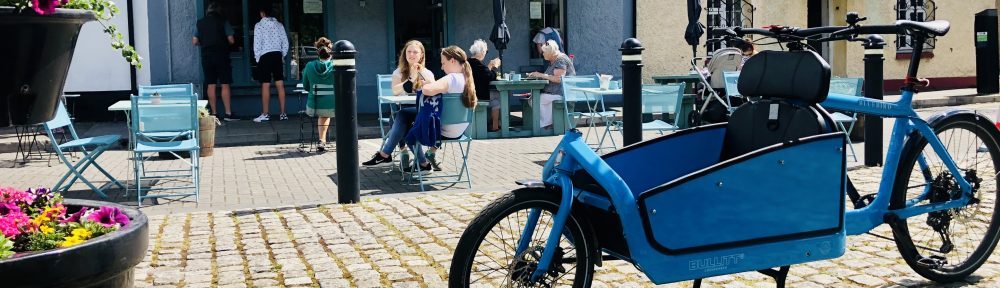
While electric vehicles have a role in decarbonising the transport sector, we regret that there is no mention of the huge potential of E-bikes. In countries where the level of cycling is high, the sale of such bikes far outweighs the number of electric cars and at far less cost to the individual and to government. It is hoped that in the future the Committee will also have the opportunity to consider the increasing use of cargo bikes for last mile deliveries across Europe, so we can replicate it here in Ireland.

We are happy to see the reference to trials of free public transport in a number of European cities, although it is disappointing that the report does not refer to the removal of hidden subsidies to car travel such as free parking at places of work, at shopping centres and in public areas.  These areas need to be addressed.

In summary, the report is an important step on the path to a carbon free future and Cyclist.ie warmly welcomes its publication.  Its ultimate success however will depend on how it informs the adoption of appropriate targets and on the monitoring and reporting of progress in Minister Richard Bruton’s  eagerly awaited All-of-Government Plan on Climate.

Government (excluding DTTaS) allocates €3.5 Million for Everyday Cycling

 In response to parliamentary questions, Minister Shane Ross is very keen to point out that in addition to funding from the Department of Transport, Tourism and Sport (DTTaS), the government also funds cycling through other departments including the Department of Community and Rural Regeneration and the Department of Housing, Planning and Local Government. We decided to investigate the contribution to cycling by these departments.

Michael Ring is Minister for the Department of Community and Rural Affairs. In May 2018, he announced the allocation of €4.5 million. This was followed in September by an additional allocation of €8 million. These rounds of funding were under the Community Enhancement Programme (CEP) which supports disadvantaged communities throughout the country by providing capital grants to community groups so none of this funding was for cycling or cycle related projects.

In January 2019, the Minister and Fáilte Ireland jointly announced funding of €10.8 million for 78 outdoor recreation infrastructure projects. Of the 78, 19 were identified as wholly or partially cycle related at an estimated cost of €1,680,786.

In February 2019, the Minister made a major announcement with an allocation of €62 million for Rural Regeneration and Development projects across the country at a cost per project ranging from €20,000 for to €10.2 Million. These included three cycle related projects. The first was the development of a cycle network in Mayo/Galway at a cost of €75,000. The second  was for a navigation/greenway project in County Meath at a cost of €845,250. While the cycling component of this scheme is open to debate, it is assumed for the purposes of this article that 25% or €211,312 is for cycling. The third was a flagship project of national importance – the development of mountain biking trails at a cost of €10.2 million. Mountain biking is a sport which is growing in popularity but it is a niche activity. Even among current cyclists it is very much a minority sport and has little, if anything, to do with utility or everyday cycling. Although funding was provided by the Department of Community, it could equally have been provided by that section of government dealing with sport or tourism or even transport. Omitting the mountain biking scheme, the total component allocated for everyday cycling from the other two amounts to €286,312 so in total, Minister Ring allocated approximately €2 million to cycling out of €86 million.

In November 2018, as part of Project Ireland 2040, Taoiseach Leo Varadkar and Eoghan Murphy, Minister for Housing, Planning and Local Government, announced an allocation of €100 million for 88 projects under the Urban Regeneration and Development Fund (URDF). The schemes were classified under various headings including community development, culture, specific capital projects, energy development, integrated urban development, library development, public realm regeneration, road/strategic infrastructure and strategic acquisitions.

There may be a number of projects which involved a small component of cycling eg projects involving public realm improvements but in isolation these are unlikely to make any significant impact to the level of cycling either locally or nationally. Cycling is only explicitly mentioned in the five:

Scheme County

Cost

Cherrywood Public Parks, Greenways & Attenuation Dublin

€870,000

Sustainable Swords (Category B) Dublin

(estimated)  €257,500

Cycling & Walking Galway

€2,900,000

Smarter Travel Killarney
(Link & Public Realm)
Kerry

€1,000,000

Castlebar Greenway Link Mayo

€938,000

Total

€5,708,000

The total value of the five is estimated at €5.7 million but the cycling component is likely to be  of the order of €1-2 million at most out of an allocation of €100 million.

We warmly welcome this additional contribution of approximately €3.5 million to everyday cycling by Ministers Ring and Murphy. However, this is a long way from Cyclist.ie’s campaign for 10% of the DTTaS Land Transport capital budget or €149 Million based on the 2019 Department of Finance allocation. As everyday cycling is essentially about transport, the heavy lifting for funding cycling rightly belongs in the Department of Transport, Tourism and Sport. If that department fails to provide adequate funding, the primary responsibility rests with Shane Ross, the Minister in Charge.

Cycle Facilities – Not Just a Matter for Adjacent Residents

Maynooth Cycling Campaign was represented at the March Meeting of the Community Council at which there was a discussion of the footpath works at the Celbridge Road.

The question of cycling facilities on the Celbridge Road to the two schools was raised. Apparently, Kildare County Council has prepared a daft drawing showing proposed cycle facilities. (Cllr Tim Durkan informed me afterwards that he would forward a copy.) It seems somewhat dysfunctional that KCC has plans for cycling facilities but are proceeding with construction of a new footpath without any discussion/conclusion of what cycling facilities are appropriate.

The councillor stressed the need to consult with adjacent residents but a council member stated that cycle facilities were being opposed by one of the resident groups. There was also debate and conflicting views about the ownership of green areas and the entitlement or not of KCC to go in and carry out the works. This entitlement was related to the definition of green areas/amenity areas which were defined when the estate in question received planning permission.

Our view is that the rights of different groups must be balanced and that it is not simply a matter for the adjacent resident groups who generally drive, who often oppose improved facilities for cycling and favour the status quo. The needs of the wider population, objectives of the County Development Plan and government policy must also be taken into consideration.

The 1979 Delft Cycle Plan

Quote

Delft was the third city in The Netherlands to experiment with modern cycling infrastructure, aided by the national government. After the experiments in Tilburg and The Hague in the 1970s, where they built one very good (but also very expensive) cycle route, that had mixed results but didn’t lead to more cycling overall, Delft took a different and innovative approach. Delft wanted to improve the city’s existing cycle network, which had a lot of missing links. The reason for this area-wide experiment was the increasing modal share of private motor traffic. The city clogged up and couldn’t cope with all those cars, it certainly wouldn’t be able to accommodate even more cars in the future. Cycle expert André Pettinga, who worked for the city of Delft at the time, summarises the need for the Delft Cycle Plan in just a few words: “The local government wished to increase the modal share of cycling!”. This cycle plan was a direct answer to the mainly car-driven Traffic Circulation Plans that had been made for many cities in the Netherlands, including Delft, in the 1960s. The execution of those plans was stopped oneafter the other, because of opposition of the public and changed ideas regarding urban planning……………….

via The 1979 Delft Cycle Plan

National Roads Network Indicators 2017

[This post was drafted last summer but only completed and uploaded to the website in January 2019.] 

Last year, TII published the National Roads Network Indicators 2017 which is their annual report on the state of Irish national roads. This includes national primary roads, national secondary roads and motorways although the report also includes some data on regional and local roads.

screenshot 2019-01-23 at 10.47.41

Following the same format as last year, the report is divided into the five sections, four of which are considered below:

  1. Road Network – presenting key statistics on the components of the road network
  2. Safety – looks at the number of fatalities in the network and whether the network is getting safer or not
  3. Accessibility and Environment – impact of investment on employment accessibility
  4. Economic – looks at overall travel demand.


Road Network

One of the interesting facts thrown up in the report is that 88% of roads deliver the highest level of Service A ie free flow conditions with 96-97% of roads delivering Level of Service C which is minimum stable flow.

The comparison with the Level of Service for cycle facilities is striking. Most cycle facilities offer the lowest level of service ie D. These include most of the greenways developed even those which have been hyped and spun as world class. They also include many schemes in urban areas  where the allocation of space is the minimum for cycling but above minimum for motorised traffic. Local authorities consider such schemes to be in accordance with DMURS despite the hierarchy of road users prioritising cyclists above car drivers.

As in 2016, 39% of trips were estimated to be less than 15 minutes in duration and 38% of trips were less than 10km in length. There was also no change in the average trip distance at 19.4km and average trip duration at 22 minutes. Once more it shows the potential to substitute trips by bicycle if the government was to properly #Allocate4Cycling by providing adequate funding and specifying high standards.

The annual growth rate in traffic on the network was 3.0% nationally in 2017 compared to 4.6% in 2016. In the mid-east which includes Kildare and the other commuter counties surrounding Dublin the growth rate was 4.4% in 2017 and 5.2% in 2016. If maintained at this rate, the growth in traffic on national roads between 2016 and 2025 will be almost 50%.

SAFETY

In the section of safety, TII pulled two sleights of hand in their presentation of road fatality statistics.

The 2017 Report gives a reduction of 28% between 2013 and 2017 (64 to 46 fatal collisions) but this disguises the fact that there had been a significant increase (72) in the number of fatal collisions in 2016 which the report  ignores.

The three year average of fatal collisions on national roads is as follows:

Year 2013 2014 2015 2016 2017
Fatal Collisions  on National Roads 64 66 61 72 46
3 Year Average of  Fatal Collisions on National Roads 65.0* 63.7 66.3 59.7 59.0*

Table 1         Three Year Average of Road Fatalities on National Roads

* These are averaged over  2 years only as the third year is not available

The percentage difference between 2013 and 2017 is only of the order of 8% which is very different from the 28% reported.

The second sleight of hand is in relation to the different reporting periods. The 2016 report considered six years (2011-2016) whereas the 2017 report considered five (2013-2017). If they had used a period of 5 years in 2016 as in  2017, the change in fatalities would be from 48 (2012) to 72 (2016) – an increase of 50% which would take the gloss off the TII performance.

ACCESSIBILITY & ENVIRONMENT

The 2016 report states that a key benefit of a quality road system is improved accessibility to jobs which is generally seen as positive. The Impact of Road Investment on Job Accessibility between 2013 and 2017 shows this in graphical form. In practice however, this is seen in induced demand – longer commutes, more congestion in the urban areas and more noise and air pollution for those living in city centres and urban areas which are negative consequences.

ECONOMIC

The philosophy of TII in relation to traffic growth ( and by extension to climate change) is clearly set out in this section. The report states

Trends in overall employment in the economy drive commuting traffic whilst personal incomes are the major determinant of non-commuting traffic. With regard to the carriage of goods, economic output is the major determinant.

These statements are half right but simplistic. The underlying assumption is that the growth in commuting (motorised) traffic on national roads will be by private car. In the absence of any change in funding by the Department of Transport from roads to active travel, it excludes the possibility that there will be major increases in the number of people using sustainable modes of transport such as walking, cycling and public transport as required by National Transport Authority’s Statement of Strategy 2018-2030 and Smarter Travel. It also ignores policies on climate change and the potential risk of paying millions of euros for failing to meet our international obligations to reduce carbon emissions.

In considering 2017 and beyond, the report states

Given ….. economic trends, the prospects are for continued significant growth in National Roads traffic overall and HGV traffic in particular.

As cyclist fatalities have increased with increasing traffic over the last eight years, this is hardly good news for cyclists.

Cycle Tracks Should Be Laid In Red Asphalt — The Ranty Highwayman

Quote

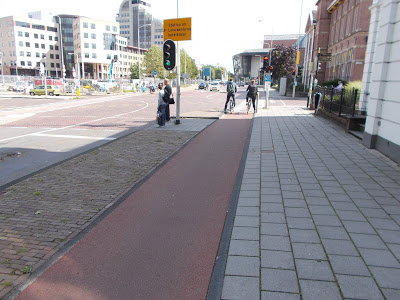
Ever since my first visit to the Netherlands in the summer of 2015, I have been obsessed with the use of red asphalt for cycle tracks (OK, the Dutch do design quite well generally).The main reasons are that using a coloured surface helps to provide visual priority in situations such as cycle tracks crossing side…

via Cycle Tracks Should Be Laid In Red Asphalt — The Ranty Highwayman

Cyclist.ie Press Release : Dept of TRANSPORT & RSA – BLIND TO CYCLISTS’ FATALITIES

The Department of Transport Tourism and Sport (DTTaS) and the Road Safety Authority (RSA) can rightly claim responsibility for the large decrease in road fatalities over the last thirty years. However,  in claiming a reduction in road fatalities in 2018, they are blind to the trend of increasing cyclist fatalities since 2011 and by failing to properly allocate for safer cycling, the DTTaS perpetuates a road and traffic environment where cyclist safety is secondary.

The DTTaS and the RSA are very concerned about the number of fatalities on Irish roads. At the end of each year, they respond to the annual number of fatalities and welcome the results if the number goes down and lament if the number goes up. Their benchmark for success or failure of road safety policy is annual number of fatalities relative to the previous year. This is a good yardstick when the numbers involved are relatively large. When the number is relatively small, as in cyclist fatalities, the total for consecutive years can vary widely.

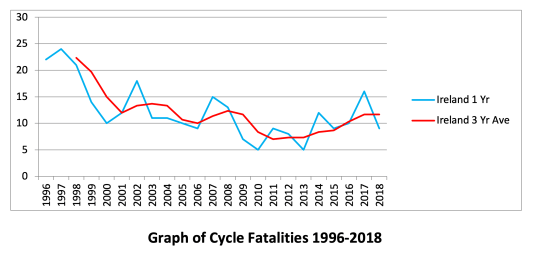
If, however, the number of fatalities is averaged over three years the effect of large swings is reduced and longer term trends are discernible. Analysis using a three year average shows that cyclist fatalities were at a low point in 2011 but have since risen significantly  – more than 50%, albeit over seven years. Other countries which have significantly increased the level of cycling, have done so while simultaneously reducing the number of fatalities.

Colm Ryder, Chair of Cyclist.ie, the Irish Cycling Advocacy Network, states “The increasing level of cyclist fatalities in Ireland is unacceptable. To address this as a matter of urgency, the DTTaS must begin to properly allocate for cycling”.

The DTTaS currently spends less than 2% of its transport capital budget on cycling.  To maximise the contribution of cycling to reducing carbon emissions and increase health and environmental outcomes, the Minister must increase expenditure to 10% of the Land Transport capital budget, and not to 10% of the Public Transport budget as recently announced. The Intergovernmental Panel on Climate Change has reported that the next twelve years are critical to prevent global warming  beyond 1.5o. The  clock is ticking ……..

For Attached Graph and Table, see below

181222 Cie DTTaS Press Release Ver2


END


Reference: RSA/Garda Siochana, Provisional Review of Fatal Collisions January to 31  December 2018 pdf 

Cyclist.ie Press Release – CLIMATE ACTION: MINISTER ROSS MUST INVEST IN CYCLING

The following press release appeared in the Examiner on 21st December.

The Government’s recently published Annual Transition Statement 2018 has ignored the potential for cycling to reduce transport emissions.  The legislation is designed to enable Ireland’s transition to a low carbon, climate resilient and environmentally sustainable economy by 2050. However, the section of the Statement dealing with the decarbonising of the transport sector  demonstrates a complete failure by Minister Ross and his Department to grasp the potential contribution that cycling can make to a reduction in carbon emissions.

Transport accounts for over 52% of energy used in Ireland and is increasing. It is one of the four key areas where a reduction in carbon emissions is required to meet our international obligations. Section 4.4 of the Annual Sectoral Mitigation Statement deals with decarbonising transport and states that this involves providing meaningful alternatives to the private car, continuing investment in sustainable transport and promotion of modal shift.

However, in the accompanying National Mitigation Plan Actions, a different narrative unfolds – one where rhetoric is divorced from anything remotely approaching meaningful action.

The Update Report on Actions contains a section entitled “Actions not delivered as planned”. It includes words like “publish”, “review”, and “strategy” rather than “fund” and “enable”. Six of the actions were due to be completed by the Department of Transport Tourism and Sport in 2017. These include “Publish a review of the National Cycle Policy Framework” which originally commenced in 2013 and which 5 years on has still not been completed.

Under Actions Complete, the Decarbonising Transport section lists five items.  The DTTAS were responsible for two – setting up a behavioural change working group and publication of a Greenway Strategy. Greenway funding is welcome but it is disingenuous to claim that publication of a strategy or the setting up of a working group will reduce emissions and it is noted that no estimate of emission reduction is included.

The recent IPCC report clearly spells out the urgent need to reduce carbon emissions in order to limit global warming to 1.5°C. To minimise environmental damage and  fines arising from the failure to meet Ireland’s climate change targets, Minister Ross must adopt much more ambitious actions than currently outlined. Cycling is the mode of transport for more than 40% of people in many progressive European cities.  Cycling will not solve the problem of climate change on its own, but as 57% of Irish journeys are less than 8 km, it can make a significant contribution as well as alleviating congestion, contributing to cleaner air, improving health outcomes and creating attractive neighbourhoods, For cycling to play its part however, Minister Ross must begin to properly fund high quality cycling infrastructure which will enable cycling for all.

“Cycling offers the best and quickest return on investment of all transport expenditure. We urgently need to invest a minimum of 10% of transport funding in cycling infrastructure, to give people a safe, attractive alternative to the car” says Gerry Dornan, Vice Chairperson of Cyclist.ie, the Irish Cycling Advocacy Network.

Nearly two thousand years ago, the Emperor Nero is reputed to have fiddled while Rome burnt. In the next few years we shall see if our current leaders will emulate him or take decisive action to stop climate change.

END

2019 Cycling Allocation – 1.26% Transport Capital Budget?

Investment in cycling is difficult to estimate. Central government provides funding, local government provides funding, other government bodies provide funding and some infrastructure and/or finance is provided by developers as part of planning conditions.

Irish cycling advocates have long been interested in the level of investment by central government but even there the exact level is difficult to uncover. Efforts by different politicians and parties to find out through parliamentary questions  were unsuccessful with replies carefully crafted to avoid answering the questions. The Minister has made periodic statements about funding both inside and outside the Dáil  but cycling is lumped in with walking or the Minister talks in terms of sustainable travel which also includes investment in buses and trains. If you were to ask most Irish politicians “How much does the government spend on cycling?” – they would have no idea. In countries with high levels of cycling, politicians do know – perhaps not expenditure in a specific year but they have a headline figure which the government aims for.

In Ireland, expenditure in the Department of Transport, Tourism and Sport is subdivided into five programmes – (1) Land Transport, (2) Civil Aviation, (3) Maritime Transport and Safety, (4) Sports and Recreational Services and (5) Tourism Services. Of these, Land Transport is the most important area receiving over 90% of the total budget.

The table below gives a breakdown of Land Transport expenditure for 2018. The figures are taken from the Revised Estimates Volume for Public Services 2018 which was published in December 2017. In the future, these will be reclassified as provisional figures before the actual expenditure outturns are finalised, as shown in the annual Appropriation Accounts. The government provides a similar level of detail on expenditure for all departments but does not give a breakdown of expenditure at  lower levels.

2018 Current Non Pay Current Pay Pension Capital Grand Total
 B.1 – Administration – Pay 12,460 12,460
 B.2 – Administration – Non Pay 2,237 295 2,532
 B.3 – Road Improvement/maintenance 72,207 19,160 2,130 815,356 908,853
 B.4 – Road Safety Agencies & Expenses 1,853 2,774 139 350 5,116
 B.5 – Vehicle And Driver Licencing Expenses 15,900 3,500 19,400
 B.6 – Carbon Reduction 5,500 5,500
 B.7 – Public Service Provision Payments 281,713 18,650 300,363
 B.8 – Public & Sustainable Transport Investment Programme 1,605 398,940 400,545
 B.9 – Public Transport Agencies & Expenses 2,819 2,830 11 5,660
 B.10 – Miscellaneous Services 78 78
Total €378,412 €37,224 €2,280 €1,242,591 €1,660,507

TABLE 1       Land Transport Expenditure 2018  (€ 000)
                     (Source: Databank Department of Public Expenditure & Reform)

Most areas in Land Transport receive negligible capital investment. The two which stand out are Road Improvement/Maintenance at €815M (or 65% of the total) and Public & Sustainable Transport Investment Programme at €398 (or 32.1% of the total).  This clearly demonstrates the disparity between the capital allocation for roads as opposed to all other modes of transport including cycling.

Public Transport & Sustainable Transport is the main source of funding for cycling. However, funding for cycling  is also provided under other programmes. For example, in 2018 greenways were funded under the Tourism programme while investment in a velodrome appeared under Sport. This article  concentrates on the departmental funding of cycling from Public Transport & Sustainable Transport but also includes Greenways.

We have identified eight areas of expenditure which involve provision for cycling but the same funding may also be used to provide for other modes of transport. In order to estimate the contribution to cycling alone, it is necessary to separate/estimate what proportion of funding goes to cycling and what goes elsewhere.

  1. Bus Connect

Expenditure on Bus Connect is estimated at €79M in 2018. The primary reason for this expenditure is the need to reorganise the bus service. It is considered reasonable that a proportion should be allocated to cycling as the project includes the provision of segregated cycle facilities on part of the Bus Connect network. It was decided to proportion 10% for cycling as that is the government target for cycling. There are grounds for arguing that 10% is too high and other arguments that 10% is too low but as Bus Connect is a new project, it was decided that 10% was reasonable until its outcome in relation to the provision of cycling infrastructure is clear.

  1.  Cycling/Walking

Cycling/Walking has been allocated €8M in 2018 rising to €15 in 2019. In the absence of any further information from the Department, it was considered reasonable to divide the allocation 50:50 betweeen the two modes.

  1.  Sustainable Transport  Mobility Grants (STMG)

STMG has been allocated €14M in 2018. It may be thought that a large percentage goes to cycling but STMG also includes public transport and walking projects. The proportion of 25% was estimated on the basis of the NTA Outturn Reports.

  1.  Smarter Travel Workplaces

The allocation for Smarter Travel Workplace is estimated at €0.60M per annum. Again, it is an area which includes other modes of transport with cycling only accounting for 33% of expenditure.

  1.  Green Schools

The allocation for Green Schools is also modest at €1.65M but once more the proportion which is spent on cycling is low. The proportion of 33% was estimated from Annual Reports from Green Schools.

  1.  Greenways

Greenways are funded under the Tourism heading and are primarily for recreational reasons as public lighting is not generally provided and Waterways Ireland insist on a low quality dust surface which deters many utility and sport cyclists. Greenways, if constructed to a high standard, have the potential to cater for utility cyclists. Therefore, it was thought fair to include their expenditure in order to estimate overall departmental spending on cycling.

  1.  Cycle Right

All funding for Cycle Right goes to cycling.

  1.  Bikeweek

All funding for Bikeweek goes to cycling.

A breakdown of Department funding for cycling for the years 2018-2021 is given in the Table 2. Some of the funding is current rather than capital spending but has been included to get an overall figure for Department spend.

 Area of Expenditure 2018  2019  2020  2021 TOTAL 
Bus Connect
Bus Connect €79.00 €143.00 €246.00 €282.00 €750.00
Cycling Contribution (10%) €7.90 €14.30 €24.60 €28.20 €75.00
Cycling/Walking
Cycling/Walking €8.00 €15.00 €35.00 €52.00 €110.00
Cycling Contribution (50%) €4.00 €7.50 €17.50 €26.00 €55.00
STMG
STMG €14.00 €17.00 €47.00 €57.00 €135.00
STMG Cycling Contribution (25%) €3.50 €4.25 €11.75 €14.00 €33.75
Smarter Travel Workplaces
Smarter Travel Workplaces €0.60 €0.60 €0.60 €0.60 €2.40
STW Cycling Contribution (33%) €0.20 €0.20 €0.20 €0.20 €0.79
Green Schools
Green Schools €1.65 €1.65 €1.65 €1.65 €6.60
Green Schools Cycling Contribution (20%) €0.33 €0.33 €0.33 €0.33 €1.32
Cycle Right
Cycle Right (100%) €0.65 €0.65 €0.65 €0.65 €2.60
Greenways – Tourism
Greenways €0.00 €13.45 €15.2 €24.35 €53.00
Greenways Cycling Contribution (50%) €0.00 €6.73 €7.60 €12.18 €26.5
Bikeweek
Bikeweek (100%) €0.40 €0.40 €0.40 €0.40 €1.60
DTTAS Expenditure on Cycling €16.98 €34.36 €63.03 €81.96 €196.31

TABLE 2       Departmental Allocation & Contribution to Cycling 2018-2021 (€ M)

In 2018, total expenditure is estimated at €16.98M rising to €34.36M in 2019. The #Allocate4Cycling campaign seeks 10% of the Land Transport Capital budget to be devoted to cycling. As the Land Transport capital budget is estimated at €1243M and €1544M in 2018 and 2019 respectively, this level of expenditure on cycling equates to 1.37% and 2.22% for those years – a long way from what is required to significantly impact on health, congestion, sustainability and climate change.

Of the eight areas of expenditure, the total allocation for four (Smarter Travel Workplaces, Green Schools, Cycle Right and Bikeweek) is negligible at €1.6M per annum. The allocations for Greenways and Cycling/Walking are significant  but most of the funding is in the latter years of the investment programme which shows a lack of priority by the Minister. While he did announce greenway funding of €53M in 2018, no significant if any funding will be spent this year as councils have until November to make an application for schemes. Furthermore, it is assumed that 50% of the Cycling/Walking allocation is for cycling.  In theory it could be anything between 0.1% and 99.9% and still accord with statements by the Minister.

  2018 2019 2020
DTTAS Expenditure on Cycling €9.08 €19.45 €39.40
DTTaS Total Capital Voted Expenditure €1,243.00 €1,544.42 €1,934.52
% Cycling 0.73% 1.26% 2.04%

TABLE 3       % of Departmental Expenditure on Cycling 2018-2020
                      Excluding Bus Connect (€ M)

By far,  the largest area of expenditure  is  the  Bus Connect  project with  contributions to cycling of €7.9M  and  €14.3M in  2018   and  2019.  It  hardly  needs  to be pointed out  that  Bus Connect is  running into problems politically with very vocal opposition to the proposed reorganisation  of bus  routes. If  there  are delay to  routes,  no preliminary  or  detailed designs  can proceed  so it is more than  likely  that any expenditure  on cycling  routes adjacent  to key bus routes  will not  happen  until  the end of  2019  or later.  If  so,  the proportion of  Land Transport capital expenditure allocated to cycling in 2018 and 2019 could fall as low as 0.73% and 1.30% respectively (see Table 3) and  this for a mode of transport which is used for more than 40% of journeys in many Dutch and Danish cities. The Minister has been quoted as saying that his Department “gets” cycling. Unless there is openness on his intended levels of investment,  its impact on levels of cycling  AND a commitment to substantial funding, cycle advocates will continue to disagree.

PS      For  comparison,  Finland,  which  is  similar  in  population  to  Ireland,  has  just announced funding of  €23M for a single cycle project,  albeit the most expensive in its history.